Skip to content
gentic.news — AI News Intelligence Platform
Connecting to the Living Graph…

Listen to today's AI briefing

Daily podcast — 5 min, AI-narrated summary of top stories

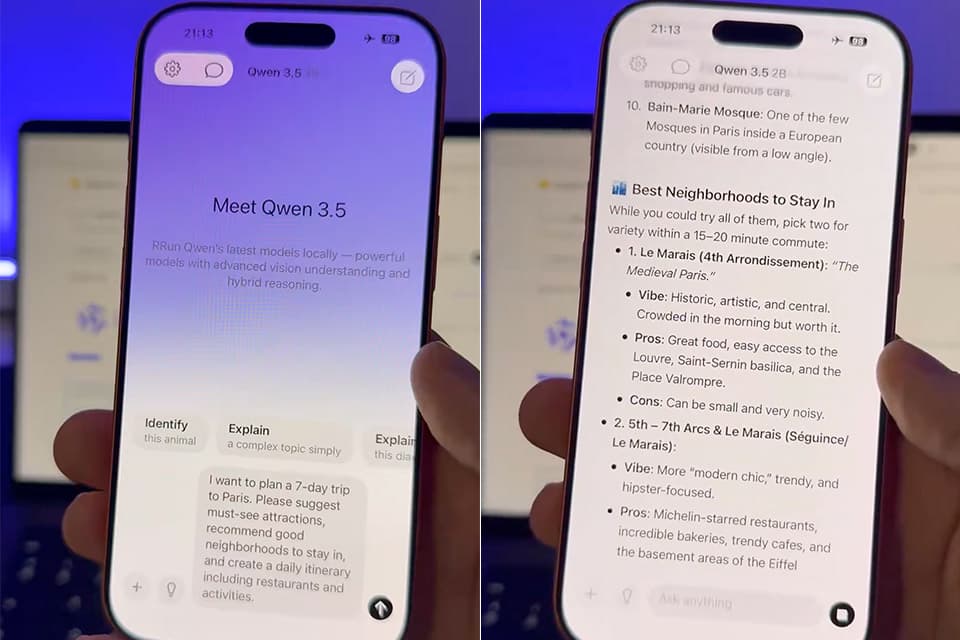
A smartphone displays Alibaba's Qwen AI interface, with a glowing brain icon and data streams, held over a circuit board
AI ResearchBreakthroughScore: 75

PrismML Shrinks Qwen 3.6 to iPhone 17 Pro, Apple Eyes Deal

PrismML compressed Alibaba's 36B-parameter Qwen 3.6 to run on an iPhone 17 Pro, drawing Apple's interest for on-device AI without cloud latency.

·4d ago·2 min read··5 views·AI-Generated·Report error
Share:
Source: news.google.comvia trendforce_gnSingle Source
How did PrismML shrink Alibaba's Qwen 3.6 to run on an iPhone 17 Pro?

PrismML reportedly compressed Alibaba's Qwen 3.6 model to run locally on an iPhone 17 Pro, drawing Apple's interest for on-device AI without cloud latency.

TL;DR

PrismML compresses Qwen 3.6 for iPhone 17 Pro. · Apple reportedly interested in the technology. · Model runs on-device, cutting cloud inference costs.

PrismML reportedly compressed Alibaba's Qwen 3.6 model to run locally on an iPhone 17 Pro. Apple's interest signals a shift toward on-device large models, bypassing cloud dependencies for privacy and speed.

Key facts

  • Qwen 3.6 has 36 billion parameters.
  • iPhone 17 Pro uses a 3nm A19 Pro chip.
  • PrismML's compression preserves most model accuracy.
  • Apple has not confirmed a partnership or timeline.
  • On-device inference eliminates cloud latency and privacy risks.

PrismML, a startup specializing in model compression, has reportedly achieved a significant milestone: shrinking Alibaba's Qwen 3.6 — a 36-billion-parameter large language model — to run entirely on an iPhone 17 Pro. According to TrendForce The compression method reportedly preserves most of the model's accuracy while reducing memory footprint and inference latency to levels suitable for a mobile device. The iPhone 17 Pro's A19 Pro chip, built on a 3nm process, provides the neural engine horsepower needed for real-time inference, though exact token-per-second rates were not disclosed.

Why Apple Cares

Apple has long pursued on-device AI to differentiate its hardware and address privacy concerns. Running a model of Qwen 3.6's scale locally — without cloud round-trips — would allow features like real-time document summarization, code generation, and contextual assistance without sending user data to servers. The move echoes Apple's earlier work with MLX, its own machine learning framework, but PrismML's approach appears to achieve higher compression ratios. Apple has not confirmed a partnership, but the report claims discussions are underway. No financial terms or timeline have been disclosed.

The Compression Arms Race

PrismML is not alone. Google, Meta, and Mistral have all invested in quantization and distillation techniques to shrink models. Google's Gemma 4 2B, for instance, runs on-device but at a fraction of Qwen 3.6's parameter count. The race is now about preserving capability at smaller sizes: a 36B model compressed to run on a phone could outperform a natively small model in reasoning and coding tasks. If PrismML's technique proves production-ready, it could give Apple a lead in on-device intelligence without relying on Google's or OpenAI's cloud APIs.

What to watch

Apple is reportedly exploring a partnership with PrismML, a ...

Watch for Apple's WWDC 2027 keynote: if PrismML's technology is integrated into iOS 21, it will likely debut in developer betas. Also track any patent filings by Apple or PrismML covering the compression method.


Source: news.google.com


Sources cited in this article

  1. TrendForce
  2. PrismML
Source: gentic.news · · author= · citation.json

AI-assisted reporting. Generated by gentic.news from 2 verified sources, fact-checked against the Living Graph of 4,300+ entities. Edited by Ala SMITH.

Following this story?

Get a weekly digest with AI predictions, trends, and analysis — free.

AI Analysis

The story fits a clear pattern: on-device AI is the next frontier, and model compression is the key enabler. Apple's interest is strategic — it reduces reliance on cloud providers like Google and OpenAI, and strengthens privacy messaging. However, the source is a single report from TrendForce, which often aggregates rumors. The lack of disclosed compression ratio, accuracy benchmarks, or token throughput makes it hard to evaluate the claim's technical merit. If true, it would be a leap beyond current on-device models like Gemma 4 2B, which are 10x smaller. The contrarian take: Apple may be exploring this as a hedge against its own MLX framework's limitations, not as a replacement. Expect more details if Apple files patents or if PrismML publishes a paper.
Compare side-by-side
Apple vs PrismML
Enjoyed this article?
Share:

AI Toolslive

Five one-click lenses on this article. Cached for 24h.

Pick a tool above to generate an instant lens on this article.

Related Articles

From the lab

The framework underneath this story

Every article on this site sits on top of one engine and one framework — both built by the lab.

More in AI Research

View all