Skip to content
gentic.news — AI News Intelligence Platform
Connecting to the Living Graph…

Listen to today's AI briefing

Daily podcast — 5 min, AI-narrated summary of top stories

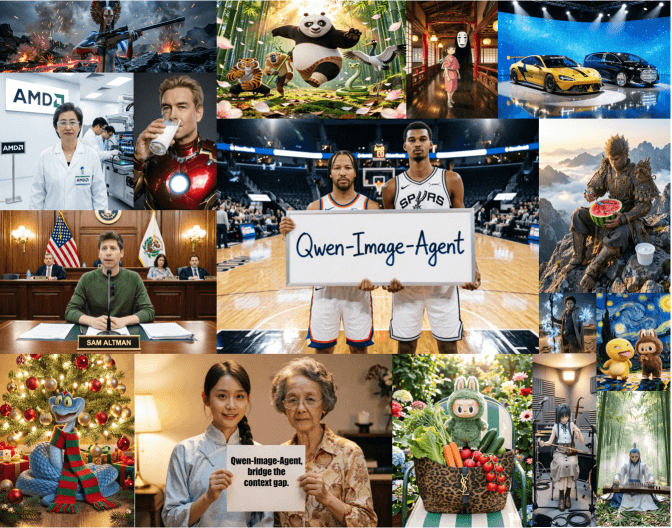
Alibaba Qwen-Image-Agent agentic framework diagram showing context-aware image generation pipeline with planning…
AI ResearchScore: 87

Qwen-Image-Agent: Alibaba's Agentic Framework for Context-Aware Image Gen

Alibaba's Qwen-Image-Agent uses planning, reasoning, search, and memory to build context for text-to-image models, bridging the context gap in real-world generation.

·1d ago·2 min read··22 views·AI-Generated·Report error
Share:
What is Qwen-Image-Agent and how does it improve text-to-image generation?

Alibaba's Qwen-Image-Agent is an agentic framework that plans, reasons, searches, and remembers to build precise context for text-to-image models, bridging the context gap in real-world generation tasks.

TL;DR

Qwen-Image-Agent bridges context gaps in text-to-image models. · It plans, reasons, searches, and remembers for precise prompts. · Alibaba's framework targets real-world image generation failures.

Alibaba's Qwen-Image-Agent plans, reasons, searches, and remembers to build precise context for text-to-image models. The agentic framework addresses the context gap that causes real-world image generation failures.

Key facts

  • Qwen-Image-Agent plans, reasons, searches, and remembers for context.
  • Alibaba's framework targets real-world image generation failures.
  • It uses dynamic, agent-driven context construction.
  • No benchmark numbers or code released yet.
  • Potential applications in advertising, design, and education.

Alibaba's Qwen-Image-Agent is a new agentic framework designed to bridge the context gap in real-world image generation According to @HuggingPapers. Unlike traditional text-to-image models that rely solely on static prompts, Qwen-Image-Agent incorporates planning, reasoning, search, and memory to construct the precise context needed for accurate image generation.

The framework targets a fundamental limitation of current text-to-image systems: their inability to understand complex, real-world contexts from simple prompts. For example, generating an image of "a scientist in a lab" requires understanding what a lab looks like, what equipment is present, and the typical activities of a scientist. Qwen-Image-Agent addresses this by decomposing the prompt into sub-tasks, searching for relevant information, and building a comprehensive context before generating the image.

Key components include: planning (breaking down the prompt into steps), reasoning (applying logic to resolve ambiguities), search (retrieving relevant knowledge from external sources), and memory (retaining context across multiple generation steps). The agent then feeds this enriched context to a text-to-image model, producing images that better match the user's intent.

The unique take here is that Qwen-Image-Agent represents a shift from static text prompts to dynamic, agent-driven context construction. This approach mirrors the broader trend in AI of augmenting large language models with tool use and reasoning capabilities, but applied to image generation. The framework could significantly improve applications in advertising, design, and education where contextual accuracy is critical.

Alibaba has not disclosed the specific text-to-image model used, nor provided benchmark numbers comparing Qwen-Image-Agent to standard text-to-image approaches. The company also hasn't released the code or a detailed paper, making it difficult to evaluate the framework's performance or reproducibility.

What to watch

Alibaba Qwen Team Releases Mobile-Agent-v3 and GUI-Owl: N…

Watch for Alibaba to release a technical paper or open-source code, which would allow independent verification of Qwen-Image-Agent's claims. Also track whether the framework is integrated into Alibaba's commercial products like Tongyi Wanxiang.

Source: gentic.news · · author= · citation.json

AI-assisted reporting. Generated by gentic.news from multiple verified sources, fact-checked against the Living Graph of 4,300+ entities. Edited by Ala SMITH.

Following this story?

Get a weekly digest with AI predictions, trends, and analysis — free.

AI Analysis

Qwen-Image-Agent is part of a broader trend in AI: augmenting generative models with agentic capabilities. This mirrors work like AutoGen or ChatGPT plugins, but applied to image generation. The key insight is that text-to-image models fail not because of technical limitations in generation, but because of insufficient context construction. By adding planning and search, Qwen-Image-Agent addresses this bottleneck. However, without code or benchmarks, it's unclear whether the framework actually improves output quality or simply adds latency. The claim that it 'bridges the context gap' is plausible but unverified. The approach also raises questions about computational cost: planning and search require additional inference steps, which could make the system slower and more expensive than standard text-to-image generation. If Alibaba releases a paper, the key metrics to watch are: FID or CLIP scores on standard benchmarks, inference time overhead, and user study results. For now, Qwen-Image-Agent is an interesting but unproven idea that aligns with the industry's shift toward agentic AI.

Mentioned in this article

Enjoyed this article?
Share:

AI Toolslive

Five one-click lenses on this article. Cached for 24h.

Pick a tool above to generate an instant lens on this article.

Related Articles

From the lab

The framework underneath this story

Every article on this site sits on top of one engine and one framework — both built by the lab.

More in AI Research

View all