What Happened
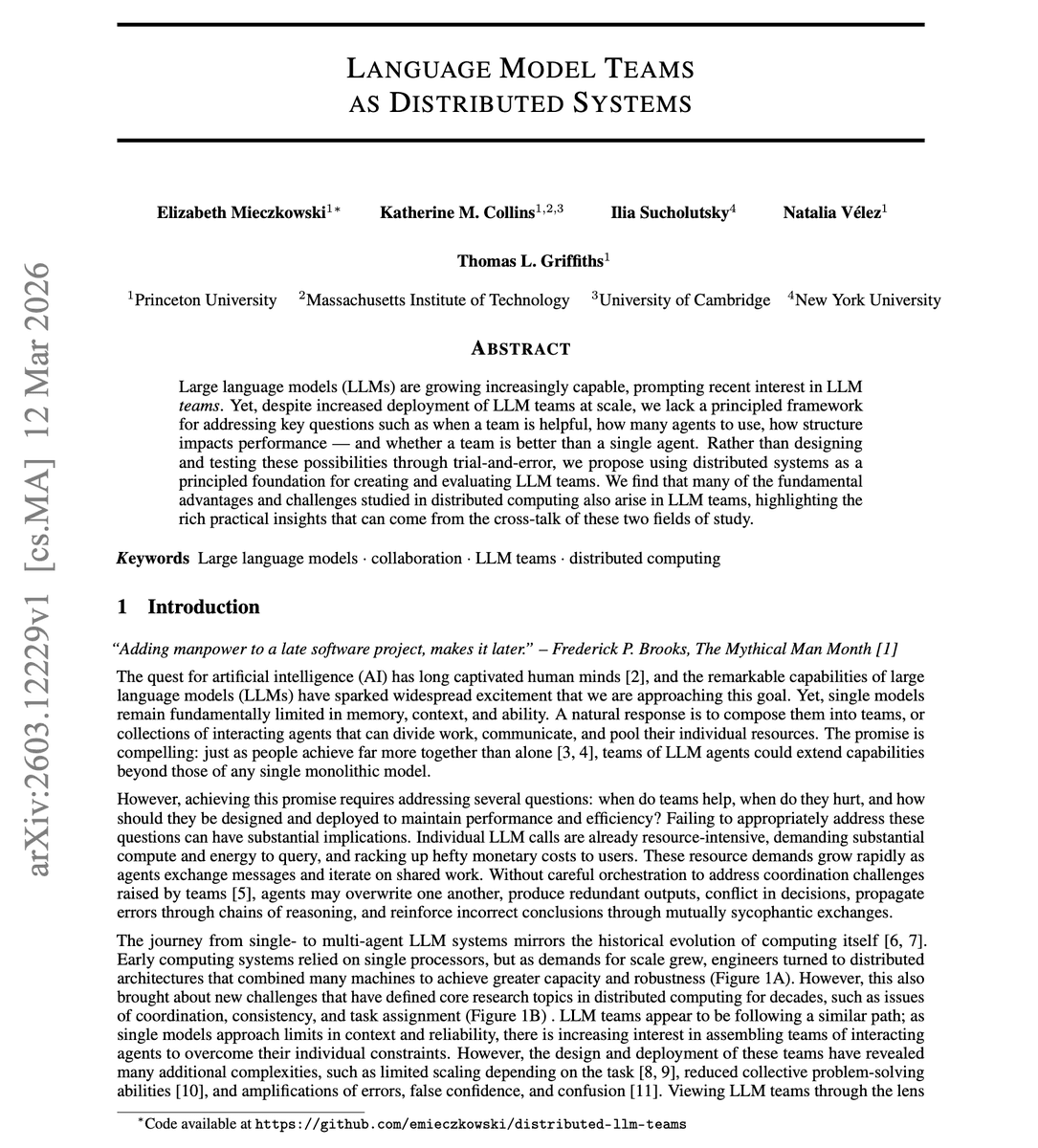
A research paper highlighted by AI researcher Omar Sanseviero applies established distributed systems theory to the design of LLM-based multi-agent systems. The core finding: teams of LLM agents face fundamentally the same coordination problems that distributed computing systems solved decades ago—specifically O(n²) communication bottlenecks, straggler delays, and consistency conflicts.
The work, titled "LLM Multi-Agent Systems: Challenges and Open Directions" (or a similar title based on the linked paper), proposes evaluating LLM teams through the lens of distributed systems. It argues that designing these systems without understanding principles like consensus protocols is akin to building a computer cluster without that knowledge.
Key Insights from the Paper
The analysis reveals direct parallels:
- Communication Bottlenecks: As the number of agents (n) increases, the potential communication overhead scales with O(n²), severely limiting scalability, just as in classic distributed systems.
- Straggler Delays: The performance of the entire LLM team can be gated by the slowest agent, a problem analogous to slow nodes in a distributed cluster.
- Consistency Conflicts: Multiple agents operating on shared information or goals can produce conflicting outputs without proper coordination mechanisms.
The paper also notes a trade-off in coordination structures. While decentralized teams wasted more communication rounds without progress, they demonstrated faster recovery when individual agents stalled, mirroring the resilience properties of certain distributed architectures.
Context & Why This Matters Now
The push to create complex systems using multiple LLM agents—for tasks like software development, research, or problem-solving—has largely proceeded through empirical trial and error. This paper provides a formal, principled framework to guide design decisions: when teams actually help, how many agents to use, and what coordination structure (centralized, decentralized, hybrid) best fits a given task's requirements.
By framing the problem in existing theory, it allows practitioners to avoid rediscovering well-understood pitfalls and to adapt proven solutions, such as consensus algorithms, leader election, or fault-tolerant communication patterns, to the LLM domain.