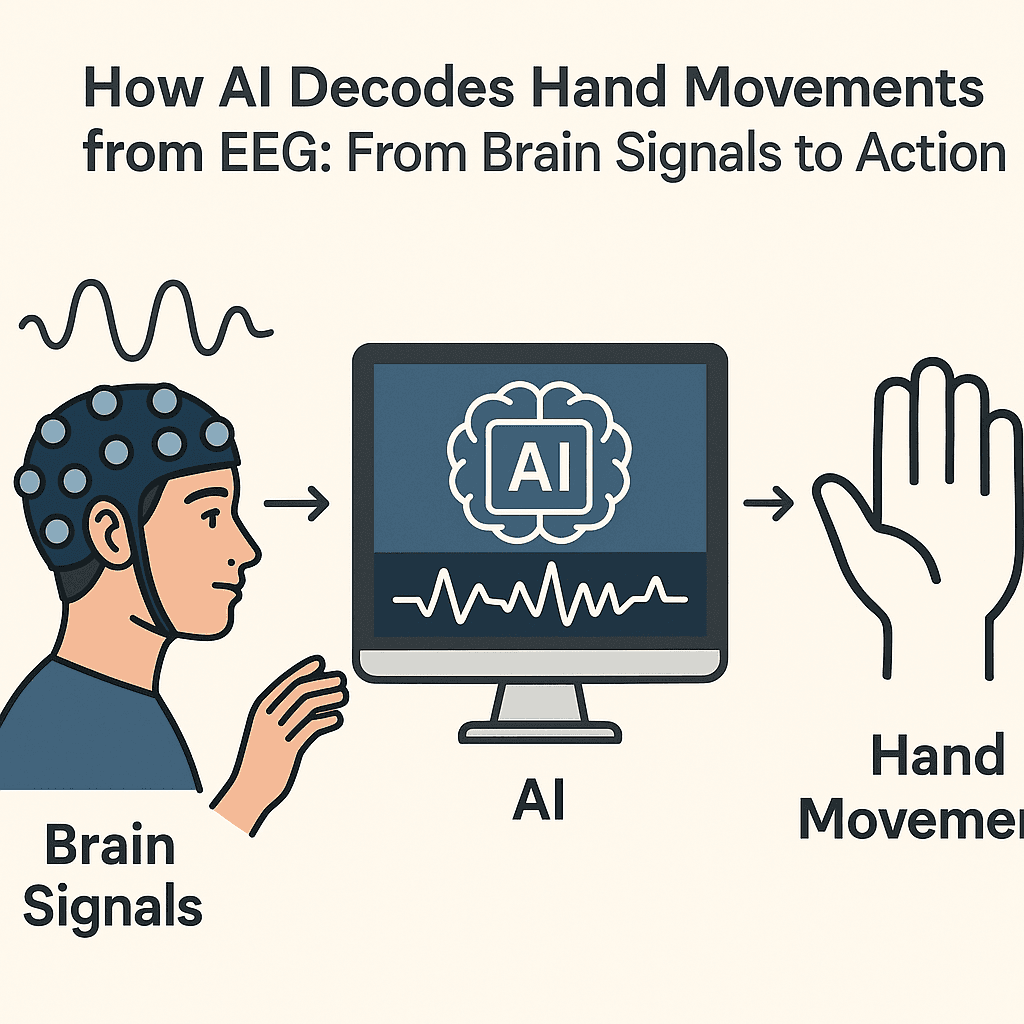
A new startup, Sabi, has launched a wearable brain-computer interface (BCI) that looks like a normal beanie but contains an array of up to 100,000 tiny biosensors. Dubbed the Sabi Cap, the device uses electroencephalography (EEG) to read brain signals through the scalp and a proprietary AI model to translate internal speech into text at approximately 30 words per minute. The company positions it as a potential mass-market, non-invasive alternative to surgically implanted neural interfaces.
Key Takeaways
- Sabi released the Sabi Cap, a wearable EEG beanie with 70k-100k biosensors and a brain foundation model trained on 100k hours of neural data.
- It decodes internal speech to text at ~30 WPM and enables cursor control via intention.
What's New: A High-Density, Wearable BCI

The core innovation is a dramatic increase in sensor density for a wearable EEG system. While most clinical or research EEG headsets use between 12 and a few hundred electrodes, the Sabi Cap is designed to incorporate between 70,000 and 100,000 custom biosensors. This massive array is embedded within the fabric of a standard beanie, aiming for a form factor that is socially acceptable for daily use.
The system is powered by what Sabi calls a "Brain Foundation Model," trained on 100,000 hours of neural data collected from 100 individuals. This model performs two primary functions:
- Internal Speech Decoding: It translates a user's internal monologue (thinking words without speaking) into text displayed on a computer screen. The current claimed output speed is about 30 words per minute.
- Intent-Based Control: It allows users to click, select, or issue software commands purely by intending the action, effectively serving as a hands-free cursor and command interface.
Technical Details & The Scalp Signal Challenge
The Sabi Cap relies on EEG, a non-invasive technique that measures electrical activity from the brain through electrodes placed on the scalp. The fundamental challenge for all non-invasive BCIs is signal quality: the skull and skin severely dampen and distort neural signals. Implanted devices (like those from Neuralink or Synchron) sit directly on or in the brain tissue, capturing high-fidelity signals but requiring surgery.
Sabi's proposed solution is not a new sensing modality but a massive quantitative scaling of the traditional EEG approach. The thesis is that by deploying orders of magnitude more sensors, advanced spatial filtering and AI models can reconstruct useful signals despite the attenuation from bone and tissue. The company has not yet published peer-reviewed details on the sensor technology, signal processing pipeline, or model architecture.
How It Compares: Non-Invasive vs. Invasive BCI Paths
The launch sharpens the divide between two competing visions for the future of human-computer interaction via BCI.
Signal Source Scalp (through skull & skin) Cortical surface or within brain tissue Signal Fidelity Low-bandwidth, noisy High-bandwidth, precise Procedure Wear a hat Requires brain surgery Target Users Mass-market, healthy consumers Initially medical/clinical patients Primary Use Case Hands-free computing, communication Restoring motor/sensory function, advanced controlVinod Khosla, founder of Khosla Ventures (a Sabi investor), framed the stakes: "The biggest and baddest application of BCI is if you can talk to your computer by thinking about it... If you're going to have a billion people use BCI for access to their computers every day, it can't be invasive."
What to Watch: Claims vs. Independent Validation

The claims, particularly the 30 WPM internal speech decoding, are ambitious. State-of-the-art academic research in non-invasive speech decoding from EEG typically achieves far lower rates and vocabulary sizes, often in controlled settings. The jump to a consumer-grade wearable performing at this level would represent a significant breakthrough.
Key questions for practitioners and observers:
- Benchmarks: When will Sabi release objective performance metrics (accuracy, latency, vocabulary size) on standardized BCI tasks?
- Generalization: How well does the "Brain Foundation Model" generalize across users without extensive per-user calibration?
- Real-World Performance: How does the system handle environmental noise, user motion, and dry electrode contact over time?
gentic.news Analysis
This launch intensifies the race to define the dominant paradigm for next-generation human-computer interfaces. Sabi is betting that a brute-force, AI-driven approach to non-invasive sensing can overcome the fundamental physics limitations of EEG to achieve performance nearing that of invasive systems for specific tasks like internal speech. This follows a notable trend of applying foundation model paradigms to biological data streams, similar to efforts in genomics and protein folding.
The emphasis on a "wearable beanie" directly challenges the surgical pathway championed by Neuralink, which received FDA clearance for its first human implant in 2024 and has since conducted ongoing clinical trials. Sabi's approach aligns more closely with other non-invasive players like NextMind (acquired by Snap in 2022) and open-source projects like OpenBCI, but at a proposed sensor density that is unprecedented for a consumer product.
For the AI/ML community, the most intriguing technical component is the "Brain Foundation Model" trained on 100k hours of multi-subject data. If valid, this suggests a move away from models painstakingly calibrated to individual users—a major bottleneck for BCI adoption—and toward a more generalizable base model that can be lightly fine-tuned. This mirrors the progression seen in large language models. However, the biological variability of brain signals is immense, making this a far harder transfer learning problem. The field will be watching closely for technical publications that detail the model's architecture, training data composition, and zero-shot or few-shot learning capabilities across new users.
Frequently Asked Questions
How does the Sabi Cap work?
The Sabi Cap is an electroencephalography (EEG) device containing tens of thousands of tiny sensors that sit against the scalp. These sensors pick up faint electrical signals produced by the brain. A proprietary AI model, trained on 100,000 hours of neural data, processes these signals to identify patterns associated with internal speech and intention, translating them into text output and computer commands.
Is the Sabi Cap better than implanted BCIs like Neuralink?
"Better" depends on the goal. Implanted BCIs like Neuralink's N1 device capture signals with much higher fidelity and bandwidth, enabling complex control of cursors or robotic limbs. The Sabi Cap's advantage is that it requires no surgery, making it a viable option for mass-market, daily use by healthy individuals for tasks like silent communication and hands-free computer control. It trades off ultimate performance for accessibility and safety.
What is the accuracy of the internal speech-to-text feature?
Sabi has announced a speed of "about 30 words per minute" but has not yet published detailed accuracy metrics (e.g., word error rate) for its internal speech decoding. Performance in real-world, noisy environments outside of a demo setting remains a key open question. Independent validation will be crucial to assess its practical utility.
When will the Sabi Cap be available to buy?
The source material announces the product's release but does not provide specific details on commercial availability, pricing, or a purchase timeline. As a newly launched product from a startup, it likely will move into a limited beta or early access program before a general consumer release.