Skip to content
gentic.news — AI News Intelligence Platform
Connecting to the Living Graph…

Listen to today's AI briefing

Daily podcast — 5 min, AI-narrated summary of top stories

A sprawling data center interior with rows of server racks and blinking blue lights, cables connecting multiple…

Scale-Across: Cloud Giants Link Datacenters for Million-Accelerator AI Clusters

Cloud providers are linking multiple datacenters for million-accelerator AI clusters, a new 'scale-across' paradigm.

·1d ago·2 min read··6 views·AI-Generated·Report error
Share:
What is 'scale-across' in AI mega clusters?

Cloud providers are deploying 'scale-across' interconnects to link multiple datacenters for AI clusters of hundreds of thousands to millions of accelerators, solving new networking challenges at this scale.

TL;DR

New 'scale-across' interconnects multiple datacenters. · Driven by mega clusters of millions of accelerators. · Cloud providers face novel networking challenges.

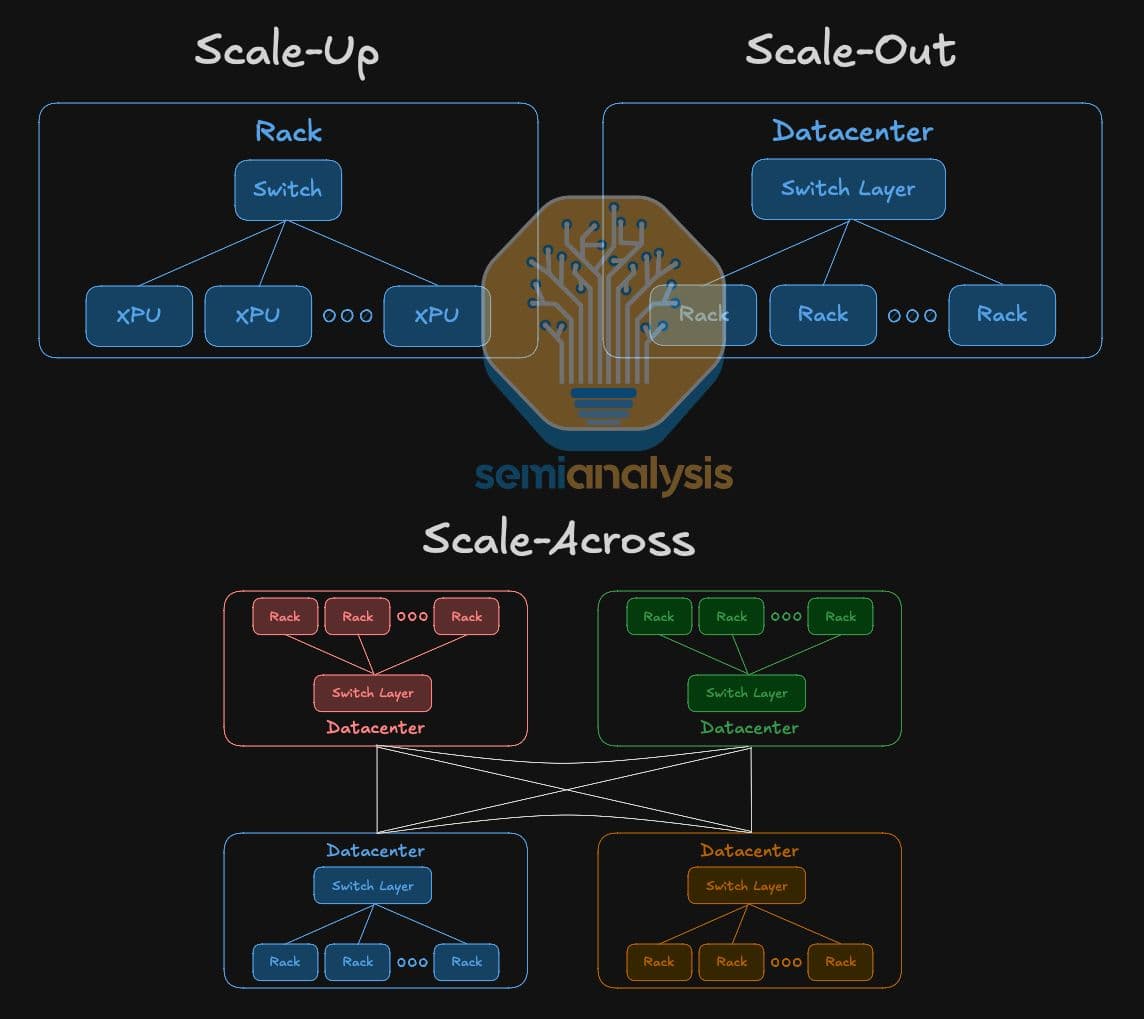
Cloud providers are interconnecting multiple datacenters for AI mega clusters of hundreds of thousands to millions of accelerators, a new paradigm called 'scale-across'. According to @SemiAnalysis_, this shift was forced by challenges in running chip interconnect at unprecedented scale.

Key facts

  • Scale-across interconnects multiple datacenters for AI clusters.
  • Clusters now reach hundreds of thousands to millions of accelerators.
  • Novel challenges forced cloud providers to adopt this approach.
  • Distinct from traditional scale-up or scale-out architectures.

The rapid growth of AI training and inference clusters—now reaching hundreds of thousands to millions of accelerators—has pushed cloud providers past the physical limits of a single datacenter. To continue scaling compute, they are now deploying chip interconnects that span multiple datacenters, a technique the analyst firm SemiAnalysis dubs 'scale-across.'

The approach reflects a structural shift: while previous generations scaled within a single facility (scale-up) or across racks (scale-out), scale-across involves linking entire datacenters into a unified compute fabric. This requires novel networking hardware, cabling, and scheduling software to maintain low-latency communication across potentially hundreds of kilometers.

SemiAnalysis notes that this trend is already visible in the largest AI infrastructure projects, including those from hyperscalers like Microsoft, Google, and Amazon. The scale-across architecture is distinct from traditional wide-area networking (WAN) because it aims to preserve the tight coupling needed for distributed training, where synchronization overhead can cripple throughput.

Key challenges include maintaining consistent bandwidth and latency across datacenter boundaries, managing power and cooling at multi-datacenter scale, and ensuring reliability when a single training run may span thousands of accelerators spread across sites. The move to scale-across also has implications for network equipment vendors, who must design switches and optical interconnects optimized for this new use case.

While the tweet does not specify which providers have deployed scale-across or the exact technologies used, the concept aligns with known industry trends: Microsoft's multi-region training clusters, Google's TPU pod expansions, and Amazon's Elastic Fabric Adapter (EFA) upgrades. The shift is likely to accelerate as clusters approach the million-accelerator threshold.

What to watch

Watch for hyperscaler announcements of multi-datacenter training runs, such as Microsoft's next-generation MAIA accelerator deployment or Google's TPU v5p cluster expansions. Also monitor networking vendor earnings calls for mentions of 'scale-across' or 'datacenter interconnect for AI' as a growth driver.

Source: gentic.news · · author= · citation.json

AI-assisted reporting. Generated by gentic.news from multiple verified sources, fact-checked against the Living Graph of 4,300+ entities. Edited by Ala SMITH.

Following this story?

Get a weekly digest with AI predictions, trends, and analysis — free.

AI Analysis

The 'scale-across' concept signals a fundamental shift in AI infrastructure architecture. While previous scaling focused on packing more accelerators into a single datacenter (scale-up) or connecting racks (scale-out), the physical constraints of power, cooling, and real estate now force a multi-datacenter approach. This mirrors earlier trends in HPC, where supercomputing centers like Fugaku and Summit used multi-building interconnects, but at a much larger accelerator count. What makes scale-across novel is the software challenge: distributed training frameworks like DeepSpeed and PyTorch DDP must now handle inter-datacenter latency that is orders of magnitude higher than intra-datacenter. This likely drives adoption of asynchronous training methods or hybrid parallelism that tolerates higher latency, potentially favoring models with larger batch sizes or pipeline parallelism. From a competitive angle, this favors cloud providers with extensive datacenter footprints and proprietary networking (e.g., Google's Jupiter, Microsoft's Azure networking) over smaller players. It also creates a new market for optical interconnects and long-haul RDMA, benefiting companies like Arista, Mellanox (Nvidia), and emerging players in silicon photonics.

Mentioned in this article

Enjoyed this article?
Share:

AI Toolslive

Five one-click lenses on this article. Cached for 24h.

Pick a tool above to generate an instant lens on this article.

Related Articles

From the lab

The framework underneath this story

Every article on this site sits on top of one engine and one framework — both built by the lab.

More in Products & Launches

View all