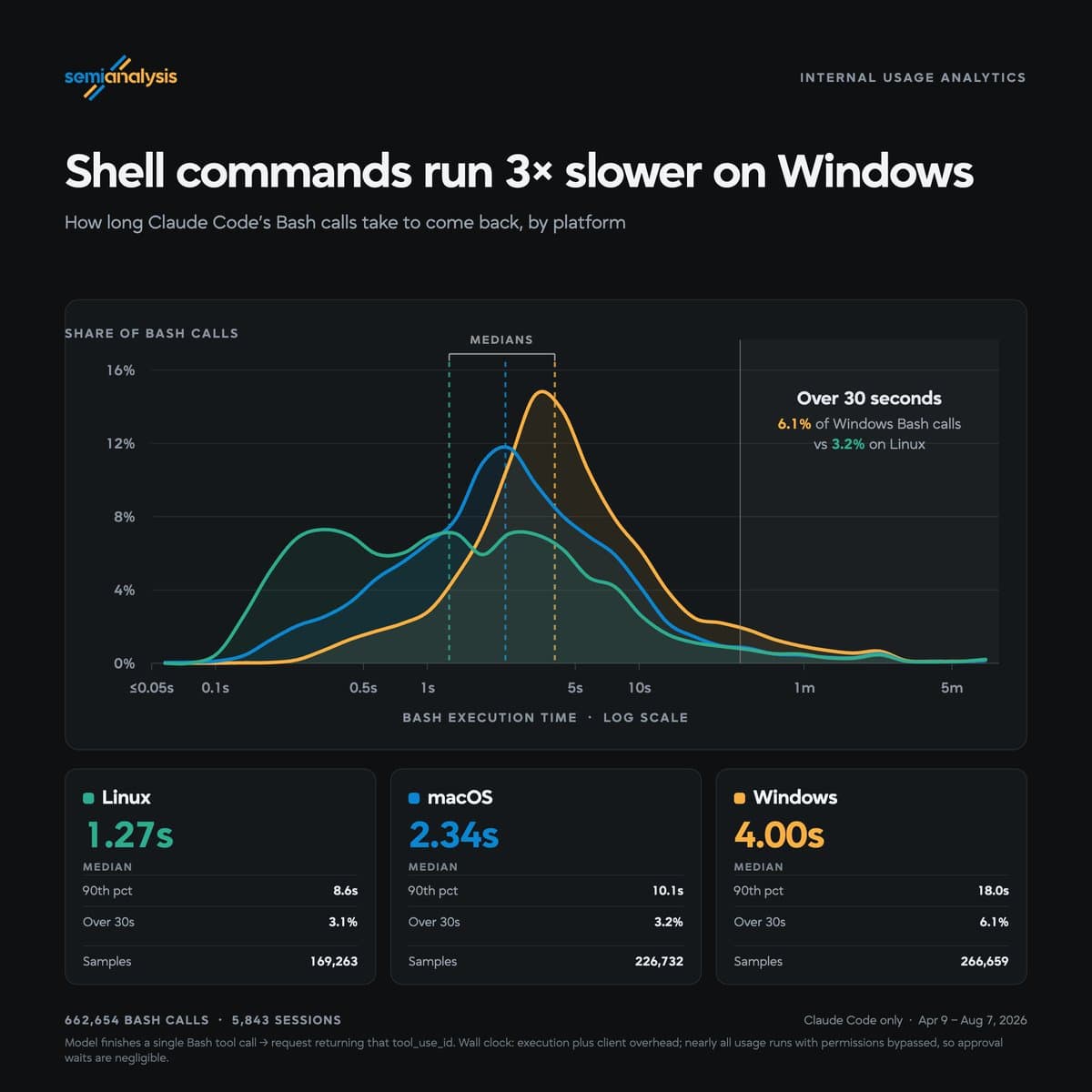
SemiAnalysis examined 2.91M real Claude tool responses and found Linux runs shell commands roughly 3x faster than Windows. The analysis, posted to X, quantifies how OS and microarchitecture choices shape agentic AI latency.
Key facts
- 2.91M Claude tool-use responses analyzed
- Linux ~3x faster than Windows for shell commands
- Data from real production traffic, not synthetic benchmarks
- OS choice compounds across multi-step agentic loops
- Microarchitecture effects teased but not detailed in excerpt
SemiAnalysis published a data-driven thread analyzing 2.91M actual Claude tool-use responses to measure how operating systems and microarchitectures affect end-user experience with agentic AI. According to @SemiAnalysis_, the headline finding is stark: Linux executes shell commands about 3x faster than Windows.
This is not a synthetic benchmark. The dataset comes from real production traffic — actual Claude invocations calling shell tools. That makes it more representative of agentic workloads than microbenchmarks that isolate syscall overhead or process spawn latency. The 3x delta likely reflects a combination of Windows' heavier process-creation path, antivirus scanning hooks, and filesystem overhead, though the thread does not break down the exact contributors.
What the 3x delta means for agentic AI
For agentic loops that chain dozens or hundreds of shell commands per task, a 3x per-command penalty compounds across the full run. A task that takes 10 seconds on Linux could take 30 seconds on Windows. That difference is the difference between an agent feeling responsive and feeling sluggish — a direct hit to user trust and adoption. The finding also suggests that agentic AI infrastructure teams targeting Windows desktops should consider WSL2 or native Linux tooling to close the gap, though SemiAnalysis does not explicitly test those configurations in the cited excerpt.
Microarchitecture as a second lever
The thread signals microarchitecture as a second variable, but the excerpt stops short of detailing specific CPU comparisons. The company did not disclose whether the 3x figure holds across Intel and AMD parts, or whether ARM-based Windows machines (Snapdragon X series) shift the balance. That omission leaves an open question for follow-up analysis.
Why this matters beyond the headline
The unique angle: this is one of the first large-scale, real-world datasets quantifying OS overhead specifically for agentic AI, not for traditional server workloads. Most latency studies focus on model inference time (time-to-first-token, tokens-per-second). SemiAnalysis' data shifts attention to the tool-execution layer — the part of the loop where the model is idle and the OS is the bottleneck. For teams building agent orchestration layers, this suggests OS choice is a first-order optimization target, not an afterthought.
What to watch
Watch for SemiAnalysis to publish the full breakdown, including microarchitecture-specific results and whether the Windows gap persists under WSL2. Also track whether agentic AI frameworks (Claude Code, OpenAI Codex CLI) begin documenting OS-specific latency guidance in their official docs.