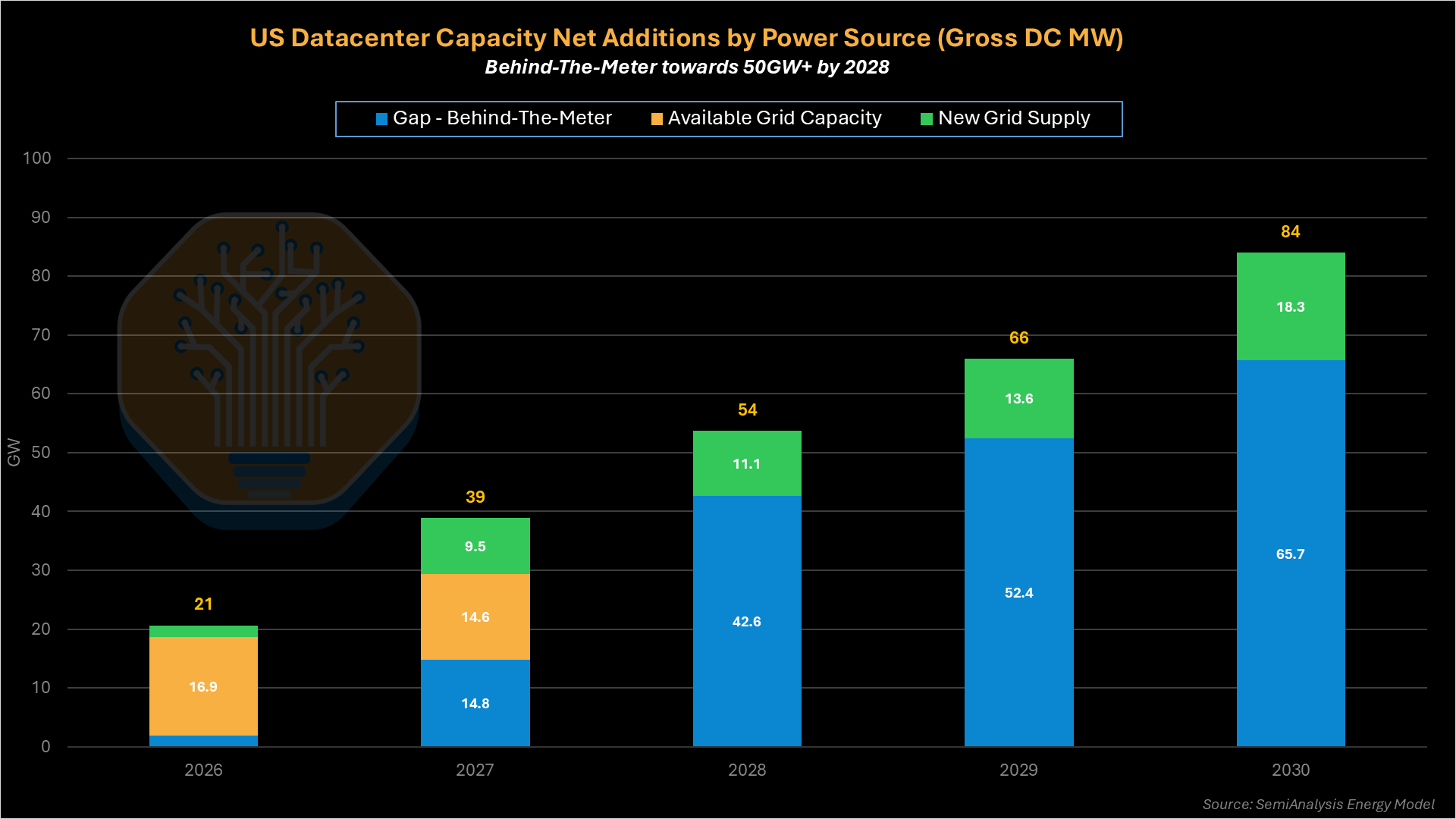
SemiAnalysis projects US behind-the-meter datacenter capacity could exceed 40GW by 2028. Grid interconnection delays are pushing over 50% of new datacenter builds off-grid within three years.
Key facts
- 40GW+ behind-the-meter datacenter capacity projected by 2028
- 50%+ of new US datacenter builds off-grid by 2028
- Interconnection queue averages over 5 years
- Triples current US datacenter capacity if realized
The US electric grid's inability to keep pace with AI datacenter demand is reshaping how hyperscalers build. According to @SemiAnalysis_, behind-the-meter datacenter capacity could surpass 40GW by 2028, representing over half of all new datacenter capacity added annually.
Why the grid can't keep up
Interconnection queues at US regional transmission organizations now average over five years from application to energization, per public FERC data cited in the analysis. Behind-the-meter builds bypass this entirely by attaching generation directly to the datacenter—typically gas turbines, on-site solar, or dedicated nuclear. The report argues this structural bottleneck, not compute supply, will become the binding constraint on AI scaling.
The 50%+ threshold
SemiAnalysis estimates that behind-the-meter will account for 50%+ of new US datacenter capacity by 2028. This flips a long-standing industry norm where grid-connected facilities dominated. The shift carries implications: behind-the-meter plants face fewer regulatory hurdles but higher capital costs and less operational flexibility. For hyperscalers like Amazon, Google, and Microsoft, the trade-off is acceptable if it means securing power on schedule.
What this means for AI buildout
The report implies the next constraint on frontier model training isn't GPU availability or data—it's power delivery. If 40GW+ materializes, it would roughly triple current US datacenter capacity. The analysis does not specify which generation sources will dominate, but gas-fired behind-the-meter plants are the most common near-term solution. Longer-term, small modular reactors and on-site renewables with storage could emerge, though timelines remain uncertain.
What to watch
Watch FERC interconnection queue data for Q2 2026—if average queue times exceed 6 years, expect more hyperscaler announcements of behind-the-meter gas or nuclear builds. Also monitor AWS, Google, and Microsoft Q3 capex calls for mentions of behind-the-meter power purchase agreements.
[Updated 26 Jun via gn_ai_data_center]
A new bill advancing in Congress would require tech companies to pay for the energy costs of their AI data centers, according to CNBC. The legislation targets the financial burden on utilities and ratepayers as behind-the-meter builds proliferate. If enacted, it could raise the cost of off-grid gas or nuclear projects, potentially slowing the 40GW+ trajectory SemiAnalysis projects. [per CNBC]
[Updated 27 Jun via gn_dc_power]
PJM's latest capacity auction cleared at $15 billion, driven by surging AI datacenter demand, according to TradingKey. The auction outcome signals that grid-connected capacity is becoming prohibitively expensive, reinforcing the economic case for behind-the-meter builds. Separately, the report notes a nuclear SMR boom is underway, with multiple hyperscalers exploring on-site small modular reactors as a longer-term solution to bypass grid constraints.