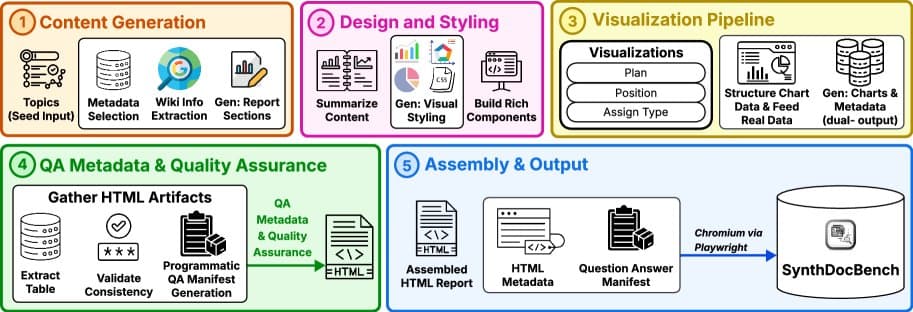
ServiceNow's SynthDocBench provides a controlled synthetic benchmark for long-context visual document understanding. The benchmark independently varies document length, layout, modality, and reasoning difficulty to diagnose why VLMs fail.
Key facts
- SynthDocBench varies document length, layout, modality, reasoning.
- Benchmark is synthetic and controlled for diagnostic purposes.
- ServiceNow released SynthDocBench via @HuggingPapers.
- Existing VLM benchmarks conflate multiple failure factors.
- SynthDocBench isolates architectural weaknesses in VLMs.
ServiceNow has released SynthDocBench, a controlled synthetic benchmark for long-context visual document understanding According to @HuggingPapers. The benchmark is designed to independently vary document length, layout, modality, and reasoning difficulty to diagnose why vision-language models (VLMs) fail on long-context documents.
Why a Synthetic Benchmark Matters
Existing benchmarks for document understanding often conflate multiple factors—document length, layout complexity, visual noise, and reasoning depth—making it hard to isolate the precise failure mode of a VLM. SynthDocBench addresses this by generating synthetic documents where each variable is controlled independently. This allows researchers to pinpoint, for example, whether a model degrades due to context length (e.g., documents exceeding 128K tokens) or due to layout complexity (e.g., multi-column tables with nested headers).
The Unique Take: Diagnosing, Not Just Ranking
Most benchmarks rank models with a single score. SynthDocBench's value is diagnostic: it reveals why a model fails, not just that it fails. By isolating variables, it can attribute performance drops to specific architectural weaknesses—such as attention span, visual encoder resolution, or reasoning chain depth. This mirrors the approach of controlled psychophysics in human vision research, applied to VLMs.
What SynthDocBench Controls

The benchmark systematically varies: document length (from short paragraphs to multi-page reports), layout (single column, multi-column, tables, forms), modality (text-only, text-with-images, charts), and reasoning difficulty (fact extraction, arithmetic, multi-step inference). ServiceNow has not yet released benchmark results or model rankings, but the framework itself is a tool for the community. [The company did not disclose the figure for the number of generated documents or the compute cost to produce the benchmark.]
Comparison to Prior Art
SynthDocBench enters a crowded field of VLM benchmarks (DocVQA, InfographicsVQA, ChartQA), but those are static datasets with fixed distributions. SynthDocBench's synthetic generation allows for unlimited scaling and controlled perturbation—a capability previously seen in NLP with tools like GLUE/SuperGLUE's diagnostic sets. The key advance is applying this to the multi-modal, long-context regime where failure modes are poorly understood.
What to watch
Watch for ServiceNow or third-party researchers to release model rankings on SynthDocBench, which will provide the first controlled comparison of VLM long-context document understanding. Also watch for adoption of the benchmark by VLM developers (e.g., Meta, Google, OpenAI) to stress-test their models.