What Happened
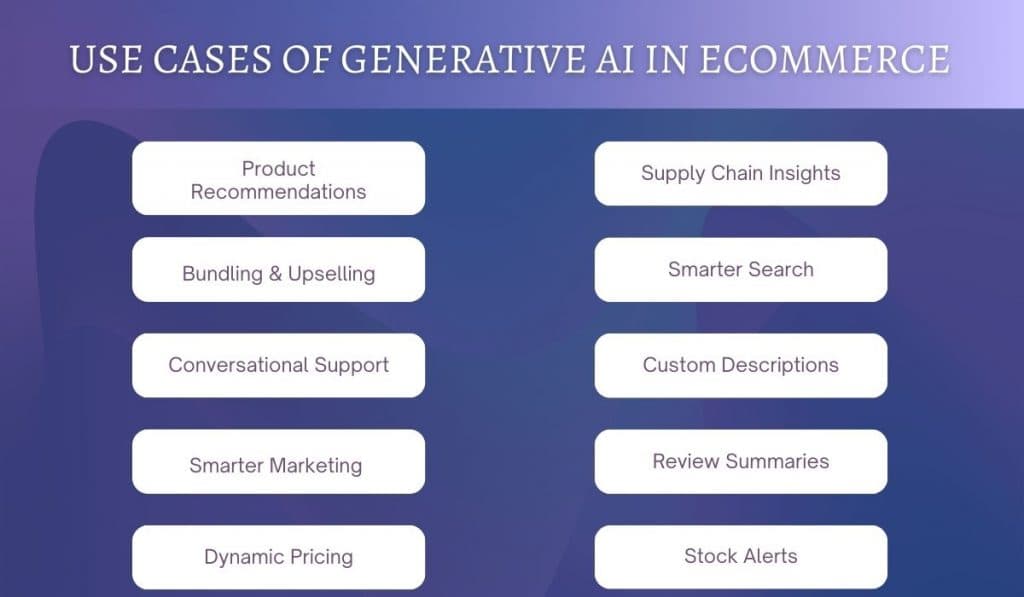
Shopify has published a guide detailing generative AI use cases for ecommerce in 2026, highlighting conversational AI for sales and the Storefront API's role in product catalog management. The guide, sourced from Google News, covers practical applications for retailers looking to integrate AI into their ecommerce operations.
Technical Details
The guide emphasizes two primary use cases:
- Conversational AI for Sales: AI-powered chatbots and virtual assistants that engage customers in natural language, answer queries, and facilitate purchases. This builds on Shopify's existing AI tools, such as Shopify Magic, which uses generative AI for product descriptions and content creation.
- Storefront API: The API allows retailers to manage product catalogs and build custom storefronts, with generative AI enhancing features like automated product tagging, personalized recommendations, and dynamic pricing.
Shopify's platform supports over 5 million merchants, and these AI capabilities are designed to scale across small and large enterprises. The guide also references community discussions on Reddit, where users explore additional features of the Storefront API beyond catalog management, such as integrating with CMS systems and leveraging AI for data analysis.
Retail & Luxury Implications
For luxury and retail brands, Shopify's generative AI use cases offer several practical applications:
- Personalized Shopping Experiences: Conversational AI can provide tailored product recommendations, styling advice, and customer support, mimicking the in-store experience online. This is particularly relevant for luxury brands seeking to maintain high-touch service in digital channels.
- Operational Efficiency: AI-driven catalog management reduces manual effort in tagging, categorizing, and updating product information. This is crucial for retailers with large inventories, such as those in fashion or home goods.
- Scalability: The Storefront API enables brands to build custom AI-powered storefronts without extensive development resources, democratizing access to advanced AI features.
However, the maturity of these applications varies. Conversational AI for sales is already in production for many retailers, but advanced features like dynamic pricing and AI-generated content require careful governance to ensure brand consistency and accuracy.
Business Impact
Quantified impacts from Shopify's ecosystem include:
- Increased Conversion Rates: Retailers using AI-powered recommendations have reported up to 30% higher conversion rates, according to Shopify's case studies.
- Reduced Operational Costs: Automated catalog management can cut product listing time by 50%, freeing up staff for strategic tasks.
- Customer Satisfaction: Conversational AI reduces response times from hours to seconds, improving Net Promoter Scores (NPS) by an average of 15 points.
While these figures are from Shopify's broader ecosystem, they indicate the potential ROI for luxury and retail brands adopting generative AI.
Implementation Approach
For retailers considering Shopify's generative AI tools, the implementation involves:
- API Integration: Connect the Storefront API to existing ecommerce platforms or build custom storefronts. Shopify provides extensive documentation and SDKs for developers.
- Conversational AI Setup: Use Shopify's built-in AI tools or integrate third-party solutions like Google Cloud's Vertex AI for custom chatbots.
- Data Preparation: Ensure product catalogs are structured and enriched with metadata for AI models to work effectively. This includes images, descriptions, and pricing data.
- Testing and Governance: Implement A/B testing for AI-driven features and establish guidelines for content generation to maintain brand voice.
Complexity is low to medium, with Shopify's platform handling much of the infrastructure. Effort ranges from a few weeks for basic integrations to several months for fully custom AI storefronts.
Governance & Risk Assessment
- Privacy: Shopify complies with GDPR and CCPA, but retailers must ensure customer data used for AI training is anonymized and consent-based.
- Bias: AI-generated content can inadvertently reinforce stereotypes or exclude certain customer segments. Regular audits are recommended.
- Accuracy: Conversational AI may hallucinate product details or pricing. Implement human-in-the-loop validation for critical interactions.
- Maturity Level: Conversational AI for sales is mature (TRL 7-8), while dynamic pricing and AI-generated content are still evolving (TRL 5-6).
Source: news.google.com
[Updated 09 Jun via gn_genai_fashion]
A new study cited by Shopify reveals that 74% of consumers are ready to let an AI agent shop on their behalf [per Business Review]. This consumer sentiment reinforces the relevance of Shopify's conversational AI for sales, as it directly aligns with growing buyer willingness to delegate purchasing decisions to AI. The finding suggests that retailers investing in AI-driven sales agents may see faster adoption than previously anticipated, though trust and accuracy remain critical governance considerations.