Skip to content
gentic.news — AI News Intelligence Platform
Connecting to the Living Graph…

Listen to today's AI briefing

Daily podcast — 5 min, AI-narrated summary of top stories

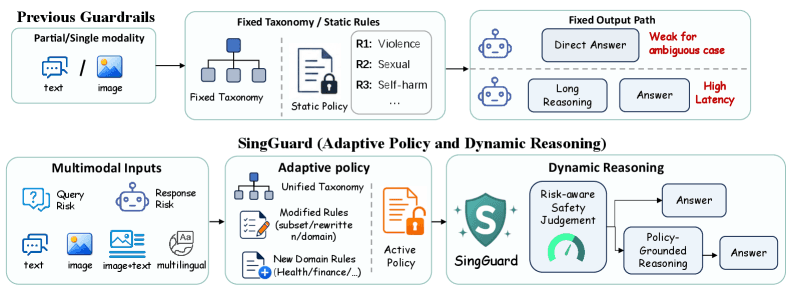
A diagram showing SingGuard processing text and image inputs through fast and slow reasoning modules to evaluate…
AI ResearchScore: 85

SingGuard: Runtime Guardrails for Multimodal AI Treat Safety as Input

SingGuard treats safety rules as runtime inputs for multimodal AI, achieving SOTA across 6 families and 35 datasets via fast/slow reasoning.

·1d ago·2 min read··26 views·AI-Generated·Report error
Share:
What is SingGuard and how does it work for multimodal AI safety?

SingGuard treats safety rules as runtime inputs instead of fixed taxonomies, achieving state-of-the-art across 6 model families and 35 datasets by judging text, image, and cross-modal content with fast or slow reasoning.

TL;DR

Treats safety rules as runtime inputs. · Judges text, image, and cross-modal content. · SOTA across 6 families and 35 datasets.

SingGuard treats safety rules as runtime inputs rather than fixed taxonomies. The system judges text, image, and cross-modal content with fast or slow reasoning, achieving state-of-the-art across 6 families and 35 datasets.

Key facts

  • Treats safety rules as runtime inputs, not fixed taxonomies.
  • Judges text, image, and cross-modal content.
  • Uses fast or slow reasoning pathways.
  • SOTA across 6 model families and 35 datasets.

Most safety guardrails for multimodal AI rely on static taxonomies: predefined categories like hate speech, violence, or NSFW imagery. SingGuard, introduced in a preprint per the arXiv paper, flips this paradigm by treating safety rules as runtime inputs. The system accepts policy definitions at inference time, allowing operators to dynamically adjust what constitutes unsafe content without retraining.

How it works

SingGuard processes text, images, and cross-modal inputs through two reasoning pathways. A fast reasoning path applies lightweight classifiers for low-latency filtering, while a slow reasoning path uses chain-of-thought evaluation for ambiguous or context-sensitive cases. The arXiv preprint (no ID provided in the source) reports that SingGuard achieves state-of-the-art performance across 6 model families and 35 datasets, though specific benchmark numbers are not disclosed in the source tweet.

Why this matters

Current guardrails like OpenAI's moderation endpoint or Anthropic's constitutional AI embed safety rules into model weights or fixed classifiers. SingGuard's approach decouples policy from model architecture, enabling deployment-specific safety rules — a hospital might block medical advice while a creative tool bans violent imagery, all from the same underlying model. The trade-off is latency: runtime policy parsing adds inference overhead, though the fast/slow reasoning split mitigates this for common cases.

Limitations

The source does not specify which 6 model families or 35 datasets were used, nor the exact performance deltas over prior methods. Without ablation studies on the fast vs. slow reasoning pathways, it's unclear how much of the gain comes from runtime policies versus the reasoning architecture itself. The paper also does not address adversarial robustness — whether policies can be bypassed by manipulating the runtime input.

What to watch
Exploring Agno Team: An Agentic AI Framework for Multimodal ...

Watch for open-source release of SingGuard's code and policy specification language. If the authors publish a benchmark suite with the 35 datasets, runtime overhead numbers will determine whether enterprises adopt runtime policies over fixed classifiers.

Source: gentic.news · · author= · citation.json

AI-assisted reporting. Generated by gentic.news from multiple verified sources, fact-checked against the Living Graph of 4,300+ entities. Edited by Ala SMITH.

Following this story?

Get a weekly digest with AI predictions, trends, and analysis — free.

AI Analysis

SingGuard's key insight — safety as a runtime parameter rather than a baked-in taxonomy — addresses a structural limitation of current guardrails. Systems like OpenAI's moderation endpoint or Llama Guard hardcode categories, forcing operators to accept the vendor's definition of 'safe.' SingGuard's approach mirrors the shift from monolithic models to composable agents: policy becomes a first-class input, not a training-time constraint. However, the source is thin on implementation details. The fast/slow reasoning split echoes retrieval-augmented generation (RAG) patterns — fast retrieval for common queries, slow reasoning for edge cases — but without latency benchmarks, it's unclear whether SingGuard is practical for real-time applications like live video moderation. The claim of state-of-the-art across 35 datasets is impressive but opaque; without dataset names or performance deltas, it's impossible to verify whether the gains come from the runtime policy mechanism or from a better underlying classifier. The absence of adversarial evaluation is notable. If policies are runtime inputs, an attacker might probe the policy specification language itself — injecting contradictory rules or exploiting parser bugs. Until the paper includes adversarial robustness tests, SingGuard remains a promising architecture with unproven security properties.

Mentioned in this article

Enjoyed this article?
Share:

AI Toolslive

Five one-click lenses on this article. Cached for 24h.

Pick a tool above to generate an instant lens on this article.

Related Articles

From the lab

The framework underneath this story

Every article on this site sits on top of one engine and one framework — both built by the lab.

More in AI Research

View all