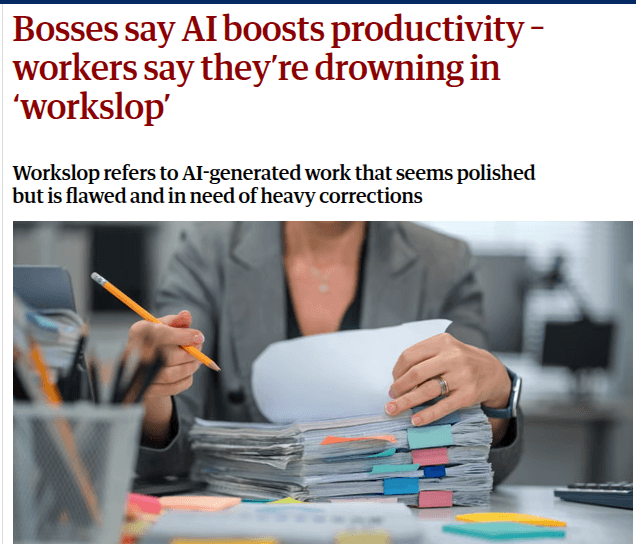
A new report from The Guardian, based on a survey of 5,000 white-collar US workers, exposes a significant and growing divide in how artificial intelligence is perceived in the workplace. While leadership is broadly enthusiastic, a large portion of the workforce reports that mandated AI tools are not saving time but instead creating a new burden—termed "workslop."
The core finding is a stark perception gap: 92% of high-level executives say AI makes them more productive, while 40% of non-managers report that AI saves them no time at all. This suggests that the promised efficiency gains from generative AI are not being realized uniformly across organizational hierarchies.
The 'Workslop' Tax: Shifted, Not Saved, Labor
The report identifies a critical pattern: for many employees, AI adoption does not equate to saved labor but to shifted labor. The initial drafting or content generation phase may accelerate, but this is often offset—or overwhelmed—by increased time spent on downstream tasks. Employees report significant time dedicated to:
- Checking and verifying AI-generated output for accuracy and coherence.
- Rewriting and editing to align output with specific tone, brand voice, or factual requirements.
- Arguing over or correcting poor-quality or irrelevant AI suggestions.
This phenomenon, where the cognitive overhead of managing and correcting AI output creates a net drag on productivity, is being labeled "workslop"—a new tax on employee time imposed by poorly integrated or mandated technology.
The Implementation Divide
The data points to a fundamental disconnect in the AI adoption experience. Executives, who often set the strategy and mandate the tools, are experiencing productivity boosts, potentially from AI-aided analysis, summarization, and decision-support. Meanwhile, frontline knowledge workers, who are tasked with integrating these tools into daily, granular tasks, are bearing the brunt of the integration costs without seeing the benefits.
This aligns with a common pattern in enterprise technology rollout: the benefits are often concentrated at the strategic level, while the friction and adjustment costs are absorbed operationally. The survey indicates that forced or top-down AI integration, without adequate training, use-case refinement, or employee input, risks creating resentment and reducing effective output, counter to its stated goals.
gentic.news Analysis
This report provides crucial, real-world data to a debate that has been largely theoretical or anecdotal. For the past two years, the AI industry narrative, driven by vendor claims and executive keynotes, has been dominated by promises of unprecedented productivity gains. This survey is one of the first large-scale indicators that the on-the-ground reality for many workers is far messier.
This finding connects directly to our previous coverage of Microsoft's Copilot for Microsoft 365 and its mixed reception. While early studies sponsored by Microsoft showed promising time-savings, independent analyses and user reports frequently highlighted a steep learning curve and context-switching costs that eroded net benefits for many tasks. The "workslop" concept formalizes this friction.
Furthermore, this executive-worker perception gap isn't new to AI; it mirrors historical patterns observed during the rollout of major enterprise software like ERP systems in the 1990s and early 2000s. Leadership touted integration and efficiency, while operational staff struggled with rigid workflows and data entry burdens. The speed and pervasiveness of generative AI, however, are accelerating and amplifying this dynamic.
For AI practitioners and technical leaders, this is a critical reminder that model performance on a benchmark is only one component of success. Deployment architecture, user experience design, and change management are equally vital. A model that scores 95% on a summarization task can still fail in production if it introduces 10 minutes of verification work for a human. The next frontier for applied AI research may need to shift from pure capability to human-AI collaboration efficiency—measuring and optimizing for the total time-to-correct-output, not just initial generation.
Frequently Asked Questions
What is 'workslop' in the context of AI?
"Workslop" is a term emerging from workplace discourse to describe the additional, often unproductive labor created by poorly implemented AI tools. It refers to the time employees spend checking, correcting, arguing over, or reformatting AI-generated output, which can offset or exceed the time saved by using the AI in the first place. It's seen as a tax on employee time imposed by mandatory but suboptimal technology integration.
Why is there such a big gap between executives and employees on AI productivity?
The gap likely stems from different use cases and proximity to the work. Executives may use AI for high-level summarization, data analysis, or drafting communications, where slight inaccuracies are less critical. Non-managers often use AI for core, detailed tasks where errors have immediate consequences, requiring rigorous verification. Furthermore, executives mandate the tools but don't experience the daily friction of integrating them into repetitive workflows, leading to a perception bias.
What should companies do to avoid creating 'workslop'?
To mitigate workslop, companies should move beyond top-down mandates. Effective strategies include: piloting tools with volunteer teams to identify real friction points, investing in targeted training that goes beyond basic functionality to cover validation and editing best practices, and allowing employee choice in when and how to use AI for specific subtasks rather than enforcing blanket usage. Measuring success should focus on net outcome quality and time, not just AI tool adoption rates.
Does this mean generative AI is not productive for businesses?
Not necessarily. The data suggests that current implementation strategies are often unproductive for a significant segment of the workforce. The technology itself has clear potential, but realizing its benefits requires careful integration focused on human-AI collaboration. The high satisfaction rate among executives indicates there are valuable use cases; the challenge is extending those benefits equitably and efficiently across all levels of an organization by reducing the integration overhead for individual contributors.