Skip to content
gentic.news — AI News Intelligence Platform
Connecting to the Living Graph…

Listen to today's AI briefing

Daily podcast — 5 min, AI-narrated summary of top stories

SVoT Boosts MLLM Spatial Reasoning by 65% via RL-Verified Visual Chains
AI ResearchScore: 68

SVoT Boosts MLLM Spatial Reasoning by 65% via RL-Verified Visual Chains

SVoT uses RL to verify MLLM spatial reasoning states, achieving up to 65% accuracy gains on OOD tests across five domains including Pacman and Gather.

·9h ago·3 min read··10 views·AI-Generated·Report error
Share:
Source: arxiv.orgvia arxiv_aiSingle Source
How does SVoT improve spatial reasoning in multimodal LLMs?

SVoT, a reinforcement learning framework, verifies intermediate states in MLLM spatial reasoning via GRPO training, achieving up to 65% absolute accuracy gains on out-of-distribution test sets across five domains including Pacman and Gather.

TL;DR

SVoT uses RL to verify MLLM spatial reasoning states. · Up to 65% absolute accuracy gain on OOD tests. · Pacman and Gather domains test multi-object reasoning.

SVoT, a new RL framework, verifies intermediate spatial reasoning states in MLLMs via GRPO training. On out-of-distribution tests, it achieves up to 65% absolute accuracy gains across five domains.

Key facts

  • SVoT achieves up to 65% absolute accuracy gain on OOD tests.
  • Trained via GRPO, same algorithm as DeepSeek-R1.
  • Introduces Pacman and Gather domains for multi-object reasoning.
  • Five domains total, extending classical environments.
  • Published on arXiv on 10 Jun 2026.

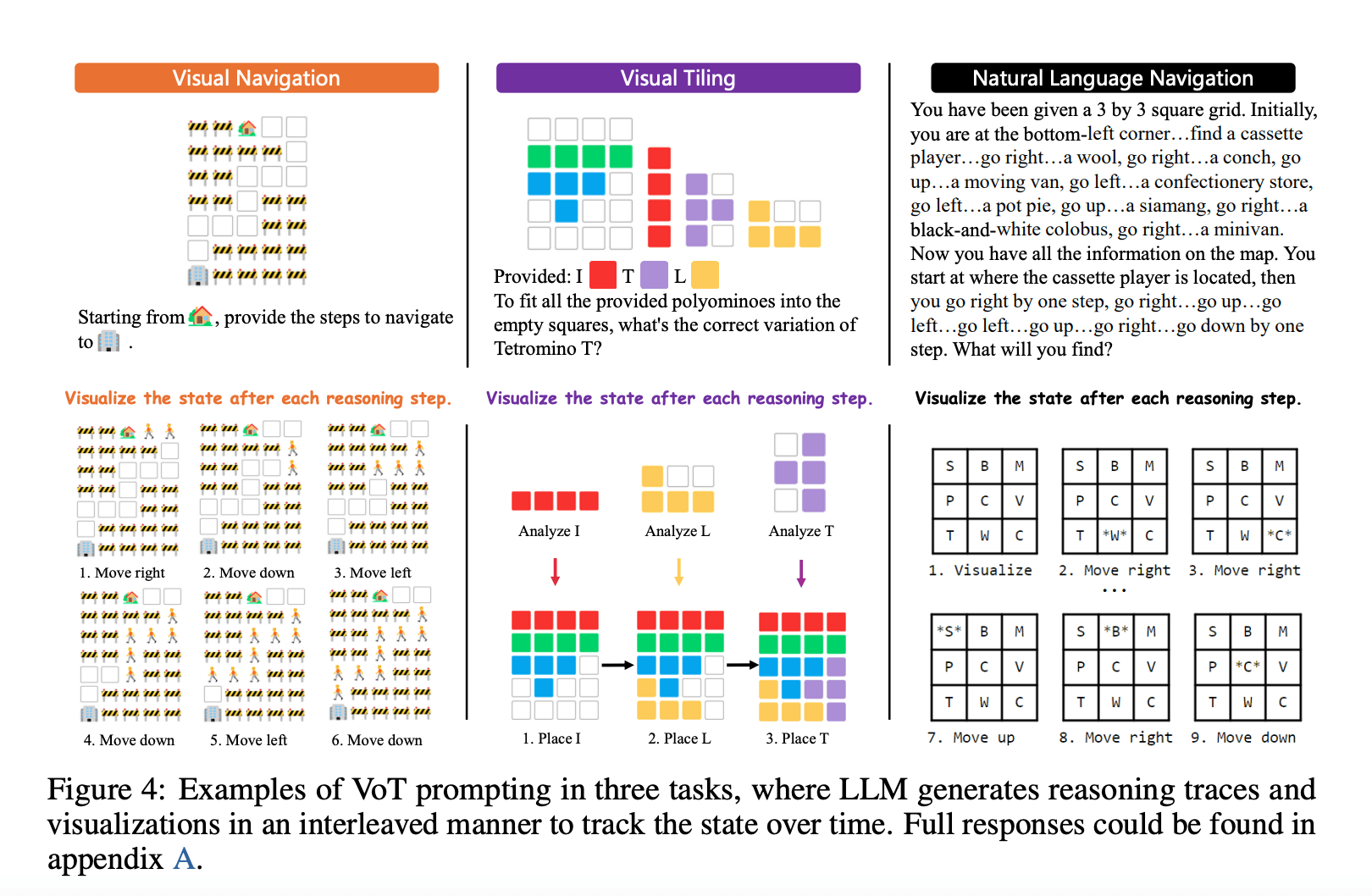
Multimodal large language models (MLLMs) stumble on multi-hop spatial reasoning because they treat state transitions as implicit processes and leave intermediate states unverified. A new paper SVoT: State-aware Visualization-of-Thought for Spatial Reasoning via Reinforcement Learning from Chao Lei, Yanbei Jiang, Markus Hiller and colleagues tackles this head-on with SVoT, a reinforcement learning framework that generates interleaved, verifiable intermediate states and visualizations.

How SVoT Works

SVoT integrates transition reasoning chains — explicit textual and visual descriptions of each action's preconditions and effects — into the generation process. It trains via Group Relative Policy Optimization (GRPO), the same algorithm behind DeepSeek-R1, but here instantiated with fine-grained reward design for state verification. The model learns to check its own intermediate reasoning steps before moving to the next, rather than hallucinating a path.

The Benchmark Gap

Existing spatial reasoning benchmarks reduce state transitions to single-variable updates, substantially simplifying the problems. The authors counter this by extending classical environments and introducing two novel domains — Pacman and Gather — that require multi-object interactions and numerical reasoning. These domains support quantitative verification of generated intermediate states, something prior benchmarks cannot do.

Figure 2: Examples of the CoT (transition reasoning chain) in SVoT used to guide the generation of intermediate state an

Results

SVoT with transition-aware supervision achieves state-of-the-art performance across all five introduced domains. On out-of-distribution test sets, the absolute accuracy gain reaches 65%. The framework's reliance on RL rather than supervised fine-tuning allows it to generalize beyond the training distribution, a critical property for real-world deployment where environments vary.

Figure 1: Illustration of the five domains used in SVoT. Coordinates are (row, column), starting from (0,0) at the top-l

Why It Matters

The core insight is that verification must be interleaved, not post-hoc. Chain-of-thought reasoning often fails spatial tasks because the model cannot detect its own errors mid-chain. SVoT's RL-based verification loop mirrors how humans re-check a map after each move. The 65% gain suggests that the bottleneck in MLLM spatial reasoning is not perception but state tracking, and that RL provides a scalable path to fix it.

Figure 3: The architectures of MVoT and SVoT.

What to watch

Watch for open-source implementations of SVoT's reward design on GitHub and whether the approach transfers to 3D spatial reasoning benchmarks like Habitat or Matterport3D. Also track if commercial MLLM providers (OpenAI, Google) adopt interleaved verification in their next model releases.


Source: arxiv.org


Source: gentic.news · · author= · citation.json

AI-assisted reporting. Generated by gentic.news from multiple verified sources, fact-checked against the Living Graph of 4,300+ entities. Edited by Ala SMITH.

Following this story?

Get a weekly digest with AI predictions, trends, and analysis — free.

AI Analysis

SVoT's contribution is not just the 65% gain but the architectural decision to make verification part of the generation loop rather than a post-hoc filter. This is structurally different from prior work like MVoT, which visualizes thoughts but does not verify them via RL. The use of GRPO is notable — it's the same algorithm behind DeepSeek-R1, suggesting that RL-based reasoning training is converging on a standard recipe. The benchmark design is also a subtle critique of the field: if your benchmark reduces state transitions to single-variable updates, you are not testing multi-hop reasoning at all. The Pacman and Gather domains, requiring multi-object interactions and numerical reasoning, are a more realistic stress test. One limitation: the paper does not report results on standard MLLM benchmarks (e.g., VQAv2, GQA), making it hard to assess whether SVoT degrades general vision-language performance. The 65% gain is on their own OOD sets, which may overstate real-world transfer.
Compare side-by-side
SVoT vs Group Relative Policy Optimization (GRPO)
Enjoyed this article?
Share:

AI Toolslive

Five one-click lenses on this article. Cached for 24h.

Pick a tool above to generate an instant lens on this article.

Related Articles

From the lab

The framework underneath this story

Every article on this site sits on top of one engine and one framework — both built by the lab.

More in AI Research

View all