What Happened
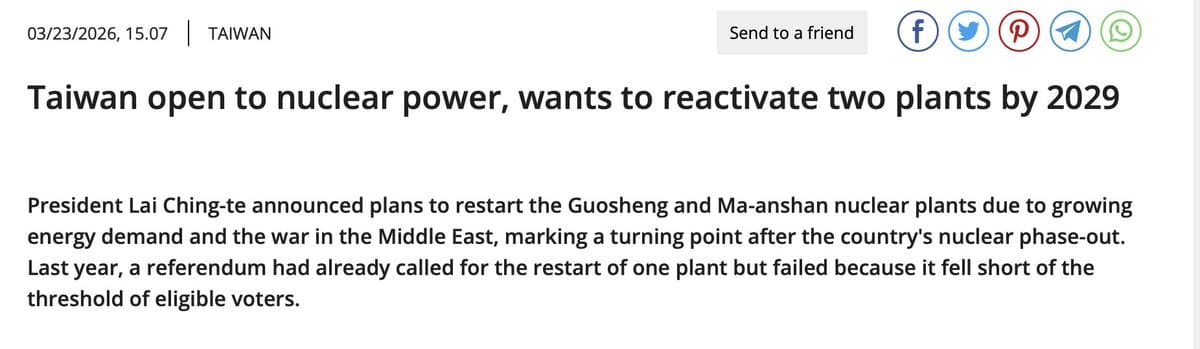
Taiwan is reversing its nuclear energy policy and returning to nuclear power generation. This decision is framed as a direct response to the nation's critical vulnerability in energy security. According to the analysis, Taiwan imports 97% of its power, with 37% of that originating from the Middle East. The island's strategic reserves, particularly for liquefied natural gas (LNG), are reportedly sufficient for only 11 days without foreign imports.
The source cites the Iran-Iraq War and current geopolitical tensions as stark demonstrations of how external "shocks" can threaten a nation's economic survival by disrupting energy supplies. This vulnerability is not just theoretical; it translates into tangible financial risk, with bond markets already applying risk premiums due to the potential for expensive energy imports to drive inflation.
The Global Energy Security Landscape
The analysis positions Taiwan's move within a broader global chessboard of energy strategy:
- China: Portrayed as having secured "the best position" through a massive dual-track expansion of renewable energy (notably solar power) and nuclear power plants. The source claims China built more solar panels in 2025 alone than the US produced in over ten years.
- United States: Possesses domestic oil and LNG resources but remains affected by global conflict dynamics.
- Russia: Has significant oil and gas reserves.
- Europe: Described as being in "the worst position," characterized by highly volatile energy prices, the phased abandonment of nuclear power (except in France), and high dependence on external resources due to domestic scarcity. The expansion of renewables is noted as progressing slowly.
Taiwan's pivot to nuclear power is presented as a "paradigmatic" response to this global situation. The core argument is that energy independence and security are strategically vital for national survival and, by extension, for sustaining advanced technological sectors.
The Direct Link to AI's Future
The source makes a explicit, value-neutral connection between energy security and artificial intelligence: "But securing energy is essential, also for the future of AI." This statement frames reliable, abundant, and sovereign energy production not as a general economic concern, but as critical infrastructure specifically for powering and developing AI technologies. The immense computational demands of training and running large-scale AI models require stable, scalable electricity. A nation dependent on volatile, imported fuel sources is seen as building its AI future on a fragile foundation.
gentic.news Analysis
This report, while not a technical AI announcement, highlights a fundamental and often under-discussed bottleneck in the global AI race: the physical infrastructure of power. The discourse typically focuses on algorithms, chips, and talent, but Taiwan's strategic calculus underscores that energy is the ultimate substrate. For an island facing unique geopolitical pressures, securing a baseload, sovereign power source like nuclear energy is a prerequisite for any long-term, high-stakes technological ambition, including becoming or remaining an AI hub.
The contrast drawn between global powers is instructive. China's reported aggressive build-out of both nuclear and solar aligns with its stated goals of AI supremacy, providing a planned energy backbone. Europe's fragmented and dependent energy posture, as described, could act as a structural drag on its AI competitiveness, increasing costs and introducing supply chain risk beyond semiconductors to include the electricity itself. The analysis suggests we are moving from an era where energy was a cost input to one where energy sovereignty is a strategic input for technological sovereignty.
For AI practitioners and companies, this signals a growing need to factor energy geography into long-term planning. The cost and reliability of training runs may become increasingly tied to the political stability of energy trade routes and domestic generation policies. Data center location decisions may start to prioritize grids with stable, sovereign generation over purely economic or latency factors. Taiwan's move is a canary in the coal mine, showing that nations are starting to make hard energy choices with their technological futures in mind.
Frequently Asked Questions
Why is Taiwan returning to nuclear power?
Taiwan is restarting its nuclear power program primarily to address a critical national security vulnerability. The island imports 97% of its energy, with a significant portion from geopolitically unstable regions. With liquefied natural gas (LNG) reserves lasting only about 11 days, the government views nuclear energy as a necessary source of stable, baseload power to ensure energy independence and economic stability in the face of potential external supply shocks.
How does energy security relate to AI development?
The development and operation of artificial intelligence, particularly the training of large language models, is extremely energy-intensive. Stable, abundant, and affordable electricity is a critical infrastructure requirement. A nation or region dependent on volatile imported energy faces higher costs and significant operational risk, which can hinder its ability to compete in the global AI race. Secure energy sovereignty is increasingly seen as a foundational element for technological sovereignty.
What is China's energy strategy according to the analysis?
The analysis positions China as having a leading energy security strategy based on a massive, dual-track expansion. It involves building out renewable energy at a unprecedented scale—claiming more solar panels built in 2025 than the US produced in a decade—while also significantly expanding its nuclear power capacity. This approach aims to provide a robust, domestically controlled energy backbone to support its industrial and technological ambitions, including AI.
Why is Europe described as being in a weak position?
Europe is characterized by a combination of factors: phasing out nuclear power (with the major exception of France), slow progress in expanding renewable energy capacity, and high dependence on imported oil and gas due to limited domestic resources. This results in highly volatile energy prices and strategic vulnerability to external supply disruptions, creating an unstable and costly foundation for energy-intensive industries like AI.
Could Taiwan's model be applied elsewhere?
Taiwan's model of prioritizing energy independence through a mix that includes nuclear power could serve as a case study for other technologically advanced nations or regions that are highly dependent on energy imports and face geopolitical risks. Its situation magnifies a global challenge: securing the physical power required for a digital future. However, the applicability depends heavily on local political will, public acceptance of nuclear energy, and existing infrastructure.