What Happened
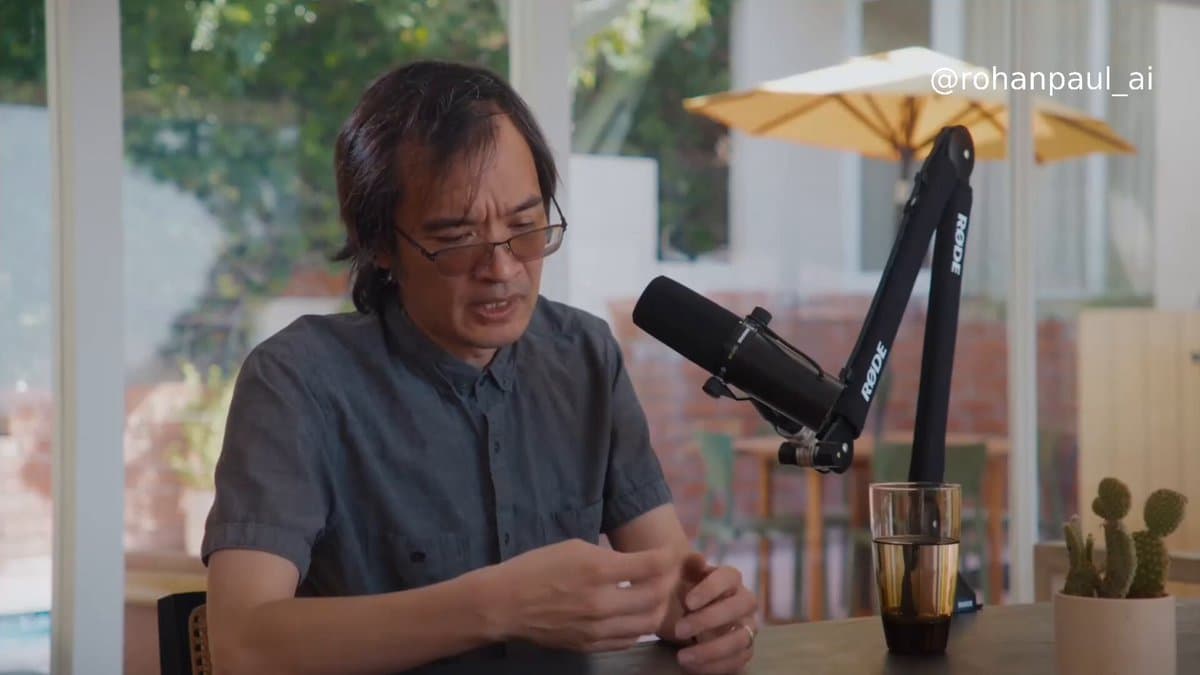
In a recent interview highlighted by AI commentator Rohan Paul, preeminent mathematician and Fields Medalist Terence Tao discussed the impact of artificial intelligence on mathematics. Tao suggested that the traditional, lengthy educational path required to reach the research frontier is being compressed by new AI tools.
"In math, you previously had to basically go through years and years of education to be a math PhD before you could contribute to the frontier of math research," Tao stated. "But now it's quite possible at the high school level or whatever, that you could get involved in a math project and actually make a real contribution because of all these AI tools and lean and everything else."
The mention of "lean" refers to Lean, an interactive theorem prover and programming language. It is part of a growing ecosystem of AI-assisted proof assistants that help mathematicians formalize and verify proofs.
Context
Terence Tao's perspective carries significant weight due to his status as one of the world's leading mathematicians. His commentary aligns with observable trends in computational mathematics. Tools like Lean, along with AI language models fine-tuned on mathematical corpora, are increasingly used to check proof correctness, suggest lemmas, and explore formalizations of complex problems.
The interview, from the podcast hosted by Dwarkesh Patel, points to a broader shift where AI acts as an intellectual amplifier. It does not replace deep mathematical understanding but can manage the substantial logistical and verification overhead, potentially allowing talented individuals to engage with advanced research earlier in their development.
This acceleration mirrors patterns seen in software engineering, where AI coding assistants have lowered the barrier to entry for contributing to complex codebases. In mathematics, the effect could democratize participation in formal research.