A fascinating new study examining the effectiveness of AGENTS.md files—specialized documentation designed to guide AI coding assistants—has revealed surprising results that challenge conventional wisdom about how we should optimize AI development workflows. The research, highlighted by AI researcher Omar Sar, demonstrates that while human-written documentation provides modest benefits, AI-generated documentation can actually degrade performance while significantly increasing computational costs.
What Are AGENTS.md Files?
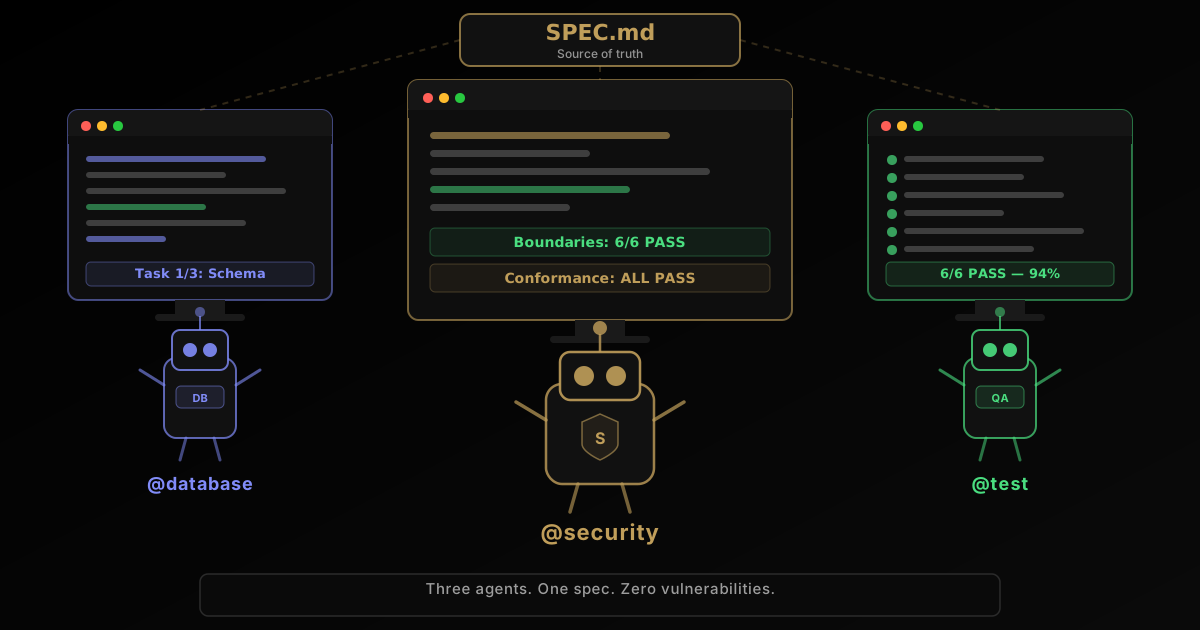
AGENTS.md files represent an emerging practice in AI-assisted software development. These markdown documents serve as specialized instruction manuals for coding agents—AI systems designed to understand, generate, and modify code. Unlike traditional documentation written for human developers, AGENTS.md files are specifically crafted to communicate with AI assistants, providing context, constraints, preferences, and project-specific guidelines.
The practice emerged organically as developers sought ways to make AI coding assistants more effective within specific codebases. By creating these specialized instruction files, teams hoped to reduce repetitive explanations, maintain consistency across AI-generated code, and encode institutional knowledge that AI systems could reference during development tasks.
The Research Findings
The study, which appears to be gaining attention in AI research circles, measured the impact of AGENTS.md files across multiple dimensions:
Performance Impact:
- Human-written AGENTS.md files improved coding agent performance by approximately 4%
- LLM-generated AGENTS.md files actually decreased performance by about 2%
- The difference suggests that quality and specificity matter significantly
Cost Impact:
- Both types of documentation increased inference costs by over 20%
- This represents a substantial computational overhead for potentially minimal gains
Behavioral Observations:
- Agents faithfully followed the instructions provided in documentation
- However, this faithful execution didn't necessarily translate to better outcomes
- The research suggests that following instructions isn't synonymous with optimal performance
The Documentation Dilemma
These findings present developers and organizations with a complex optimization problem. On one hand, human-written documentation provides measurable benefits, suggesting that well-crafted guidance can improve AI coding performance. On the other hand, the modest 4% improvement comes at a significant computational cost—over 20% increased inference expenses.
The negative impact of AI-generated documentation is particularly noteworthy. It suggests that having an AI system document its own optimal operating procedures creates a kind of feedback loop that doesn't necessarily produce better results. This finding challenges the assumption that AI systems can effectively optimize their own instruction sets.
Implications for Development Teams
For software development teams incorporating AI assistants, these findings suggest several practical considerations:
Cost-Benefit Analysis: Organizations must weigh whether a 4% performance improvement justifies a 20% increase in computational costs. For large-scale development operations, this could represent significant financial implications.
Documentation Strategy: The research suggests that if teams choose to implement AGENTS.md files, they should invest in human-authored documentation rather than relying on AI-generated versions. The quality and specificity of human-written instructions appear to make a meaningful difference.
Performance Monitoring: Teams should implement systems to measure whether their documentation practices actually improve outcomes rather than assuming they provide benefits. The research demonstrates that faithful instruction-following doesn't guarantee better results.
The Broader Context of AI-Assisted Development
This research arrives at a critical moment in the evolution of AI-assisted software development. As coding agents become more sophisticated and integrated into development workflows, understanding how to optimize their performance becomes increasingly important.
The findings highlight several broader trends in AI development:
The Instruction-Following Paradox: The observation that agents faithfully follow instructions without necessarily improving outcomes suggests that current AI systems may lack the contextual understanding to know when instructions should be adapted or overridden for better results.
The Efficiency Trade-off: The significant increase in inference costs for modest performance gains raises questions about how we should balance optimization efforts against computational efficiency.
Human-AI Collaboration: The superior performance of human-written documentation reinforces the importance of human expertise in guiding AI systems, even as those systems become more capable.
Future Research Directions
This study opens several important avenues for future investigation:
Optimal Documentation Practices: What specific elements of human-written documentation provide the most value? Are there particular formats or content types that yield better results?
Cost Optimization: Could documentation be made more efficient? Are there ways to provide guidance to AI systems without incurring such significant computational overhead?
Adaptive Systems: Could AI systems learn when to reference documentation and when to rely on their base training? This might help optimize the cost-benefit ratio.
Quality Metrics: How should we measure the quality of AI-generated documentation, and what makes human-written documentation superior?
Practical Recommendations
Based on these findings, development teams might consider the following approaches:
Selective Implementation: Rather than implementing AGENTS.md files across all projects, teams might use them selectively for complex or critical codebases where the performance improvement would justify the increased costs.
Iterative Refinement: Teams that do implement documentation should treat it as a living resource, regularly testing and refining their AGENTS.md files based on performance outcomes.
Cost Monitoring: Organizations should closely monitor the computational costs associated with AI-assisted development and establish clear metrics for evaluating whether specific optimizations provide sufficient return on investment.
Human-in-the-Loop: The research reinforces the value of human expertise in AI-assisted workflows. Rather than automating documentation creation, teams might achieve better results by investing human effort in crafting high-quality guidance.
Conclusion
The research on AGENTS.md files reveals a nuanced reality about optimizing AI coding assistants. While the promise of specialized documentation is compelling, the actual benefits are modest and come with significant computational costs. The finding that AI-generated documentation can actually harm performance serves as a valuable reminder that not all automation leads to improvement.
As AI continues to transform software development, studies like this provide crucial empirical evidence to guide practical decisions. They remind us that optimization requires careful measurement, that human expertise remains valuable, and that every efficiency gain must be evaluated against its costs.
The most significant takeaway may be that in the age of AI-assisted development, we need to approach optimization with the same empirical rigor we apply to other aspects of software engineering—testing assumptions, measuring outcomes, and being willing to abandon practices that don't deliver sufficient value.
Source: Research highlighted by Omar Sar (@omarsar0) on Twitter/X, referencing emerging findings about AGENTS.md file effectiveness in AI coding workflows.