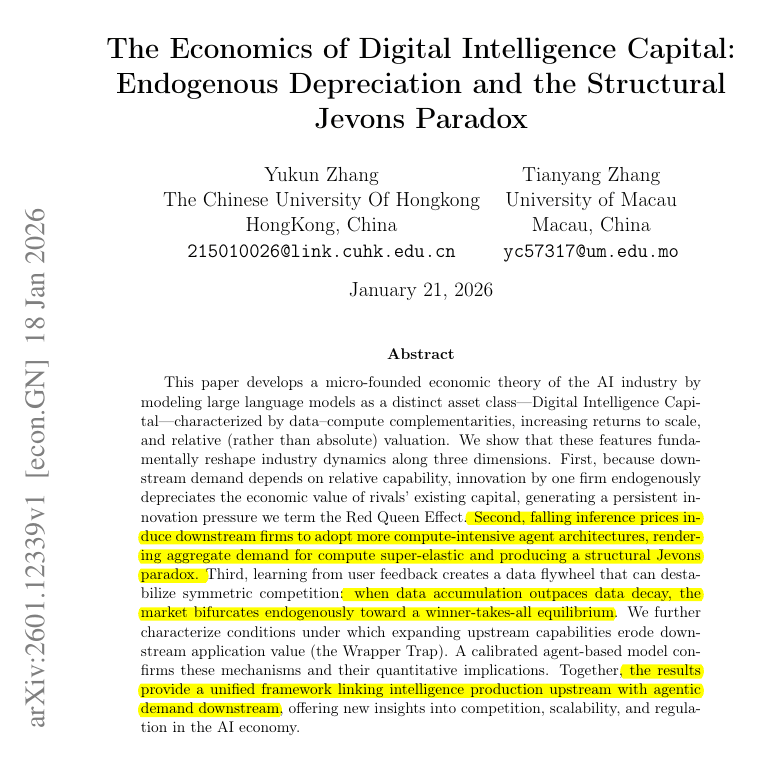
A groundbreaking economic paper titled "The Economics of Digital Intelligence Capital" has identified a fundamental paradox at the heart of the artificial intelligence industry. Researchers have mathematically modeled what they term the "Structural Jevons Paradox," revealing that improvements in AI efficiency don't reduce overall resource consumption—they dramatically increase it.
The Paradox Explained
The Jevons Paradox, named after 19th-century economist William Stanley Jevons, describes the counterintuitive phenomenon where technological improvements that increase the efficiency of resource use actually lead to increased overall consumption of that resource. The classic example is how more efficient steam engines led to greater coal consumption, not less.
This new research demonstrates that the same dynamic is unfolding in AI. As the unit cost of running large language models decreases through hardware improvements and algorithmic optimizations, the aggregate demand for AI capabilities surges exponentially. The paper mathematically proves that cheaper digital intelligence doesn't save money or energy—it encourages developers to build vastly more complex AI agents and applications that consume dramatically more computing power in total.
The Brutal Economics of AI Progress
The researchers uncovered several disturbing dynamics that emerge from this structural paradox:
1. The Upgrade Imperative
A perfectly functional LLM becomes economically worthless the moment a competitor releases a smarter version. This creates relentless pressure for constant model upgrades, regardless of whether marginal improvements deliver proportional value to end users.
2. The Feature Absorption Cycle
Small companies building simple applications on top of foundation models face inevitable extinction. As core AI models improve, they naturally absorb the features that made specialized applications valuable, crushing the very ecosystem they initially enabled.
3. The Data-Compute Feedback Loop
The paper identifies how the need for constant user data to improve models combines with massive computing requirements to create a self-reinforcing cycle. Only organizations that can afford both enormous computational resources and access to vast user data streams can compete effectively.
The Inevitable March Toward Monopoly
Perhaps the most significant finding is that this combination of factors—exploding compute requirements, the need for continuous data inflow, and the upgrade imperative—naturally pushes the entire AI industry toward monopoly or tight oligopoly.
The researchers demonstrate that the structural economics favor organizations that can:
- Absorb massive capital expenditures for computing infrastructure
- Maintain access to continuous streams of user interaction data
- Fund constant model retraining and development
- Weather periods where models are economically obsolete between upgrades
This creates an almost insurmountable barrier to entry for new competitors and gradually squeezes out smaller players who initially thrived in the ecosystem.
Real-World Implications
The energy implications alone are staggering. While individual AI queries might become cheaper, the total computational energy consumption is exploding as developers deploy increasingly complex agents, run more extensive training cycles, and maintain always-on AI infrastructure for applications that were previously impractical.
This has serious consequences for:
- Climate goals as data center energy consumption surges
- Economic diversity in the tech sector
- Innovation patterns as research focuses on scaling rather than efficiency
- Geopolitical dynamics around compute resources and semiconductor manufacturing
The Policy Challenge
The paper raises urgent questions about how societies should respond to these structural economic forces. Traditional approaches to regulating monopolies may be inadequate when the monopoly emerges not from anti-competitive behavior but from fundamental mathematical and economic properties of the technology itself.
Potential interventions could include:
- Public investment in shared AI infrastructure
- Standards for model interoperability
- Regulations around data access and portability
- International cooperation on compute resource allocation
Looking Forward
The "Economics of Digital Intelligence Capital" provides a crucial framework for understanding the AI industry's trajectory. Rather than seeing current consolidation trends as temporary or accidental, the research suggests they're mathematically inevitable given the underlying economics of digital intelligence.
This doesn't mean the future is predetermined—but it does mean that changing the trajectory will require deliberate structural interventions rather than hoping market forces will naturally produce diversity and competition.
The paper serves as both a warning and a roadmap: if we want an AI future with multiple competitors, sustainable energy use, and continued innovation at the edges, we need to build the economic and regulatory structures that can counteract the natural monopolistic tendencies of digital intelligence capital.
Source: "The Economics of Digital Intelligence Capital" (arXiv:2601.12339v1)