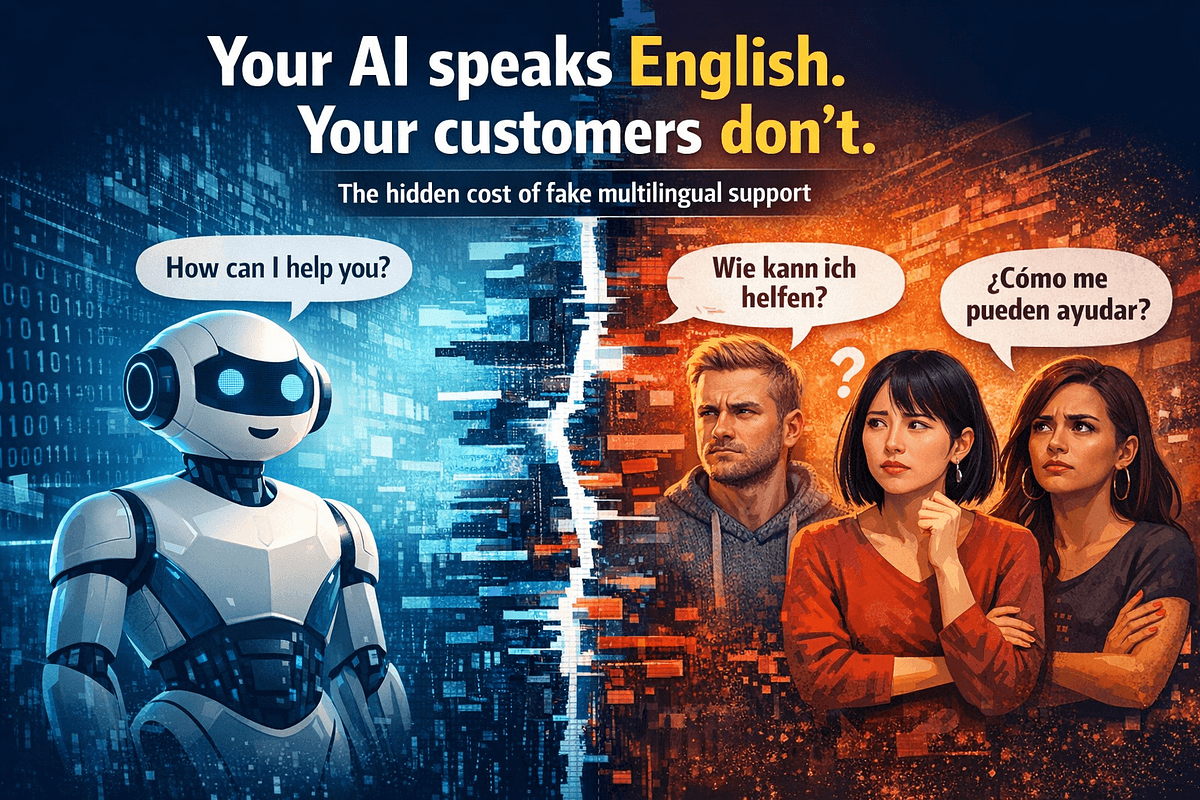
Why a simple translation API is a broken promise to your international customers, and how to build genuine multilingual support.
Key Takeaways
- An article argues that using a basic translation layer for multilingual AI customer support is a costly mistake.
- It fails to convey cultural context and appropriate tone, leading to higher churn and lower satisfaction in non-English markets.
- The solution requires treating multilingual support as a core operational capability, not just a technical add-on.
The Translation Layer Trap

The standard playbook for global expansion is broken. A founder launches in Germany with a strong product, identical to the US offering, yet sees churn rates double within months. The culprit? Customer support. German customers wrote in German, but the AI responded in English or in stilted, textbook German. The silent message was clear: "You are an afterthought."
This scenario, detailed in a recent analysis, highlights a pervasive but often ignored problem: the "translation layer trap." Most businesses handle multilingual support by plugging a translation API into their existing English system. The customer's query is translated to English, processed by an AI trained on English data, and the response is translated back. It sounds efficient, but it consistently fails.
The failure isn't in word-for-word accuracy—modern translation tools are excellent. It's in everything translation cannot touch: tone, register, cultural context, and the unspoken meaning behind words. A French customer complaining structures their grievance differently than an American. An AI trained on English patterns reads the translated text and generates a response that feels technically correct but profoundly foreign. The customer always notices.
What “Feeling Foreign” Actually Costs
This is not a soft, qualitative concern; it has hard, quantitative impact. Research consistently shows that customers receiving support in their native language resolve issues faster, report higher satisfaction, and churn at significantly lower rates. The satisfaction gap between native-language and translated support can be larger than the gap between fast and slow support. Customers will wait longer for genuine understanding over a quick, tone-deaf reply.
For businesses, this creates a hidden performance drain. English-market metrics look healthy, while international metrics lag. Teams waste months tweaking pricing, onboarding, and marketing, while the answer sits in the support queue: the experience itself is signaling a lack of care.
Why This Problem is Harder Than It Looks—and Easier Than You Think
Genuine multilingual support is not just a technology problem. It's a confluence of linguistics, cultural competence, and operational design. You cannot solve it with better translation software or by training a single model on data from forty countries.
Successful companies treat it as a distinct capability. They separate language from culture. Speaking Spanish is table stakes; understanding the nuanced differences in how a customer from Mexico versus Spain communicates frustration is the real goal. A translation layer handles neither.
They also rethink coverage. The objective isn't a human agent for every language—an impossible staffing challenge—but the right human for the right conversation, enabled by AI infrastructure. AI can triage tickets by language, route them, surface context, and handle straightforward transactional requests in any properly trained language. What AI cannot do is bring genuine cultural fluency to a complex, emotionally charged interaction. That still requires a person. The effective model uses AI to drastically reduce ticket volume, making it economically viable to deploy culturally competent agents for the interactions that truly matter.
The Markets Where This Matters Most
Sensitivity to language quality varies by market, and missteps are costly:
- Japan: Demands extreme specificity in formality and indirectness. Western AI responses often seem disrespectfully casual.
- Germany/DACH: Values directness and precision. Vague, apologetic AI responses are read as evasive.
- Spanish-Speaking Regions: Treating Latin America or Spain as a monolithic market is a critical error. Vocabulary, conventions, and tone expectations differ drastically.
- Southeast Asia (Indonesia, Vietnam, Thailand): As middle-class growth accelerates, the assumption that English support suffices is increasingly wrong. Expectations for local-language support are high.
In these markets, a genuine local-language capability provides a significant, measurable competitive advantage that compounds over time.
How to Actually Build This Without a Massive Budget
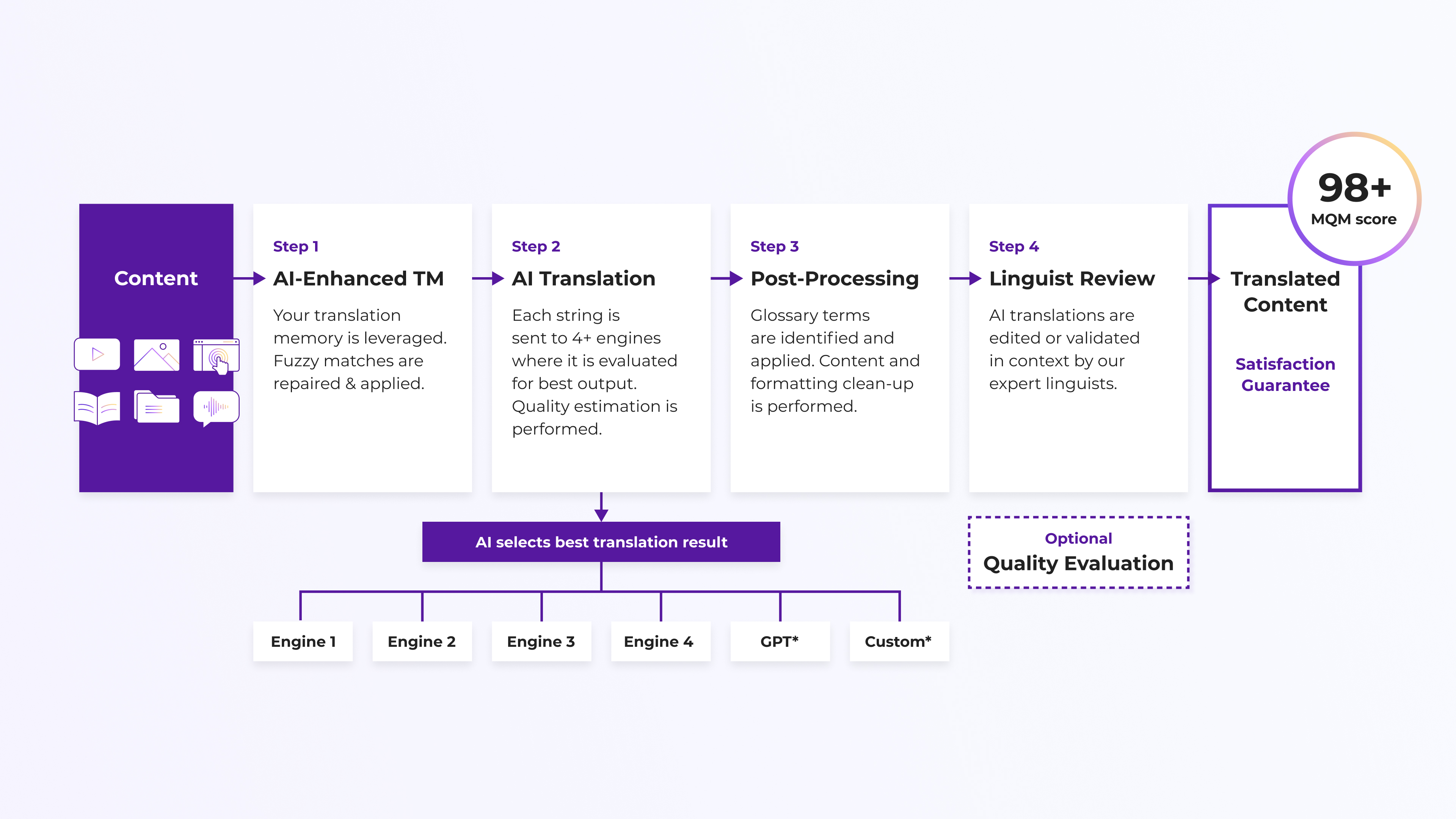
The path forward is deliberate, not despairing. Start by auditing your actual language distribution. Analyze support tickets from the last six months. Most businesses find volume concentrated in two or three non-English languages, not spread thinly across dozens. This concentration dictates priority.
For your primary languages (e.g., Spanish if it's 60% of non-English volume), define "proper" support. This means:
- Genuinely Fluent Agents: Not just conversational, but capable of nuanced communication.
- Cultural Context Training: Educating teams on communication norms and expectations.
- Properly Trained AI Systems: Models fine-tuned on real customer service data in the target language, not just a translation layer atop an English model.
For secondary languages, a robust translation layer combined with clear signposting (e.g., "This response is automatically translated") and a seamless escalation path to a human can be a viable interim step. The key is intentionality and a clear roadmap from translation to true capability.
Business Impact & Implementation Approach
The business impact is clear: reduced churn, higher customer lifetime value (LTV), and stronger brand equity in key growth markets. The cost of inaction is a persistent, hidden tax on international expansion efforts.
Implementation requires a phased, hybrid approach:
- Assessment & Prioritization: Use data to identify language hotspots and associated churn/CSAT gaps.
- Model Strategy: For priority languages, invest in fine-tuning or training separate LLM instances on high-quality, localized customer interaction data. This aligns with broader research trends on model specialization, such as recent work from MIT and Stanford on "model harnesses" that optimize system performance for specific tasks.
- Human-in-the-Loop Design: Architect workflows where AI handles classification, routing, and simple queries, while complex or sensitive issues are elevated to specialized agents.
- Continuous Feedback: Implement mechanisms to score response quality not just on resolution, but on cultural and tonal appropriateness.
Governance & Risk Assessment
The risks are primarily brand and operational:
- Brand Damage: Inconsistent, tone-deaf automated communication can alienate entire customer segments.
- Compliance & Misunderstanding: In regulated contexts or during crises, translation errors could lead to significant liability.
- Data Requirements: Building competent models requires access to large, high-quality datasets of customer interactions in target languages, which may raise privacy considerations.
The maturity of pure translation technology is high, but the maturity of culturally competent, multilingual AI support systems is low to medium. It is an emerging capability that requires careful investment and oversight.
gentic.news Analysis
This analysis cuts to the core of a practical, high-stakes AI implementation gap for global retailers. For luxury and retail houses like LVMH, Kering, or Richemont, where customer experience is the product, the cost of a "foreign-feeling" AI interaction is existential. It contradicts the promise of personalized, exclusive service.
The call for AI systems trained on localized data, rather than relying on translation layers, echoes a broader shift in AI research toward specialization and robust evaluation. This follows MIT's recent pattern of investigating the systemic factors that determine AI performance, such as their April 7th paper with Stanford on how "model harnesses"—the surrounding system code—can create a 6x performance gap. The multilingual support challenge is essentially a real-world case study needing a specialized "harness" of cultural and linguistic context.
Furthermore, the proposed solution—using AI to triage and augment, not replace, culturally fluent human agents—aligns with the pragmatic, hybrid agent architecture we see emerging elsewhere, like in the recently covered Diana AI Agent Platform. The key takeaway for AI leaders in retail is that global CX cannot be an afterthought bolted onto an English-centric AI stack. It must be a first-principles design constraint, requiring investment in localized data, specialized models, and human expertise. The brands that solve this will not just avoid churn; they will build deeper, more valuable relationships in the world's most important luxury growth markets.