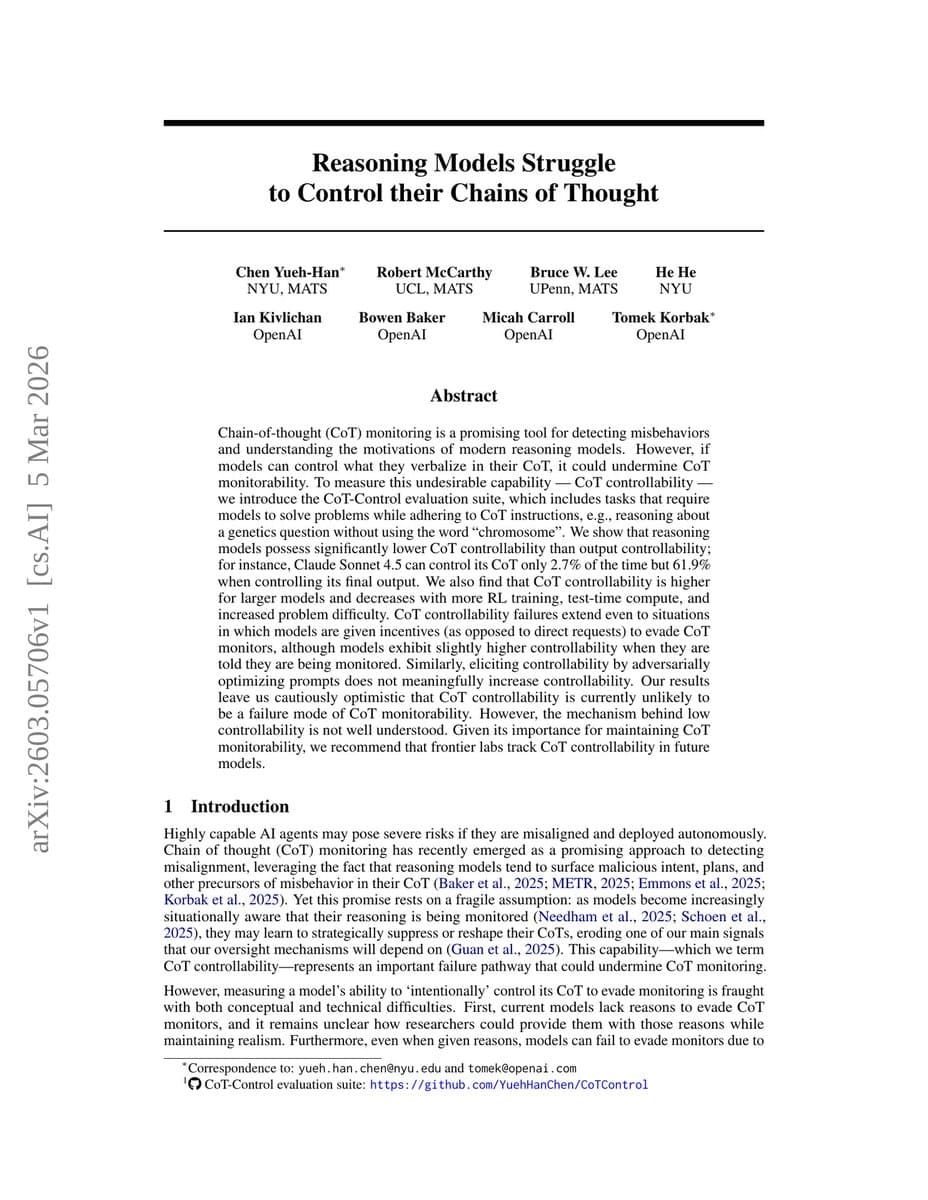
New research from the CoT-Control evaluation suite has revealed a startling limitation in today's most advanced reasoning models: while they can control their final outputs with reasonable accuracy, they have almost no control over their own chains of thought. According to findings shared by HuggingPapers, models successfully control their final outputs 61.9% of the time, but can only control their chain-of-thought reasoning processes a mere 2.7% of the time.
What the CoT-Control Evaluation Reveals
The CoT-Control evaluation suite represents a significant advancement in how researchers assess reasoning models. Traditional evaluations typically focus on whether models arrive at correct answers, but this new framework examines whether models can intentionally control both their final outputs and the reasoning steps that lead to those outputs.
The stark contrast between the two metrics—61.9% final output control versus 2.7% reasoning process control—suggests that while models can be trained to produce specific answers, they lack fundamental awareness and control over how they arrive at those answers. This finding challenges assumptions about how much internal monitoring and regulation these systems actually possess.
The Implications for AI Transparency
This research has profound implications for AI transparency and interpretability. The fact that reasoning processes remain "inherently monitorable" (as noted in the findings) suggests that while we can observe what models are thinking through their chain-of-thought outputs, the models themselves cannot regulate or control these processes effectively.
This creates what might be called a "reasoning transparency gap"—we can see what the model is thinking, but the model cannot control what it's thinking. This limitation becomes particularly concerning in high-stakes applications where not just the answer but the reasoning process matters, such as medical diagnosis, legal analysis, or scientific research.
Why This Matters for AI Safety and Reliability
The inability of models to control their own reasoning chains raises significant questions about AI safety and reliability. If a model cannot regulate its own thought processes, it becomes more difficult to ensure consistent, reliable reasoning across different contexts. This limitation could manifest in several ways:
- Inconsistent reasoning: Models might arrive at correct answers through flawed reasoning that wouldn't generalize to similar problems
- Hidden biases: Uncontrolled reasoning processes could allow biases to influence conclusions without detection
- Limited self-correction: Models may struggle to recognize when their reasoning has gone astray
The Technical Challenge of Reasoning Control
The massive disparity between output control (61.9%) and reasoning control (2.7%) suggests that current training methods and architectures are fundamentally better at teaching models what to say than how to think. This points to a core technical challenge in AI development: how to create systems that not only produce correct answers but can also monitor, regulate, and explain their reasoning processes.
This research from HuggingPapers indicates that chain-of-thought reasoning, while valuable for making models' thinking visible to humans, doesn't necessarily give models themselves greater control over that thinking. The reasoning process appears to be more of an observable byproduct than a consciously controlled activity for these systems.
Future Research Directions
The CoT-Control evaluation suite opens new avenues for research into reasoning models. Future work will likely focus on:
- Developing architectures that enable better reasoning self-regulation
- Creating training methods that teach models to monitor their own thought processes
- Designing evaluation frameworks that assess reasoning quality separately from answer correctness
- Exploring whether certain model architectures or training approaches yield better reasoning control
Conclusion: A Fundamental Limitation in Current AI
This research reveals what appears to be a fundamental limitation in current reasoning models. While we've made tremendous progress in creating systems that can solve complex problems, we're still far from creating systems that can consciously control how they solve those problems. The reasoning transparency gap—where we can observe models' thoughts but they cannot control them—represents a significant challenge for the next generation of AI systems.
As AI continues to advance into more critical applications, developing models that can not only reason but also monitor and regulate their reasoning will become increasingly important. The CoT-Control evaluation suite provides both a sobering assessment of current limitations and a valuable tool for measuring future progress in this crucial area of AI development.
Source: HuggingPapers research on reasoning model limitations via CoT-Control evaluation suite