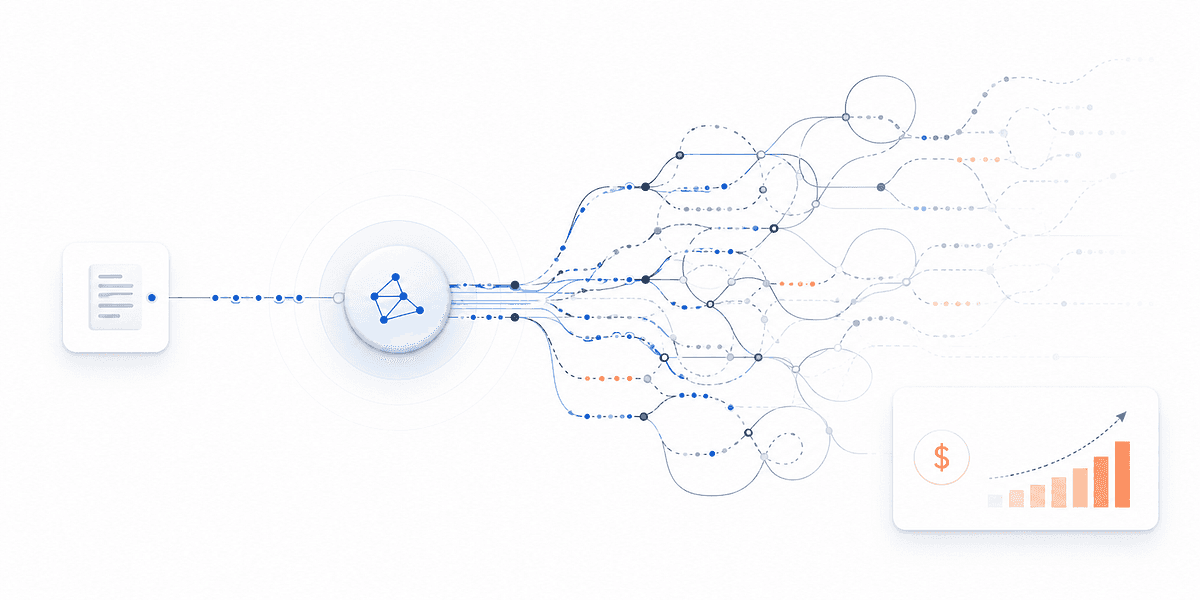
OpenAI's o-series and GPT-5.x models charge for thinking tokens at output rates, not input rates, silently inflating inference costs 5x–10x. Agentic pipelines amplify this problem through retries that regenerate hundreds of thinking tokens per step.
Key facts
- Thinking tokens charged at output rates, 5x–10x cost.
- Agentic retries regenerate hundreds of thinking tokens per step.
- Google threatens 80% price cut on Gemini reasoning models.
- Startup may pay $3k–$5k/month hidden thinking token costs.
- Google commits $11B/year to SpaceX compute.
A single chain-of-thought generation can silently cost 5x–10x more than the user expects. Most pipelines treat thinking tokens as free, but According to the source, OpenAI's o-series and GPT-5.x models charge for these tokens at output rates, not input rates. Claude Opus/Sonnet 4.x and Gemini 3/2.5 reasoning models follow the same pricing model, making reasoning expensive at scale.
Key Takeaways
- Thinking tokens from OpenAI, Anthropic, and Google models are priced at output rates, silently inflating costs 5x–10x in agentic pipelines.
- Google's 80% price cut threat exposes a structural asymmetry between startups and tech giants.
The Hidden Ops Problem
Agentic pipelines amplify this problem because they often retry failed steps, each retry regenerating hundreds of thinking tokens. A typical agentic loop—perceive, reason, act, observe—can incur 3–5 retries per task, each costing $0.10–$0.50 in hidden thinking tokens alone. [According to the source], a production pipeline handling 10,000 tasks per day could see $5,000–$25,000 in unaccounted costs.
Google's Price Cut Threat
Google is threatening an 80% price cut on its Gemini reasoning models, which could force the entire market to rethink token pricing. [According to pandaily], this reveals the structural asymmetry between AI startups and tech giants: startups cannot subsidize thinking tokens the way Google can with its $11B/year compute commitment to SpaceX. The price war may compress margins for OpenAI and Anthropic, which rely on token revenue to fund model development.
The Structural Asymmetry
For startups building on these APIs, thinking tokens represent a hidden tax that scales with complexity. A startup spending $10,000/month on API calls might be paying $3,000–$5,000 for thinking tokens alone—costs that don't appear in standard billing dashboards. Google's ability to slash prices by 80% means it can afford to treat thinking tokens as a loss leader, but smaller players cannot. The asymmetry between AI startups and tech giants means smaller players cannot absorb these costs, potentially consolidating the agentic AI market around a few large providers.
What to watch
Watch for Google's official API pricing announcement on Gemini reasoning models in Q3 2026, and whether OpenAI responds with a tiered pricing model that differentiates thinking tokens from output tokens.
Source: pub.towardsai.net
[Updated 22 Jun via towards_ai]
Microsoft Copilot Cowork is shifting to usage-based pricing as costs surge, and turning to DeepSeek V4 as a cost-effective open-source alternative [per pandaily]. This move underscores the structural asymmetry in the AI market: while Google can threaten 80% price cuts on Gemini reasoning models, Microsoft is forced to adapt its pricing model and seek cheaper alternatives like DeepSeek V4 to manage inference costs.