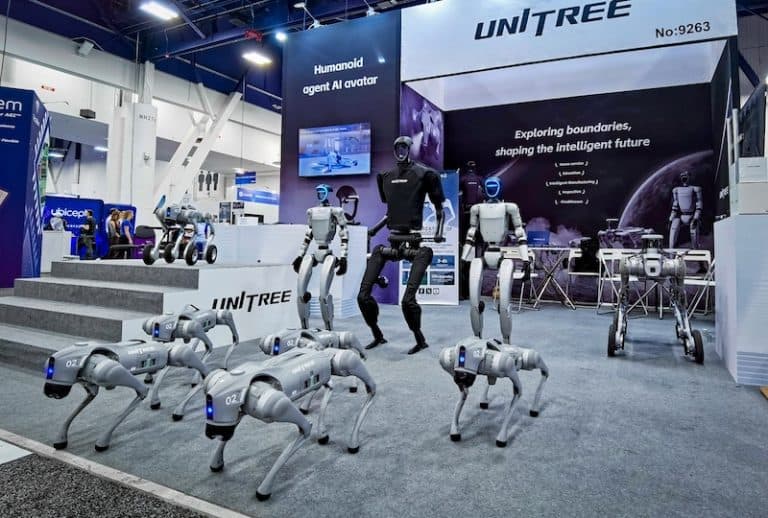
@SemiAnalysis_ claims China's Unitree will dominate global robotics due to the fastest iteration cycle in next-gen humanoid development. The analysis, posted March 12, 2026, argues iteration speed will accelerate further.
Key facts
- Unitree released H1 humanoid in 2023.
- Unitree released H1-2 in late 2024.
- Unitree released G1 general-purpose robot in early 2025.
- @SemiAnalysis_ published claim on March 12, 2026.
- No iteration time or funding figures disclosed.
@SemiAnalysis_, a respected semiconductor and AI research firm, published a take on March 12, 2026, stating that China's Unitree will dominate global robotics According to @SemiAnalysis_. The core thesis: Unitree has the fastest iteration cycle in next-generation humanoid robotics, and this cycle is set to see unprecedented acceleration.
The post does not disclose specific iteration times, funding rounds, or unit shipment numbers. Instead, the argument rests on a structural observation: Chinese robotics firms, led by Unitree, are iterating on hardware and software faster than US counterparts like Boston Dynamics or Tesla Optimus. @SemiAnalysis_ has previously highlighted China's advantages in supply chain density and engineering talent pools for electromechanical systems.
Unitree's public track record supports the speed claim. The company released the H1 humanoid in 2023, the H1-2 in late 2024, and the G1 general-purpose robot in early 2025 — a cadence unmatched by any Western humanoid startup. However, @SemiAnalysis_ provides no revenue, deployment, or benchmark data to substantiate "dominance." The claim is forward-looking, not current market reality.
The Iteration Advantage
The unique take here is not that Unitree is fast — it's that iteration speed itself, not capital or compute, is the decisive variable in humanoid robotics. @SemiAnalysis_ implies that the winner in this space will be the company that can compress the design-build-test cycle most aggressively. Unitree, with its in-house motor and actuator manufacturing and proximity to Shenzhen's supply chain, may hold that edge.
No US robotics company has publicly matched Unitree's release cadence. Boston Dynamics has not announced a new humanoid since Atlas transitioned to electric in 2024. Tesla's Optimus remains in prototype testing with no commercial ship date. If @SemiAnalysis_ is correct, the gap could widen.
Key Takeaways
- @SemiAnalysis_ claims China's Unitree will dominate global robotics due to fastest iteration cycle.
- No data on iteration time or funding disclosed.
What to watch

Watch for Unitree's next generation humanoid reveal — likely by late 2026 given the 12-18 month cadence — and whether Boston Dynamics or Tesla announces a competing ship date. Also track Unitree's commercial deployment count, which the company has not disclosed.