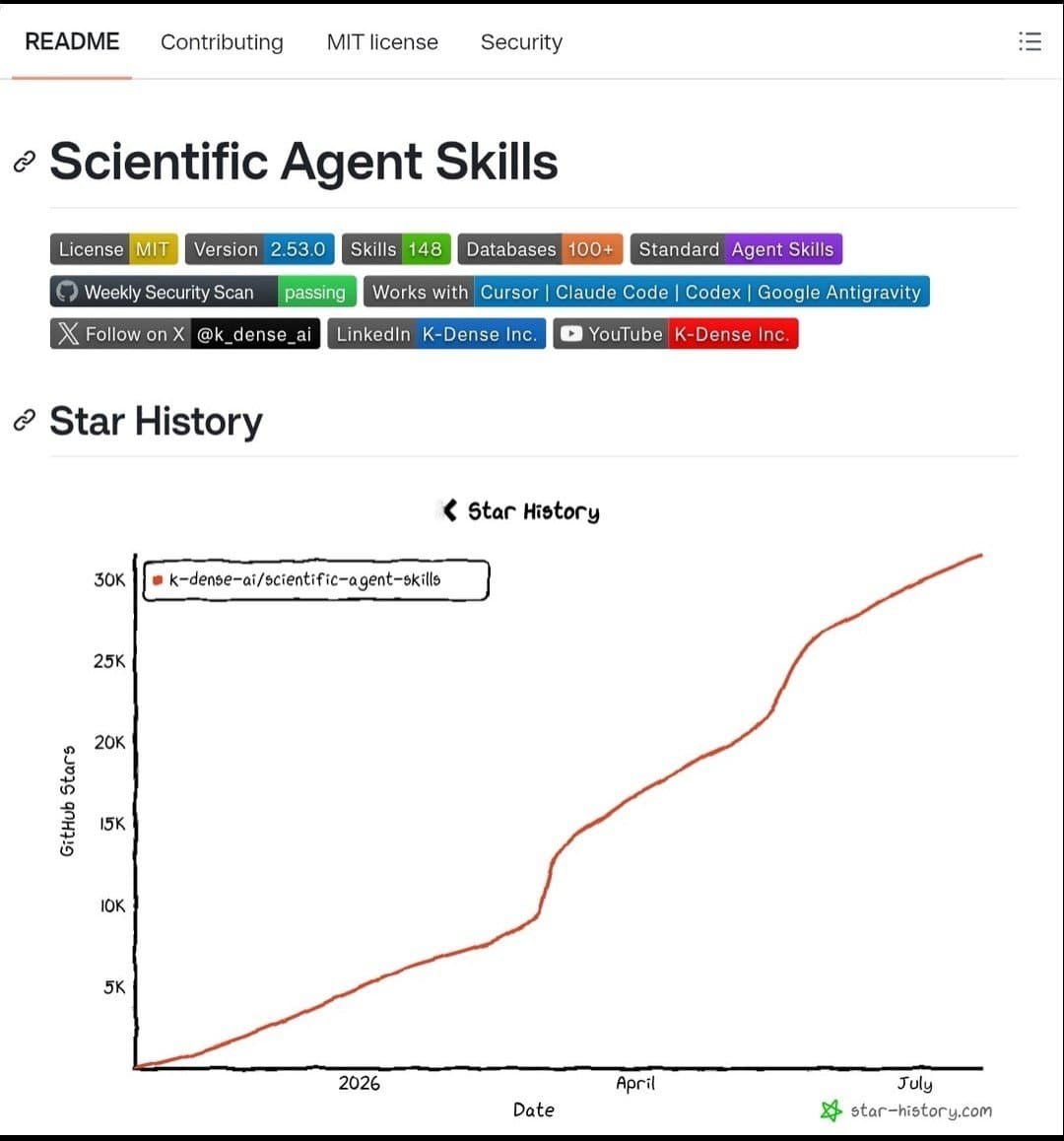
k-dense released scientific-agent-skills, an open-source library of 150 ready-to-use skills for AI agents. The library targets scientific workflows in biology, chemistry, medicine, and drug discovery.
Key facts
- 150 ready-to-use skills for scientific agent workflows
- 100+ scientific databases via unified lookup skill
- 70+ optimized Python package skills included
- Works with Claude Code, Cursor, Codex, Antigravity
- Install with: npx skills add K-Dense-AI/scientific-agent-skills
k-dense released scientific-agent-skills, an open-source library of 150 ready-to-use skills for AI agents, according to a post by @_vmlops on X. The library covers biology, chemistry, medicine, and drug discovery workflows, with a unified lookup skill for 100+ scientific databases including PubChem, ChEMBL, UniProt, and COSMIC.
What the library includes
The library bundles 70+ optimized Python package skills for RDKit, Scanpy, PyTorch Lightning, scikit-learn, and OpenMM. Workflows range from RNA-seq pipelines to molecular docking to clinical trial analysis, all pre-documented for agent consumption.
The library works with Claude Code, Cursor, Codex, Antigravity, and any host supporting the open Agent Skills standard. Installation requires a single command: npx skills add K-Dense-AI/scientific-agent-skills.
Why this matters
The release lowers the barrier for AI agents to perform specialized scientific tasks without custom integration work. Prior approaches required manual API wrappers or domain-specific fine-tuning. By packaging 150 skills behind a unified lookup, k-dense effectively creates a plug-and-play scientific toolkit for coding agents — a category that has seen rapid adoption in 2026 as enterprises push agents beyond chat and code generation into domain-specific analysis.
The open Agent Skills standard means the library is not locked to any single model provider. This contrasts with vendor-specific toolkits like OpenAI's Code Interpreter or Anthropic's tool use — k-dense bets on interoperability across agents rather than integration depth with one platform.
Limitations
The source does not disclose adoption numbers, performance benchmarks, or whether workflows have been validated against ground-truth scientific outputs. The library's utility will depend on how well the pre-documented workflows handle edge cases in real research settings, where data quality and reproducibility are paramount.
What to watch
Watch for validation benchmarks comparing scientific-agent-skills outputs against published results on standard datasets like ADMET or RNA-seq benchmarks. Also track whether major agent frameworks (Claude Code, Cursor) officially recommend the library in their documentation.