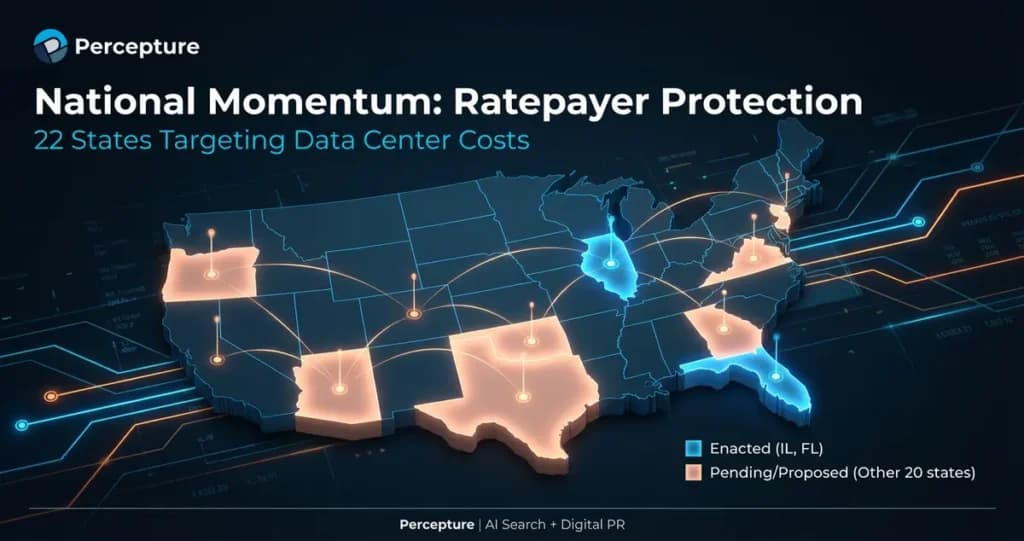
US Congress is advancing a Ratepayer Protection Act that would make AI data center builders pay for grid infrastructure costs. The bill targets a structural imbalance where residential ratepayers have historically subsidized grid upgrades for large industrial loads.
Key facts
- Bill targets AI data centers, not ordinary customers
- Projected 160% increase in data center electricity demand by 2030
- AI data centers could consume 9% of US electricity by 2030
- Bill would require direct payments for grid upgrades
- Legislation has not yet been formally introduced
The US Congress is moving a Ratepayer Protection Act that would shift the cost burden of new grid infrastructure from residential electricity customers to AI data center developers. According to @rohanpaul_ai, the legislation would require AI data center builders, not ordinary electricity customers, to bear the costs of new grid infrastructure needed to serve their facilities.
The bill targets a structural imbalance where residential and small commercial ratepayers have historically subsidized grid upgrades for large industrial loads through utility rate-basing mechanisms. With AI data centers projected to consume up to 9% of US electricity by 2030 — up from roughly 4% today — the cost of transmission and distribution upgrades could run into tens of billions of dollars. The bill would force hyperscalers to internalize those costs through dedicated tariffs or direct payments for transmission and distribution upgrades.
The Ratepayer Protection Act represents a direct legislative response to the projected 160% increase in data center electricity demand by 2030, driven largely by AI training and inference workloads. The bill's effective date and specific cost-allocation mechanism remain unclear from the initial announcement, and the legislation has not yet been formally introduced or assigned a bill number. The bill would likely face opposition from major cloud providers — Amazon Web Services, Microsoft Azure, and Google Cloud — which have already secured long-term power purchase agreements for data center capacity in Virginia, Ohio, and other high-demand regions.
If enacted, the act would represent a significant policy shift from the current model where utilities recover grid upgrade costs through broad rate bases. The bill's sponsors have not yet been named, and its path through committee remains uncertain. The legislation would need to pass both chambers and be signed by the President to become law.
What to watch
Watch for the bill's formal introduction and bill number, likely within the next 90 days. The key metric will be the cost-allocation threshold — whether the bill sets a specific dollar amount or percentage of grid upgrade costs that data center developers must cover. Also watch for opposition statements from AWS, Microsoft, and Google.
[Updated 27 Jun via gn_ai_data_center]
The bill is being championed by Senator Ed Markey and Representative Jared Huffman, who argue that AI companies should not offload infrastructure costs onto everyday Americans [per CNBC]. The legislation would require data center developers to pay for 100% of grid upgrade costs, with no cost-sharing with residential ratepayers. Markey stated, 'Big Tech shouldn't get a free ride on the backs of working families.' The bill's formal title is the 'Ratepayer Protection Act of 2025,' and it is expected to be introduced in the coming weeks.