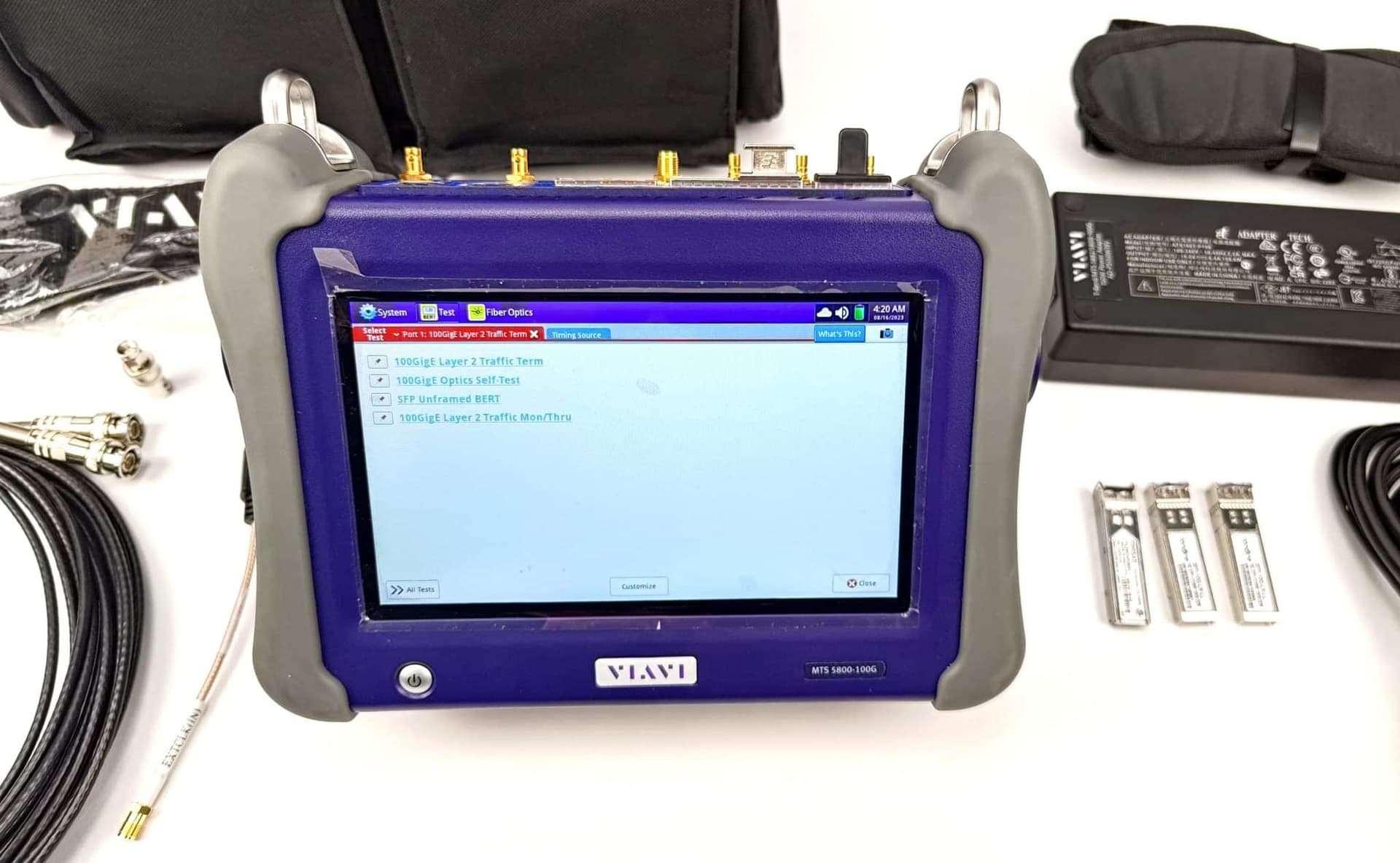
VIAVI Solutions launched the world's first validation solution for Ultra Ethernet transport in AI data centers. The tool tests 800GE and 1.6TE links to ensure low-latency, lossless performance for distributed AI training workloads.
Key facts
- VIAVI launched world's first Ultra Ethernet validation solution.
- Supports 800GE and 1.6TE link speeds.
- Targets low-latency, lossless AI transport.
- Ultra Ethernet aims to challenge InfiniBand's ~80% AI cluster share.
- No pricing or early customers disclosed by VIAVI.
VIAVI Solutions today announced the industry's first validation solution for Ultra Ethernet transport, a networking standard designed to challenge InfiniBand's dominance in AI data centers. According to the source, the solution supports link speeds of 800GE and 1.6TE, specifically targeting the low-latency, lossless transport required for large-scale AI model training.
The move comes as Ultra Ethernet Consortium members — including Google, Meta, Microsoft, and Cisco — push to standardize Ethernet-based networking for AI clusters. InfiniBand currently holds an estimated 80% share of the AI data center interconnect market, per industry estimates cited in prior reporting. VIAVI's validation tool is a critical enabler: without reliable testing gear, operators cannot certify that Ultra Ethernet links meet the tight latency and zero-packet-loss requirements of distributed training jobs spanning thousands of GPUs.
Key Takeaways
- VIAVI launched the first Ultra Ethernet validation tool for AI data centers, supporting 800GE/1.6TE links.
- The tool enables certification of low-latency, lossless transport critical for distributed AI training.
Why validation matters for AI infrastructure

AI training clusters rely on deterministic network behavior. A single dropped packet in a collective communication operation (e.g., all-reduce) can stall an entire training run, wasting thousands of GPU-hours. VIAVI's solution claims to emulate worst-case traffic patterns and verify that Ultra Ethernet links maintain microsecond-level latency under load. The company did not disclose pricing or early customer names, but the tool is available now for data center operators and equipment vendors.
The competitive landscape
Ultra Ethernet's success hinges on ecosystem maturity. InfiniBand vendor NVIDIA has a decade-plus head start in validation tooling, with its own ConnectX adapters and Cumulus switches tightly integrated. VIAVI's announcement is a signal that the Ultra Ethernet stack is advancing beyond specification into deployable hardware. The next milestone will be interoperability testing across multiple vendors' switches and NICs — a task VIAVI's solution is designed to support.
Google, which has committed $11B/year to SpaceX compute and booked Intel to package 3M+ TPUs in 2028, has a strong incentive to see Ultra Ethernet succeed as an alternative to NVIDIA's InfiniBand. The validation tool gives operators a way to certify network performance before committing to large-scale deployments.
What to watch
Watch for Ultra Ethernet Consortium interoperability demos at the next major networking conference (e.g., OFC 2027 or SIGCOMM 2027) and whether major cloud providers like Google or Meta publicly commit to Ultra Ethernet for their next-gen AI clusters.
Source: news.google.com
[Updated 23 Jun via hpcwire]
The GPU-free design of VIAVI's solution, announced from Chandler, Ariz. on June 23, 2026, emulates real-world AI workload traffic at scale without requiring expensive GPU hardware in the test environment [per HPCwire]. This approach could significantly lower the cost and complexity of network validation for hyperscalers and cloud providers, potentially accelerating Ultra Ethernet adoption by making pre-deployment testing more accessible.