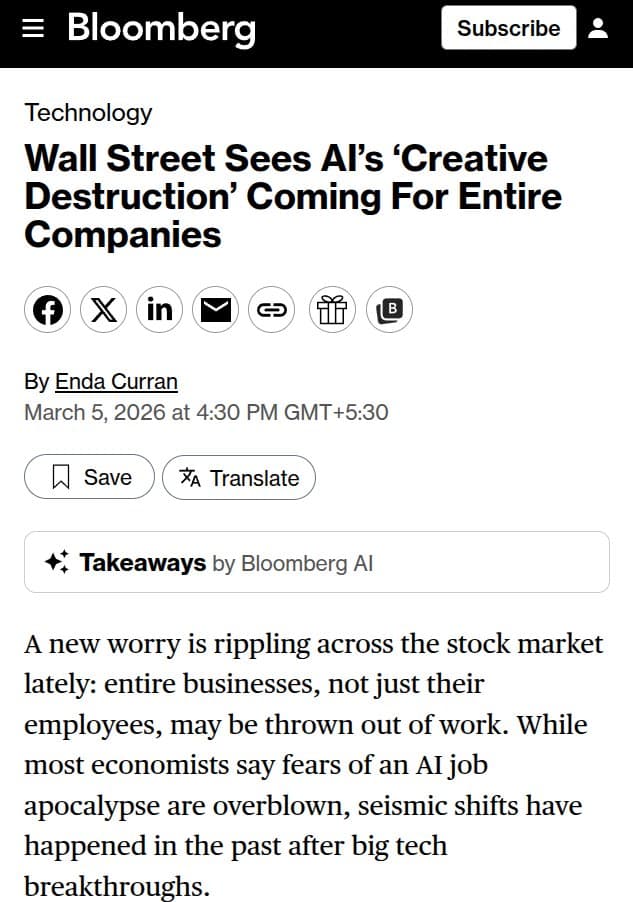
A seismic shift is occurring in how Wall Street evaluates companies, driven not by earnings reports or market share, but by artificial intelligence's capacity to render entire business models obsolete. According to Bloomberg reporting, investors have developed a new fear: that AI will make whole business models useless and put entire firms out of work, creating a fundamental revaluation of what constitutes a competitive advantage in the modern economy.
The AI Stock Trade: Winners and Losers in Real Time
The market is already responding to this new reality with remarkable speed. When financial services firm Block announced it would cut its workforce by nearly 50% to implement AI systems, its stock price jumped by 15%—a clear market endorsement of efficiency through automation. Conversely, IBM experienced a stock decline when Claude Code demonstrated capabilities that could replace large teams of human consultants, signaling investor concern about companies whose core services face AI displacement.
This pattern represents more than typical market volatility. It reveals a fundamental reassessment of how investors value human expertise versus algorithmic efficiency. The market is essentially placing bets on which companies can successfully transition to AI-enhanced operations and which will be disrupted by the technology.
Creative Destruction at Hyper-Speed
Economists have long described technological progress through Joseph Schumpeter's concept of "creative destruction"—where new innovations destroy old economic structures while creating new ones. What's different today is the velocity of this process. As the Bloomberg analysis notes, "This shift is a classic example of creative destruction, where the economy grows by letting new tech replace outdated ways of working."
The acceleration presents unprecedented challenges. Traditional business cycles allowed for gradual adaptation, but AI's capabilities are advancing at a pace that may outstrip many companies' ability to adapt. The report warns that "this transition happens so fast that it leaves many companies with huge debts and no way to compete," creating potential systemic risks as established players struggle to pivot.
Beyond Technology: The Human Expertise Valuation Crisis
Perhaps the most profound implication is how AI is forcing a reevaluation of human expertise itself. The Bloomberg analysis emphasizes that "this is a total rewrite of how we value human expertise rather than just a basic tech upgrade." Skills and knowledge that took decades to develop can now be replicated or surpassed by AI systems in specific domains, particularly in knowledge work, consulting, and analytical fields.
This creates a paradox: companies that have invested heavily in human capital may find those investments devalued, while companies that can effectively integrate AI with specialized human oversight may achieve unprecedented productivity gains. The market is struggling to develop new metrics to assess which human-AI combinations will prove most valuable.
Sector-Specific Vulnerabilities and Opportunities
The impact varies dramatically across industries. Knowledge-intensive sectors like consulting, legal services, financial analysis, and software development face immediate pressure as AI demonstrates capabilities in these domains. Companies built around proprietary methodologies or specialized human expertise are particularly vulnerable if those methodologies can be encoded in AI systems.
Conversely, companies that can leverage AI to enhance rather than replace their core offerings may see significant valuation boosts. The key distinction appears to be between companies using AI to augment their existing business models versus those whose entire value proposition faces AI competition.
The Investor's Dilemma: New Metrics for a New Era
Traditional valuation metrics—price-to-earnings ratios, revenue growth, market share—may become less relevant in an AI-driven economy. Investors must now assess:
- AI integration strategy: How effectively is a company implementing AI throughout its operations?
- Disruption vulnerability: How susceptible is the company's core business to AI competition?
- Adaptation capacity: Can the company retrain its workforce and pivot its business model?
- Data advantage: Does the company possess proprietary data that can enhance its AI systems?
These new considerations are creating a bifurcated market where companies are valued not just on current performance but on their perceived AI trajectory.
Regulatory and Ethical Implications
The rapid market response to AI workforce reductions raises significant questions about corporate responsibility and regulatory oversight. When markets reward companies for eliminating jobs through automation, what incentives remain for retraining and workforce transition programs? This dynamic could accelerate economic displacement without corresponding support systems, potentially exacerbating inequality.
Furthermore, the valuation shifts based on AI capabilities may create perverse incentives for companies to overstate their AI progress or implement automation prematurely, potentially destabilizing both companies and the broader economy.
Looking Ahead: The Next Phase of AI Integration
As AI capabilities continue to advance, this valuation dynamic will likely intensify. The Bloomberg report suggests investors are looking for "the next blockbusters"—companies that will either drive or successfully navigate the AI transformation. This search is creating new investment theses focused on AI infrastructure, integration specialists, and companies with defensible data moats.
The ultimate test will be whether markets can distinguish between genuine AI transformation and superficial adoption. Companies that successfully integrate AI to create new value propositions rather than simply cutting costs may emerge as the long-term winners in this reordered economic landscape.
Source: Bloomberg analysis of Wall Street's evolving approach to AI-driven company valuation, highlighting how investor fears about business model obsolescence are creating new market dynamics.