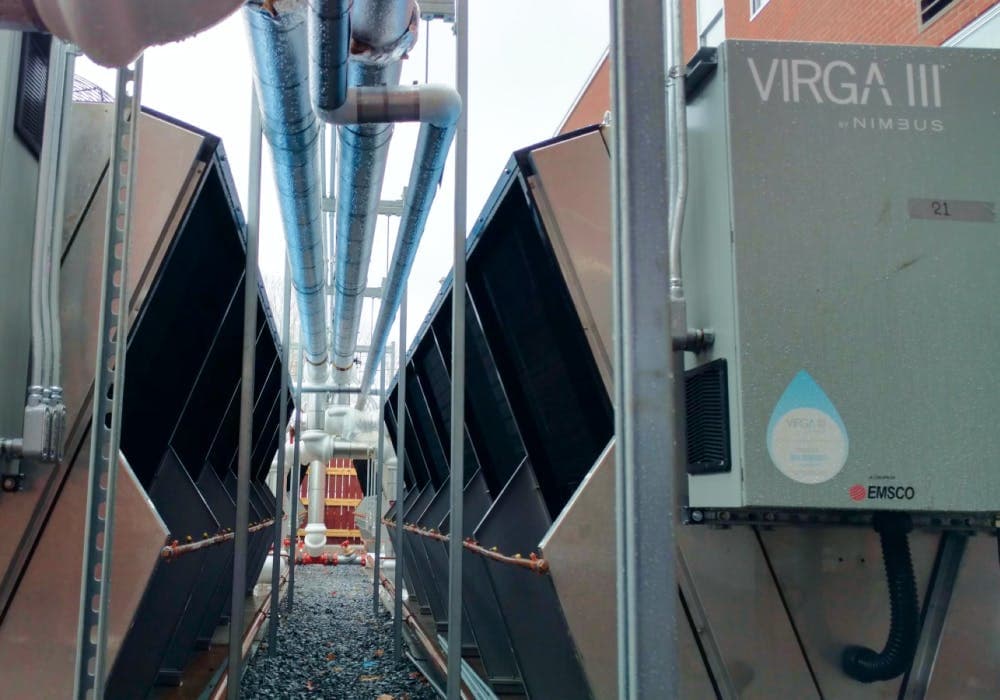
Water has joined power as a primary determinant for AI data center site selection, according to Emergence Water and Nimbus executives. The shift reflects AI facilities' unprecedented rack densities requiring liquid cooling and reliable long-term water availability.
Key facts
- Water is a top priority for community data center approval.
- AI rack densities demand liquid cooling and reliable water.
- Construction phases require significant early water sourcing.
- Atmospheric water generation reduces municipal water dependence.
- Future infrastructure integrates water, power, and intelligent controls.
Water is rapidly evolving beyond its traditional role as a sustainability metric and becoming one of the primary determinants of where AI campuses can be built, how they are cooled, and how efficiently they will operate over the coming decade, according to executives from Emergence Water and Nimbus Advanced Process Cooling Systems speaking on the Data Center Frontier podcast According to Data Center Frontier.
"From a community perspective, water is absolutely the number one priority about where and why a data center gets built," said Emergence Water Chief Product Officer Leif Percifield. "From the developer, it's pretty binary. They either have water available to them—or they don't."
The New Cooling Calculus
Traditional enterprise data centers viewed water primarily through sustainability reporting or Power Usage Effectiveness (PUE) discussions. AI facilities operating at unprecedented rack densities have fundamentally altered that equation. Liquid cooling, hybrid cooling architectures and increasingly sophisticated thermal management strategies all place new emphasis on reliable long-term water availability.
Communities are beginning to scrutinize water usage with the same intensity previously reserved for electrical demand, Percifield says, with those conversations increasingly determining whether projects proceed.
Construction and Long-term Planning
Construction phases demand significant water volumes, highlighting the importance of early water sourcing and logistics planning. Long-term water planning now considers future regional changes, regulatory shifts, and climate impacts, similar to power infrastructure planning. Innovative solutions like atmospheric water generation and adiabatic cooling are reducing dependence on municipal water supplies and improving sustainability.
The partnership between Emergence Water and Nimbus illustrates how the industry is beginning to rethink water as core infrastructure rather than a utility. Future AI infrastructure will integrate water, power, and intelligent controls into a unified, climate-aware system tailored to regional needs.
This development parallels recent trends in AI data center scaling. As Epoch AI found, AI data center scale doubles every 7 months, placing immense strain on all infrastructure resources. While power has dominated conference discussions—with utilities becoming strategic partners around natural gas generation, small modular reactors, and microgrids—water is quietly following the same trajectory.
Unique Take: Water as the Unspoken Gatekeeper
While hyperscalers and developers have publicly fixated on power procurement as the binding constraint for AI infrastructure, water availability is emerging as a more localized, harder-to-solve bottleneck. Power can be generated on-site via gas turbines or SMRs; water sourcing requires aquifer rights, municipal agreements, or capital-intensive atmospheric generation. The Emergence Water-Nimbus partnership signals that the industry is belatedly recognizing water as a structural constraint that could slow AI campus buildout more than power shortages in water-scarce regions like the American Southwest or parts of Spain and Chile.
Key Takeaways
- Water joins power as AI data center site selection constraint, per Emergence Water and Nimbus.
- Communities now scrutinize water use like electrical demand, affecting campus viability.
What to watch
Watch for hyperscaler water procurement announcements and regional water rights acquisitions in the American Southwest and Spain over the next 12 months, and whether water availability begins to cap AI campus buildout plans in water-stressed regions.
Source: datacenterfrontier.com
[Updated 03 Jul via gn_liquid_cooling]
The cooling market for AI data centers is now estimated at $1.2 trillion, drawing entrants far beyond traditional water technology firms. Samsung, LG, oil refiners, and shipbuilders are joining the fray, according to a report from finance.biggo.com [per finance.biggo.com]. This signals that water and thermal management have become as strategic as power in the AI infrastructure race.
[Updated 04 Jul via gn_ai_data_center]
The water-power nexus tightened further as Chevron signed a 20-year power deal with Microsoft for AI data centers [per Yahoo Finance]. This marks the first major oil major entry into AI infrastructure power supply, potentially unlocking stranded gas assets near water-scarce regions. The deal could accelerate development of combined water-and-power microgrids, where Chevron's operational expertise in water management for oil extraction may prove transferable to data center cooling.