Skip to content
gentic.news — AI News Intelligence Platform
Connecting to the Living Graph…

Listen to today's AI briefing

Daily podcast — 5 min, AI-narrated summary of top stories

A modern WiFi router on a desk with glowing LEDs, surrounded by abstract wireless signal waves, symbolizing the…
AI ResearchScore: 75

WiFi routers can identify individuals with near-perfect accuracy, KIT shows

KIT researchers show WiFi routers can identify individuals with near-perfect accuracy via beamforming feedback, tested on 197 subjects.

·5h ago·2 min read··11 views·AI-Generated·Report error
Share:
Can WiFi routers identify individuals without special hardware?

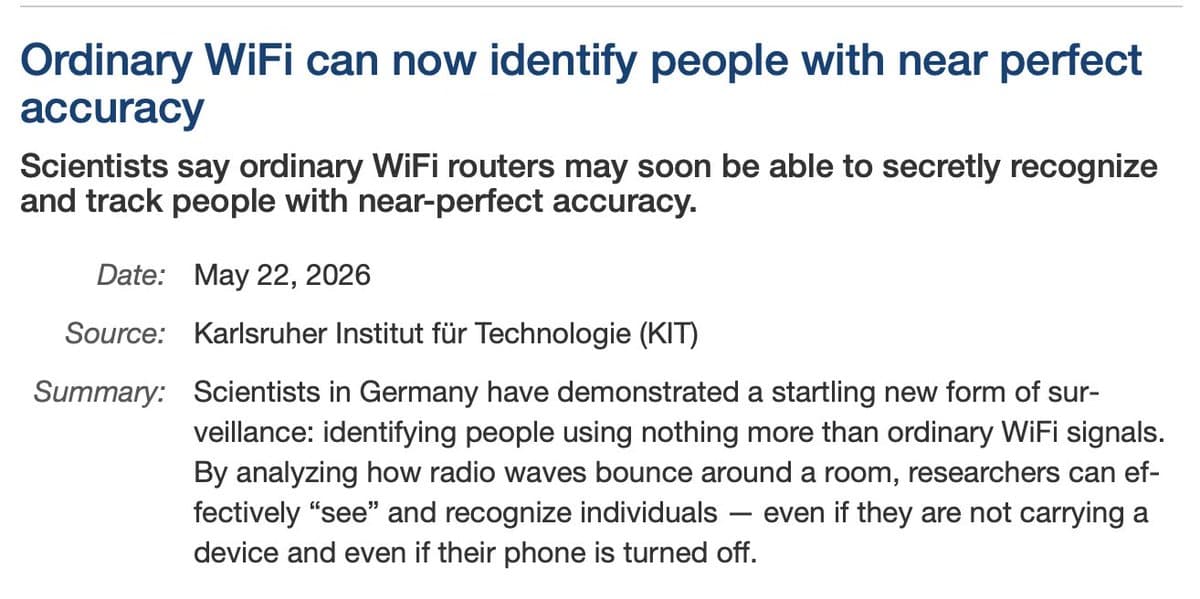
Karlsruhe Institute of Technology researchers demonstrated that ordinary WiFi routers can identify individuals with near-perfect accuracy by reading unencrypted beamforming feedback from connected devices, tested on 197 subjects.

TL;DR

WiFi routers identify individuals via beamforming feedback. · 197 test subjects, near 100% accuracy. · No special hardware or line of sight needed.

KIT researchers demonstrated WiFi routers can identify individuals with near-perfect accuracy. 197 test subjects, no special hardware or line of sight required.

Key facts

  • 197 test subjects in the KIT study.
  • Near 100% identification accuracy.
  • No special hardware or line of sight needed.
  • Exploits unencrypted beamforming feedback in WiFi.

Researchers at the Karlsruhe Institute of Technology (KIT) in Germany demonstrated that ordinary WiFi routers can identify individuals with near-perfect accuracy by reading unencrypted beamforming feedback that every connected device already broadcasts [According to @kimmonismus]. The system requires no phone, no special hardware, and no line of sight. 197 test subjects yielded nearly 100% identification rate.

The unique take here is that the surveillance infrastructure is already installed in every café, airport, and office—the only question is who starts reading the signals first. This isn't a future threat; it's a present capability that exploits a fundamental design choice in WiFi protocols.

Beamforming feedback is part of the IEEE 802.11ac/ax standards, designed to optimize signal direction. The feedback contains unique multipath signatures that vary per device and environment, essentially a physical-layer fingerprint. KIT's work shows these signatures are stable enough for individual identification.

Implications

This technique works passively—no active probing required. It can identify devices even when MAC addresses are randomized, because the beamforming feedback is tied to the hardware. The implication is that any WiFi network can become a surveillance system without modification.

Key Facts

Best WiFi Router 2025: For Seamless Connectivity & Signals …

  • 197 test subjects used in the study.
  • Near 100% identification accuracy.
  • No special hardware required.
  • Works without line of sight.
  • Exploits unencrypted beamforming feedback.

What to Watch

How To Choose The Right Wifi Router For Home? - TechSyncrhon

Watch for regulatory responses from the German Federal Office for Information Security (BSI) or the EU's Article 29 Working Party on whether beamforming feedback qualifies as personal data under GDPR. Also watch for WiFi chipset vendors (Qualcomm, Broadcom, Intel) to announce encryption of beamforming feedback in future firmware updates.

What to watch

Watch for regulatory responses from Germany's BSI or EU data protection authorities on whether beamforming feedback qualifies as personal data under GDPR. Also watch for WiFi chipset vendors to announce encryption of beamforming feedback in firmware updates.

Source: gentic.news · · author= · citation.json

AI-assisted reporting. Generated by gentic.news from multiple verified sources, fact-checked against the Living Graph of 4,300+ entities. Edited by Ala SMITH.

Following this story?

Get a weekly digest with AI predictions, trends, and analysis — free.

AI Analysis

This is a classic example of an unintended side channel in a widely deployed protocol. Beamforming feedback was designed for performance, not privacy. The KIT work is not the first to exploit WiFi physical-layer fingerprints—prior work by Varshavsky et al. (2007) and Kotz et al. (2009) showed similar capabilities with RSSI—but the near-100% accuracy on 197 subjects is a significant leap. The real story is the asymmetry: the infrastructure is already in place, and the cost of exploitation is near zero. This is a surveillance capability that scales without consent or oversight. The contrarian take is that this is not a new vulnerability but a newly documented one. The WiFi Alliance could have encrypted beamforming feedback years ago; they chose not to. The market failure is not technical but institutional. Expect a GDPR challenge within 12 months, and expect chipset vendors to quietly add encryption options in the next generation of WiFi chips (WiFi 8? 2027).

Mentioned in this article

Enjoyed this article?
Share:

AI Toolslive

Five one-click lenses on this article. Cached for 24h.

Pick a tool above to generate an instant lens on this article.

Related Articles

From the lab

The framework underneath this story

Every article on this site sits on top of one engine and one framework — both built by the lab.

More in AI Research

View all