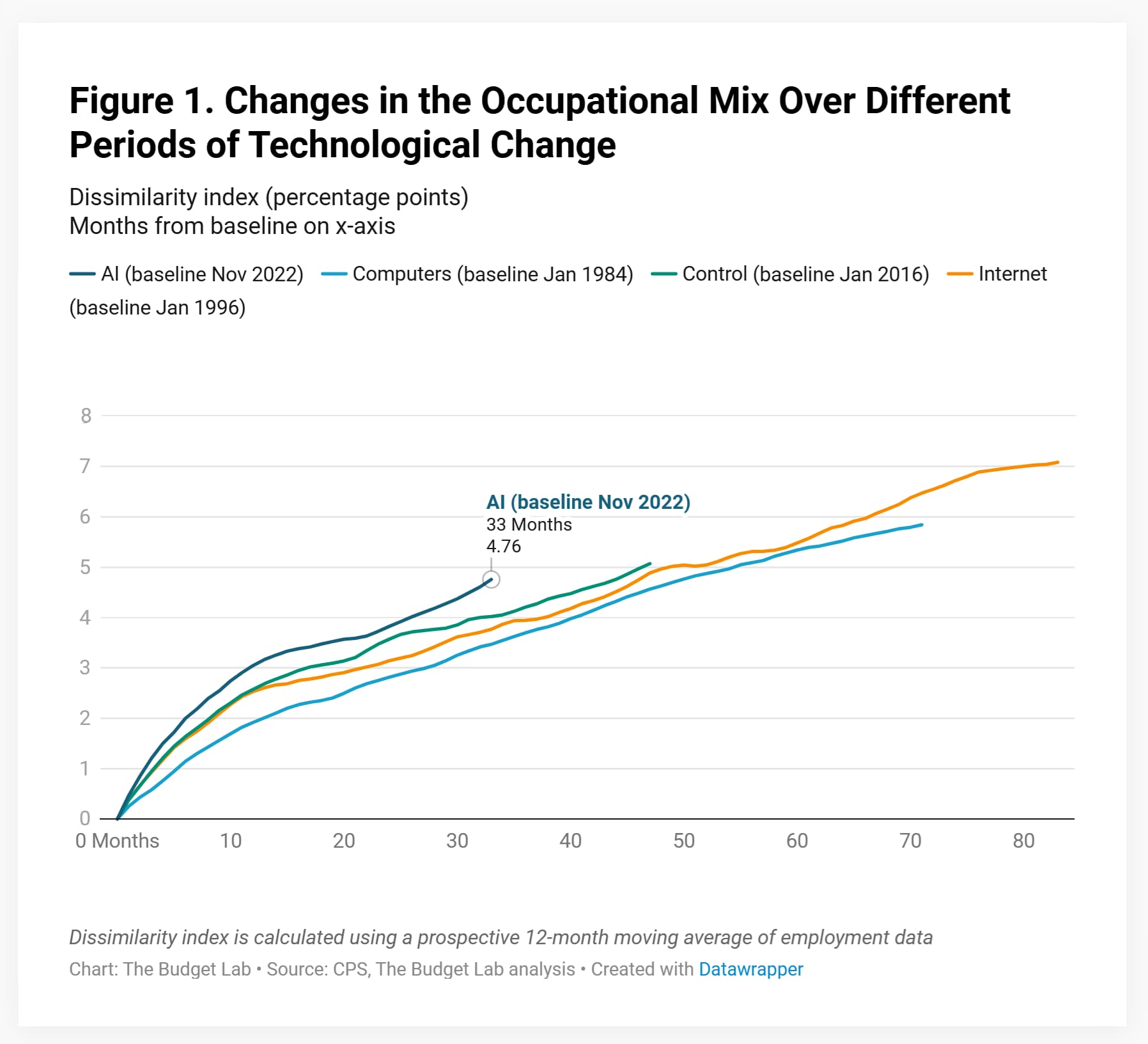
A stark prediction circulating through AI industry circles suggests we're on the brink of unprecedented workforce transformation. According to AI entrepreneur Rohan Paul, every public company will implement staff reductions of 30% or more within the next 18 months due to artificial intelligence capabilities. This projection, while dramatic, aligns with accelerating trends in corporate AI adoption and represents what could be the most significant labor market disruption since the Industrial Revolution.
The Current State of Corporate AI Adoption
Paul's assertion builds on observable patterns in today's business landscape. Currently, nearly every public company maintains substantial teams dedicated to functions like customer support, marketing, content creation, and administrative operations. These areas represent prime targets for AI automation, with technologies now capable of handling increasingly complex tasks that previously required human judgment and expertise.
Recent advancements in large language models, computer vision systems, and autonomous workflow tools have created a perfect storm for workforce transformation. Unlike previous automation waves that primarily affected manufacturing and routine tasks, current AI systems can perform knowledge work, creative tasks, and customer interactions at levels approaching—and sometimes exceeding—human capability.
The Economic Drivers Behind AI Workforce Replacement
Several converging factors make this prediction particularly compelling:
1. Shareholder Pressure and Competitive Dynamics
Public companies face relentless pressure to improve margins and demonstrate efficiency to shareholders. With AI solutions now offering clear return-on-investment metrics—often promising 40-60% cost reductions in affected departments—executives face mounting pressure to implement these technologies. Companies that delay adoption risk falling behind more agile competitors.
2. Maturation of Enterprise AI Tools
The AI tools available to corporations have evolved from experimental prototypes to robust, enterprise-grade solutions. Platforms can now handle complete business functions end-to-end, from customer inquiry resolution to complex document analysis and strategic planning support. This maturity reduces implementation risk and accelerates adoption timelines.
3. Economic Uncertainty and Cost-Consciousness
In an environment of economic uncertainty and potential recessionary pressures, companies are actively seeking ways to reduce fixed costs. Labor represents the largest expense category for most knowledge-based businesses, making it a natural target for optimization through AI-driven automation.
Which Roles Face Greatest Disruption?
While Paul's prediction suggests across-the-board reductions, certain functions appear particularly vulnerable:
- Customer Support and Service: AI chatbots and virtual agents now handle increasingly complex inquiries, reducing need for large support teams
- Content Creation and Marketing: Generative AI produces marketing copy, social media content, and basic articles with minimal human oversight
- Administrative and Coordination Roles: AI assistants manage scheduling, email triage, and basic project coordination
- Data Analysis and Reporting: Automated systems generate insights and reports from complex datasets
- Middle Management: AI-driven workflow optimization reduces need for certain supervisory and coordination roles
The Countervailing Forces: Job Creation and Transformation
While the prediction focuses on reductions, history suggests technological revolutions create new roles even as they eliminate others. The AI transition will likely generate demand for:
- AI Implementation Specialists: Professionals who can integrate AI systems into existing workflows
- Prompt Engineers and AI Trainers: Experts who optimize AI system performance for specific business needs
- Human-AI Collaboration Managers: Roles focused on maximizing productivity in mixed human-AI teams
- Ethics and Compliance Officers: Professionals ensuring AI systems operate within regulatory and ethical boundaries
Societal and Economic Implications
The scale and speed of this predicted transformation raise significant questions:
Economic Inequality Concerns
If AI-driven productivity gains primarily benefit capital owners rather than workers, we could see accelerated wealth concentration. The transition may disproportionately affect middle-income knowledge workers, potentially hollowing out the professional class that has driven economic growth for decades.
Geographic Distribution of Impact
AI automation may affect different regions unevenly. Areas with concentrations of back-office operations, customer service centers, and administrative functions could face particularly severe disruption, while AI development hubs might experience economic booms.
Educational System Alignment
Current educational institutions may struggle to adapt curricula quickly enough to prepare students for an AI-transformed workplace. The skills gap between what traditional education provides and what the AI economy demands could widen significantly.
Corporate Implementation Challenges
Despite the compelling economics, companies face significant hurdles in implementing such dramatic workforce transformations:
Cultural Resistance and Change Management
Employees may resist AI implementation, particularly when it threatens job security. Successful companies will need sophisticated change management strategies that address human concerns while maximizing technological benefits.
Technical Integration Complexities
Legacy systems, data silos, and inconsistent processes create integration challenges that can slow AI adoption. The most successful implementations will likely come from companies with modern, flexible technology infrastructures.
Regulatory and Ethical Considerations
Governments worldwide are developing AI regulations that may affect implementation timelines and approaches. Companies must navigate evolving compliance requirements while pursuing efficiency gains.
Looking Beyond the 18-Month Horizon
While Paul's prediction focuses on the immediate future, the longer-term implications extend far beyond initial workforce reductions. We may be witnessing the early stages of a fundamental reconfiguration of how work gets done in modern economies. The companies that navigate this transition most successfully will likely be those that view AI not merely as a cost-cutting tool, but as a catalyst for reinventing their business models and creating new forms of value.
The coming months will test whether Paul's dramatic prediction proves accurate. What's undeniable is that AI capabilities have reached an inflection point where their business applications are becoming too compelling for corporate leaders to ignore. The workforce implications of this technological shift will likely define the next era of economic development.
Source: Rohan Paul via X/Twitter (@rohanpaul_ai)