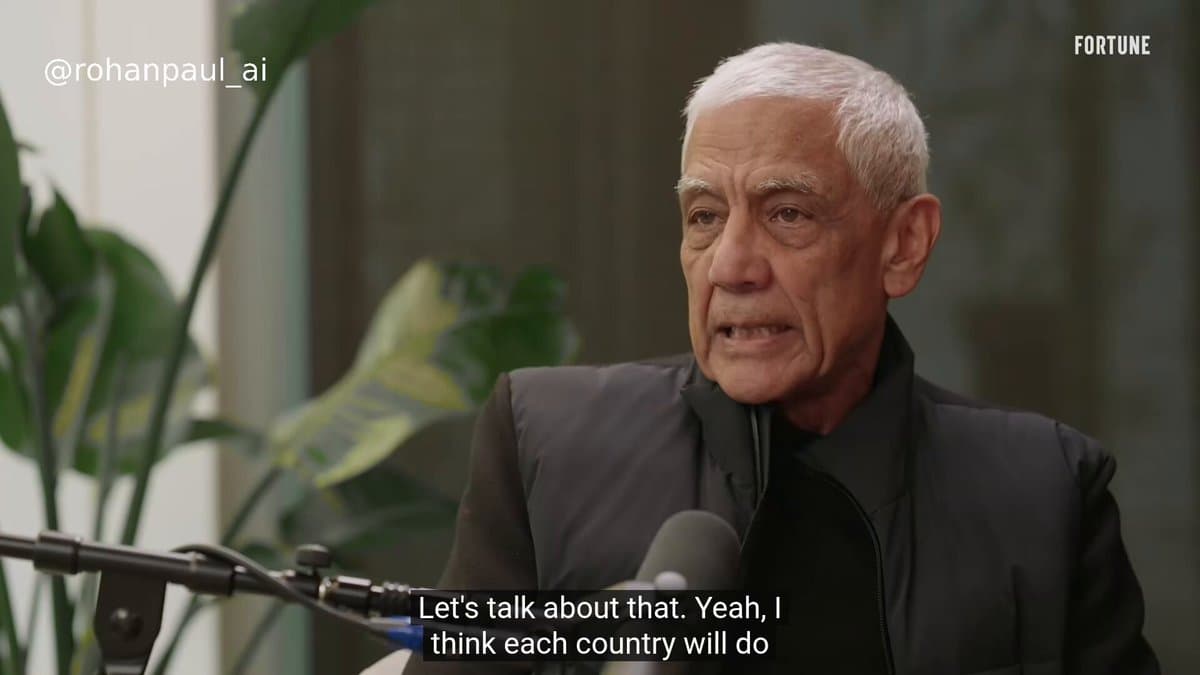
Silicon Valley visionary Vinod Khosla, co-founder of Sun Microsystems and prominent venture capitalist, has made a startling prediction about artificial intelligence's impact on the global workforce. According to Khosla, by approximately 2030, AI systems will be capable of outperforming humans in 80% of jobs across all sectors—from blue-collar positions to highly skilled professions like medicine, engineering, and accounting.
The Universal Impact Across Professions
Khosla's prediction, shared via Fortune Magazine's YouTube channel and social media platforms, paints a comprehensive picture of AI's impending workforce disruption. "Whether you're a physician, whether you're a radiologist, whether you're an accountant, whether you're a chip designer, or whether you're a salesperson, AI will do your job better," Khosla stated. This sweeping assessment suggests that no profession will remain untouched by AI's capabilities within the next six years.
The venture capitalist's timeline is particularly aggressive compared to many mainstream predictions about AI workforce integration. While most analysts have focused on gradual automation over decades, Khosla's 2030 prediction suggests a much more rapid transformation that would fundamentally reshape global labor markets within a single business cycle.
The AI Intern Transition Phase
Khosla envisions an interim period where professionals will adapt to AI through a novel working relationship. "There will be an interim period where every professional will have four AI interns they're training to leverage themselves," he explained. "I think the initial model of AI deployment will be AI interns working for somebody who's already a senior accountant, a physician, or pick your chip designer."
This "AI intern" model represents a transitional phase where human expertise remains valuable for training and supervising AI systems. During this period, professionals would essentially become managers of AI assistants, leveraging their domain knowledge to guide AI performance while gradually offloading more complex tasks to increasingly capable systems.
The Economic Implications of Free Labor
The most profound aspect of Khosla's prediction concerns the economic transformation that would follow widespread AI workforce integration. "But what happens when all labor is free?" he asks, pointing toward a future where AI systems handle most productive work with minimal human intervention.
Khosla anticipates dramatic economic consequences from this shift: "The abundance of goods and services will be very, very large. Prices will be very low. So I would suspect by 2040, even $10,000—will buy much more than you can buy if you have a $100,000 income today."
This prediction suggests a complete reconfiguration of economic value, where traditional income metrics become less meaningful as AI-driven production dramatically reduces costs across all sectors. The implication is that even modest incomes could provide unprecedented purchasing power in an AI-abundant economy.
The Path to 2030: Technical and Social Challenges
While Khosla's timeline is ambitious, it aligns with accelerating developments in AI capabilities. Recent breakthroughs in large language models, computer vision, and robotics suggest that AI systems are indeed progressing toward handling increasingly complex professional tasks. However, significant technical, regulatory, and social challenges remain before AI can reliably outperform humans in 80% of occupations.
The transition would require not just technological advancement but also substantial changes to education systems, workforce retraining programs, and social safety nets. The "AI intern" phase Khosla describes would necessitate new forms of human-AI collaboration training and potentially new certification systems for professionals managing AI systems.
Preparing for the AI Workforce Revolution
Khosla's predictions, while dramatic, serve as a call to action for businesses, governments, and individuals to prepare for coming workforce transformations. Organizations must consider how to integrate AI systems into their operations while developing strategies for human-AI collaboration. Educational institutions face the challenge of preparing students for careers that may be fundamentally different from today's professions.
Individuals across all professions would benefit from developing skills in AI management, system training, and areas where human judgment and creativity remain uniquely valuable. The transition period Khosla describes offers a crucial window for adaptation before more comprehensive AI workforce integration occurs.
Source: Predictions shared by Vinod Khosla via Fortune Magazine's YouTube channel and social media platforms.