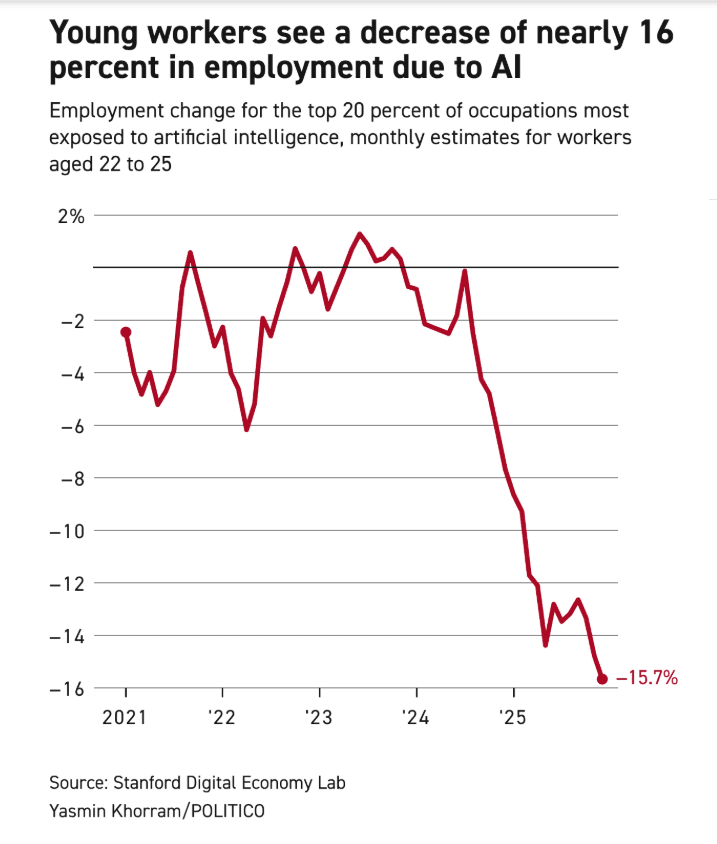
Recent workforce analysis indicates a clear pattern emerging in the AI revolution: entry-level positions and routine tasks are experiencing the earliest and most significant automation impacts. This development, highlighted by industry observers including Rohan Paul, signals a fundamental shift in how artificial intelligence is being deployed across economic sectors, with profound implications for early-career professionals, educational institutions, and corporate hiring practices.
The Automation Frontline
While discussions about AI and employment often focus on futuristic scenarios or high-skill displacement, current implementation patterns tell a different story. Organizations are systematically deploying AI tools to automate precisely those tasks that have traditionally served as entry points into the workforce: data entry, basic customer service interactions, preliminary research, document processing, and routine administrative functions.
This targeting makes strategic sense from an implementation perspective. Entry-level tasks typically involve well-defined processes, structured data, and repetitive patterns—exactly the type of work where current AI systems excel. The return on investment is often clearest in these areas, where automation can quickly reduce labor costs while maintaining or improving consistency.
Changing Career Pathways
The implications for early-career professionals are substantial. Traditional career ladders that began with mastering routine tasks before progressing to more complex responsibilities are being reconfigured. Industries from finance and insurance to marketing and legal services are redesigning entry-level positions, often eliminating or dramatically reducing the number of these roles.
This creates a paradoxical situation for new graduates and career changers. While AI tools theoretically make workers more productive, the reduction in entry-level opportunities creates bottlenecks in professional development. The "paying your dues" phase of many careers is being automated away, potentially creating experience gaps that could affect mid-career competency development.
Educational Institutions Respond
Universities and vocational training programs are already adjusting their curricula in response to these trends. There's increasing emphasis on skills that complement rather than compete with AI systems: critical thinking, complex problem-solving, emotional intelligence, and AI system management. The focus is shifting from teaching routine task execution to developing the judgment and adaptability needed to work effectively alongside increasingly capable AI assistants.
Some forward-thinking programs are incorporating AI literacy directly into their core requirements, ensuring graduates understand both the capabilities and limitations of current systems. This includes practical experience with AI tools across disciplines, preparing students for workplaces where human-AI collaboration is the norm rather than the exception.
Corporate Strategy Shifts
Organizations implementing these automation solutions face their own strategic challenges. While reducing entry-level positions may offer short-term cost savings, companies must consider longer-term talent pipeline implications. Some are developing "automation-aware" career paths that begin with different types of responsibilities, while others are creating hybrid roles that combine what were previously separate entry-level functions.
Progressive organizations are also investing in reskilling programs for existing employees whose roles are being augmented or transformed by AI. This represents a shift from seeing automation purely as a cost-cutting measure to viewing it as part of broader workforce transformation strategy.
Economic and Social Implications
The concentration of automation impacts on entry-level positions has significant socioeconomic dimensions. These roles have traditionally provided crucial economic mobility pathways, particularly for individuals without advanced degrees or specialized training. As these opportunities diminish, policymakers and community leaders face challenges in creating alternative pathways to stable employment.
There are also demographic considerations. Younger workers, who typically fill entry-level positions, may face particularly challenging early-career environments. This could potentially delay milestones like independent living, family formation, and wealth accumulation, with ripple effects throughout the economy.
Looking Forward
The current pattern of entry-level automation represents just the beginning of broader workforce transformation. As AI capabilities advance, the automation frontier will likely move up the skill ladder, affecting more complex tasks and higher-level positions. However, the initial concentration on entry-level work establishes important precedents for how organizations, educational institutions, and policymakers approach these changes.
Successful navigation of this transition will require coordinated efforts across sectors. Companies need to balance efficiency gains with sustainable talent development. Educational institutions must continuously adapt their offerings to meet evolving workplace needs. And policymakers should consider measures to support workforce transitions while encouraging innovation.
The automation of entry-level tasks isn't just about technological capability—it's about reimagining how work gets done, how careers develop, and how value is created in an increasingly AI-augmented economy. Those who understand and adapt to these changes earliest will be best positioned for success in the workplaces of tomorrow.
Source: Analysis based on observations by Rohan Paul and current workforce automation trends.