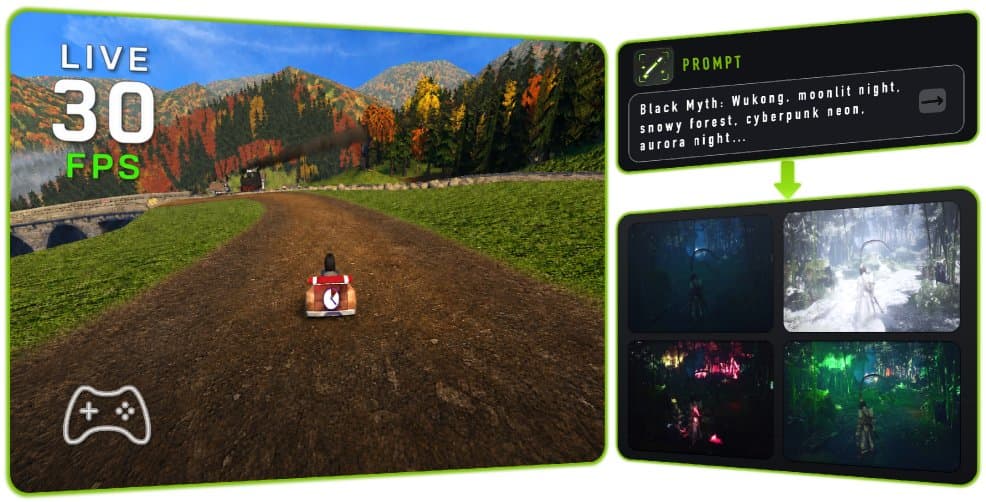
AlayaRenderer-Flash accelerates real-time interactive scene synthesis from 0.56 FPS to 31.54 FPS, achieving a 56x speedup. This enables a fully playable generative world with text-prompt control, as shared by @HuggingPapers on X.
Key facts
- AlayaRenderer-Flash achieves 31.54 FPS.
- Baseline performance was 0.56 FPS.
- 56x speedup over baseline.
- Enables text-prompt controlled generative worlds.
- Announced by @HuggingPapers on X.
AlayaRenderer-Flash, a generative world renderer, accelerates real-time interactive scene synthesis from 0.56 FPS to 31.54 FPS, achieving a 56x speedup. According to @HuggingPapers, the model enables a fully playable generative world with text-prompt control, marking a significant leap in interactive AI-driven content generation.
The work was shared via a HuggingFace paper and announced on X by @HuggingPapers, though full architectural details and benchmark methodology have not been disclosed. The jump from sub-1 FPS to over 30 FPS is critical for real-time applications like gaming and simulation, where frame rates below 30 FPS are typically considered unplayable.
This speedup likely involves model distillation, pruning, or efficient attention mechanisms, but without ablation studies or code release, the specific approach remains opaque. The claim of 'fully playable' suggests end-to-end latency optimizations, possibly including reduced memory footprint and parallelized inference. However, the source provides no information on resolution, scene complexity, or hardware used for the benchmark.
The unique angle: AlayaRenderer-Flash moves generative world models from academic demo territory into practical deployment viability. Prior generative world models, like those from DeepMind or OpenAI, have struggled with real-time inference, often requiring seconds per frame. By crossing the 30 FPS threshold, AlayaRenderer-Flash makes text-to-world generation feasible for interactive applications, potentially disrupting game development pipelines and virtual world creation tools.
How the speedup compares
FPS 0.56 31.54 Speedup 1x 56xThe table, derived from the source, highlights the dramatic improvement. The baseline likely represents an unoptimized generative model running on consumer hardware, but the source does not specify. Without reproducibility details, the claim should be treated with caution until code or a preprint is available.
Implications for the generative AI landscape
AlayaRenderer-Flash addresses the core bottleneck of generative world models: inference speed. As of early 2026, most generative world models remain too slow for interactive use, limiting them to pre-rendered content. This work could unlock real-time procedural generation, interactive storytelling, and dynamic game environments controlled by natural language. The text-prompt control adds a layer of usability, reducing the barrier for creators without 3D modeling skills.
However, the lack of disclosed methodology means competitors cannot replicate or build on this work. The field has seen similar claims that later failed to generalize across diverse scenes or hardware. Without open-source code or a detailed arXiv preprint, the community cannot verify the 31.54 FPS figure on independent hardware.
What to watch
Watch for the release of the full paper, code, or model weights. If the authors provide a reproducible benchmark, AlayaRenderer-Flash could set a new standard for real-time generative world rendering. Alternatively, if the work remains a closed demo, it risks becoming another unverifiable claim in a field hungry for practical breakthroughs.