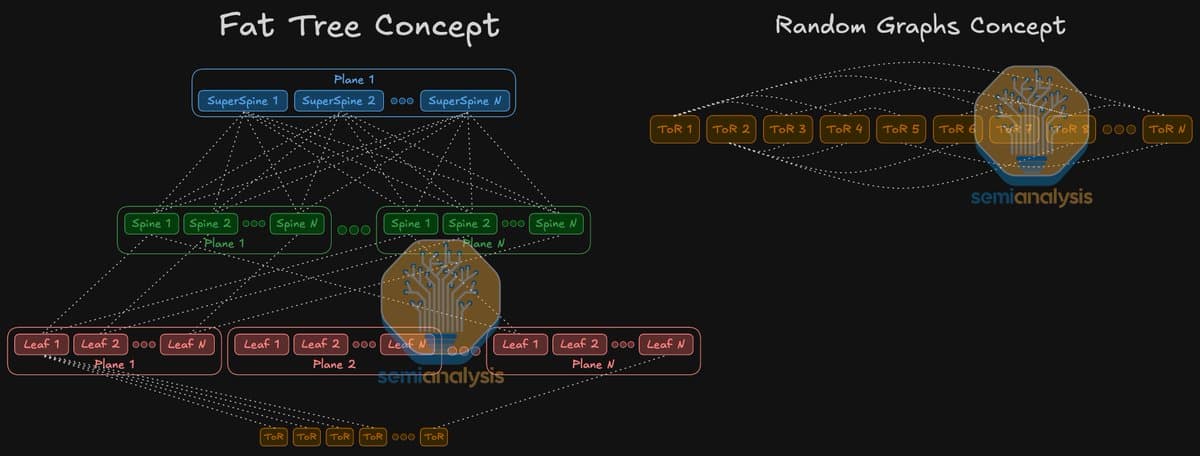
Amazon unveiled RNG (Resilient Network Graphs) in May 2026, abandoning fat-tree topologies for random-graph-based networks. According to @SemiAnalysis_, the design targets fault tolerance in large-scale AI training clusters.
Key facts
- RNG replaces fat-tree topologies with random graphs.
- Announced by Amazon in May 2026.
- Targets fault tolerance in AI training clusters.
- No published latency or deployment data yet.
- Source: @SemiAnalysis_ thread.
Amazon's RNG topology represents a structural break from the fat-tree architectures that have dominated data-center networking for decades. Traditional fat trees, used widely in hyperscaler networks from Google's Jupiter to Microsoft's Azure, rely on hierarchical layers of switches that create deterministic paths. RNG instead uses random-graph principles, where connections between switches are probabilistically distributed rather than arranged in fixed tiers.
Key Takeaways
- Amazon introduced RNG network topology using random graphs instead of fat trees for AI training clusters.
- No performance data published yet.
Why random graphs for AI training

The shift matters because AI training workloads—particularly large language model training runs spanning thousands of GPUs—are uniquely sensitive to network faults. A single link failure in a fat tree can collapse bisection bandwidth for entire sections of a cluster, stalling training for hours. Random graphs offer inherent redundancy: because no single path is critical, failures degrade performance gradually rather than catastrophically.
[According to @SemiAnalysis_], Amazon has not disclosed RNG's deployment scale, latency benchmarks, or whether it is production-ready. The company also has not said if RNG is specific to its Trainium-based clusters or intended for broader AWS networking. The lack of published performance data makes it difficult to compare against known alternatives like NVIDIA's NVSwitch or Google's Orion topology.
Market context
Amazon's move comes as hyperscalers race to differentiate their AI infrastructure. Microsoft has invested heavily in custom networking for its OpenAI clusters; Google has its own Jupiter network and TPU pod topologies. RNG, if proven, could give AWS a cost or reliability edge in the competitive cloud AI training market. However, without third-party benchmarks or production case studies, the claim remains unverified.
What about the source

The information comes from a thread by @SemiAnalysis_, a respected semiconductor and infrastructure analysis firm. Their reporting has historically been accurate on AWS hardware developments, including early coverage of Trainium and Inferentia chips. Still, the thread lacks specific technical details—no random graph construction parameters, no switch radix numbers, no measured recovery times after failures.
Amazon has not issued a press release or technical paper on RNG as of this writing. The topology may be a research project, a patent filing, or a production system—the source does not clarify which.
What to watch
Watch for Amazon to publish a technical paper or blog post detailing RNG's random graph construction, switch radix, and measured recovery times. Also track whether RNG appears in AWS re:Invent 2026 keynotes or Trainium cluster announcements.