What Happened
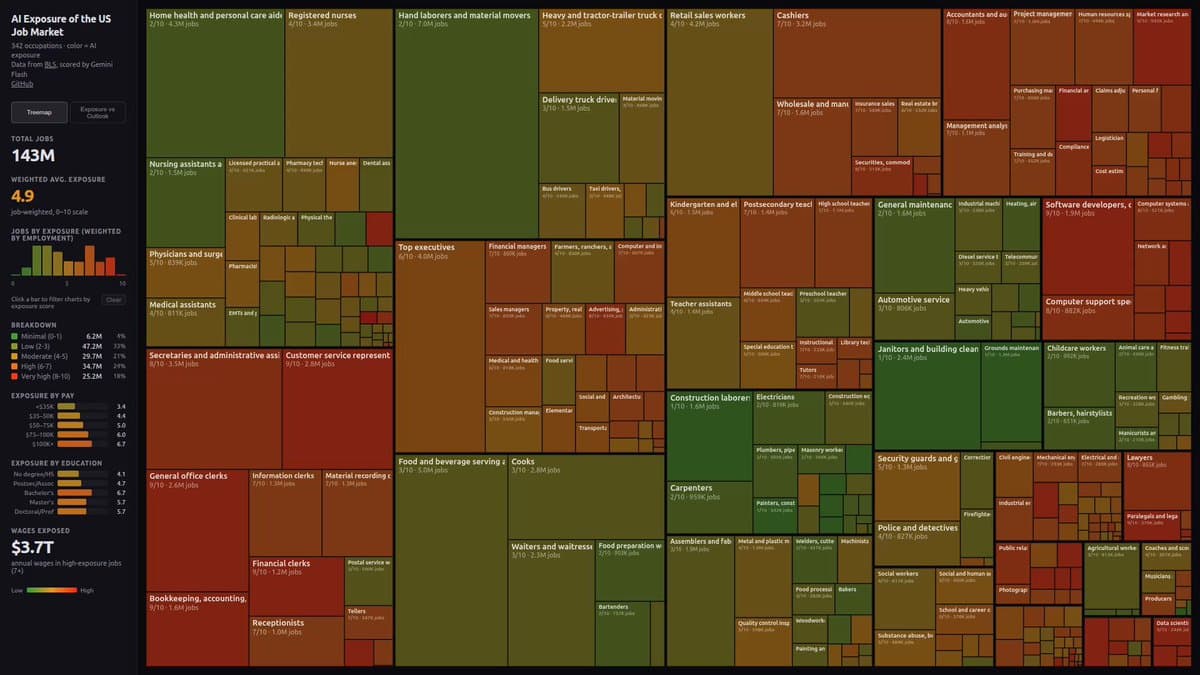
Former Tesla AI director and OpenAI founding member Andrej Karpathy briefly published a tool designed to analyze AI's potential impact on the U.S. labor market. According to a post by Rohan Paul, Karpathy deleted the original GitHub repository very quickly after its release.
The tool's methodology was straightforward: it pulled data on 342 distinct job types from the U.S. Bureau of Labor Statistics (BLS). For each occupation, it used a large language model—specifically, Gemini Flash—to assign an "AI exposure" score from 0 to 10. This score was intended to represent the probability that the job could be significantly affected or automated by AI.
The analysis found an average AI exposure score of 5.3 across all jobs.
Key Findings from the Tool
According to the shared details, the tool produced specific scores for several professions:
- Medical Transcriptionists: 10/10
- Software Developers: 9/10
- General Office Clerks: 9/10
- Lawyers: 8/10
The post summarized the finding as: "Basically any screen-based jobs are in trouble."
The most significant quantitative finding was the aggregate financial risk. The tool calculated the total annual wages associated with jobs scoring 7 or higher on the AI exposure scale. Using BLS data for employment counts and median annual wages, the sum for these high-exposure occupations was $3.7 trillion.
The formula was described as: ∑(BLS employment count × BLS median annual wage) for occupations with a Gemini Flash score ≥7.
Context
Andrej Karpathy is a prominent figure in AI, known for his work on deep learning, computer vision, and large language models. His public projects and educational materials are closely followed by the developer community. The rapid deletion of the repository suggests the tool may have been an experimental prototype or its public release was unintended.
The concept of scoring jobs for automation risk is not new; it has been explored by economists and research firms like McKinsey for years, often focusing on robotics and software automation. Karpathy's tool appears to be a modern, LLM-driven instantiation of this analysis, specifically targeting capabilities enabled by recent generative AI advances.
The use of Gemini Flash (Google's efficient, fast-inference model) as the judge for AI exposure is a notable technical choice, implying the assessment is based on current model capabilities and their projected applicability to job tasks.