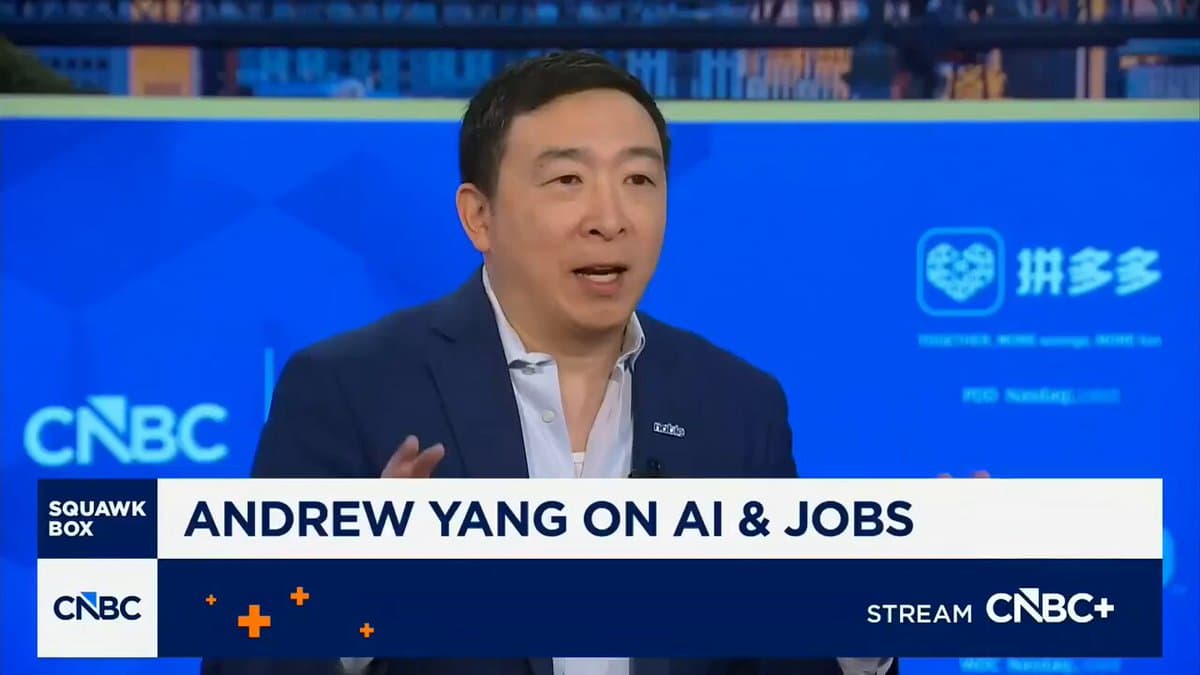
Former Democratic presidential candidate and entrepreneur Andrew Yang has proposed a radical overhaul of the U.S. tax system in response to accelerating automation. During a recent CNBC interview, Yang argued that taxes on human labor should be eliminated entirely and replaced with taxes on autonomous AI agents. This proposal represents one of the most concrete policy frameworks yet suggested for addressing the economic displacement caused by artificial intelligence.
The Core Proposal: Taxing Autonomous Systems
Yang's proposal centers on creating a new tax category specifically targeting "autonomous AI agents"—software systems capable of performing tasks without direct human intervention. While details remain preliminary, the concept suggests that as AI systems increasingly replace human workers in various sectors, the tax burden should shift accordingly from human payrolls to automated systems.
"Because this will shift revenue toward UBI," Yang explained, referring to his signature policy proposal of Universal Basic Income. The former candidate has long advocated for UBI as a necessary response to technological unemployment, famously popularizing the concept during his 2020 presidential campaign with his "Freedom Dividend" proposal of $1,000 monthly payments to every American adult.
The Economic Rationale Behind the Shift
The proposal emerges from a fundamental economic observation: as AI systems become more capable of performing human work, traditional labor-based taxation becomes increasingly unsustainable. Currently, payroll taxes fund significant portions of social safety net programs including Social Security and Medicare. If automation reduces the number of human workers contributing to these systems, alternative revenue sources must be identified.
Yang's solution represents a direct attempt to align taxation with economic production. Rather than taxing the increasingly scarce resource of human labor, his framework would tax the increasingly abundant resource of automated productivity. This approach theoretically maintains government revenue streams while removing disincentives for human employment.
Critic Concerns: Capital Flight and Implementation Challenges
Critics of the proposal have raised significant concerns, particularly regarding the mobility of software systems. "Critics worry an AI tax will trigger capital flight, as software is highly mobile," the source material notes. This represents perhaps the most substantial implementation challenge: unlike physical factories or human workers, AI systems can theoretically be relocated to jurisdictions with more favorable tax policies with relative ease.
This mobility concern echoes longstanding debates about digital taxation and the challenges of taxing intangible assets in a globalized economy. Countries have struggled for years to establish frameworks for taxing digital giants like Google and Amazon, with similar concerns about companies shifting profits to low-tax jurisdictions.
The UBI Connection: Funding the Safety Net of the Future
Yang explicitly connects his tax proposal to Universal Basic Income, suggesting that revenue from AI taxes would directly fund cash payments to citizens. This creates a direct link between technological progress and social welfare: as AI systems become more productive, they would generate more tax revenue to support those displaced by automation.
This approach represents a significant departure from current social welfare models, which typically tie benefits to employment status or specific need categories. Instead, Yang envisions a system where technological advancement directly funds universal economic security.
Historical Context and Political Viability
Yang's proposal builds upon decades of economic thought about automation's impact on employment. From the Luddites of the Industrial Revolution to contemporary economists like Erik Brynjolfsson and Andrew McAfee, observers have long debated how societies should respond when machines replace human labor.
Politically, the proposal faces substantial hurdles. Tax reform is notoriously difficult in the United States, and creating an entirely new tax category would require significant legislative effort. Additionally, defining what constitutes an "autonomous AI agent" for tax purposes presents technical and legal challenges that would need to be addressed.
International Implications and Coordination Needs
The proposal's success would likely require international coordination to prevent the capital flight critics warn about. Just as the OECD has worked to establish global minimum corporate tax rates, effective AI taxation might necessitate similar multinational agreements to prevent a "race to the bottom" where countries compete by offering AI tax havens.
This international dimension adds complexity but also potential: if implemented globally, AI taxes could represent a new form of multinational revenue sharing that acknowledges the borderless nature of digital technologies.
Looking Forward: The Debate We Need to Have
Regardless of its immediate political prospects, Yang's proposal serves an important function: it forces concrete discussion about how societies will fund themselves in an increasingly automated world. As AI systems continue to advance, questions of taxation, social welfare, and economic fairness will only become more urgent.
The debate between Yang's vision and his critics' concerns about capital flight represents a fundamental tension in 21st-century economics: how to balance the need for government revenue with the realities of global capital mobility in a digital age.
Source: Andrew Yang's interview with CNBC as reported by @rohanpaul_ai on X/Twitter