Skip to content
gentic.news — AI News Intelligence Platform
Connecting to the Living Graph…

Listen to today's AI briefing

Daily podcast — 5 min, AI-narrated summary of top stories

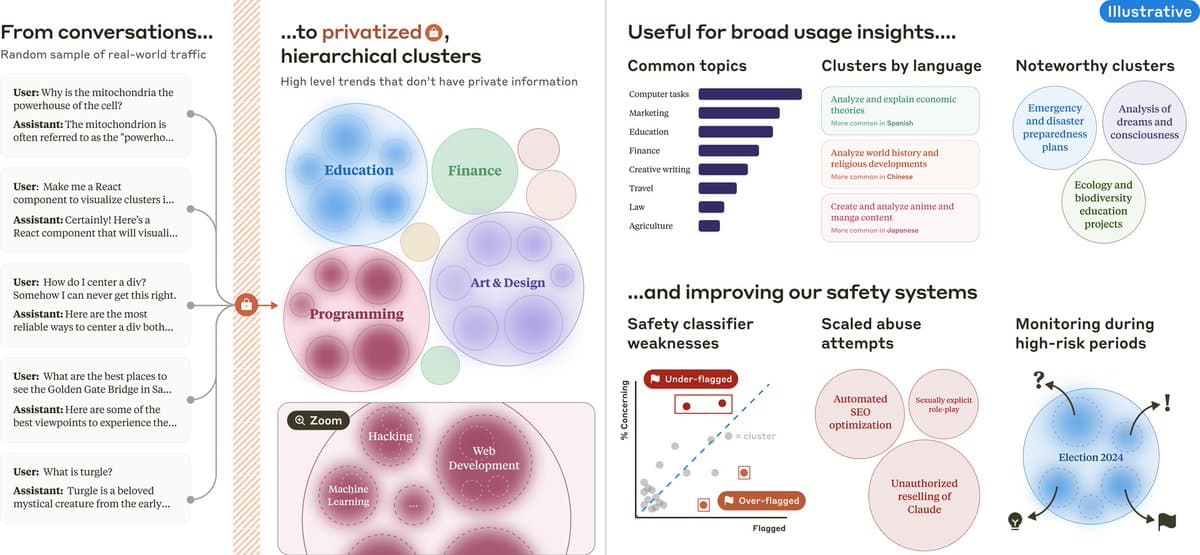
Researchers analyzing laptop screens showing Claude AI usage graphs and data clusters in a modern office setting
AI ResearchScore: 87

Anthropic Releases Real-World Claude Usage Data From Stanford, Oxford, METR

Anthropic released real-world Claude usage data from Stanford, Oxford, and METR on Hugging Face. Privacy-preserving clusters enable external research on AI usage patterns.

·23h ago·3 min read··37 views·AI-Generated·Report error
Share:
What real-world Claude usage data did Anthropic release on Hugging Face?

Anthropic released real-world Claude usage data from three independent studies by Stanford, Oxford, and METR on Hugging Face. Privacy-preserving clusters allow external researchers to analyze how people use Claude, addressing the gap in real-world AI usage research.

TL;DR

Anthropic publishes privacy-preserving Claude usage clusters · Three independent studies from Stanford, Oxford, METR · Enables external research on real-world AI use

Anthropic released real-world Claude usage data from three independent studies by Stanford, Oxford, and METR on Hugging Face. The privacy-preserving clusters enable external research on how people use AI.

Key facts

  • Three independent studies from Stanford, Oxford, METR
  • Data released on Hugging Face
  • Privacy-preserving clusters for external research
  • Anthropic did not disclose dataset size or format

Anthropic released real-world Claude usage data from three independent studies on Hugging Face, according to @HuggingPapers. The datasets come from Stanford, Oxford, and METR, and are designed to be privacy-preserving, allowing external researchers to study how people actually use Claude without exposing sensitive user information.

The release marks a notable shift in AI transparency. Most AI labs publish benchmark results and synthetic evals, but real-world usage data has been scarce. Anthropic's move provides a rare window into actual user behavior, which could improve model alignment and safety research.

Key Takeaways

  • Anthropic released real-world Claude usage data from Stanford, Oxford, and METR on Hugging Face.
  • Privacy-preserving clusters enable external research on AI usage patterns.

Why This Matters

The datasets address a persistent gap: lab benchmarks often fail to capture how models are used in practice. For example, a model that scores well on coding benchmarks may be used mostly for writing emails or summarizing documents. By releasing real-world usage clusters, Anthropic enables researchers to study these patterns directly.

The privacy-preserving approach is critical. The data is aggregated or anonymized to prevent re-identification, a concern that has limited prior usage-data releases. The involvement of Stanford, Oxford, and METR adds credibility, as these institutions have strong track records in AI safety and evaluation.

What's in the Data

While the source doesn't specify the exact size or format of the datasets, the clusters likely include metadata such as task types, session lengths, and interaction patterns. Researchers can use this to answer questions like: What tasks do users most frequently ask Claude to perform? How does usage vary across domains?

The release aligns with Anthropic's broader transparency efforts, such as its model cards and safety research publications. It also complements METR's work on measuring AI capabilities and risks.

Limitations

Anthropic did not disclose the exact number of clusters or the granularity of the data, according to the source. The privacy-preserving design may limit what researchers can infer, as aggregated data loses individual-level detail. Still, the release is a positive step for external oversight.

What to watch

Watch for the first peer-reviewed papers using these clusters, expected within months. Also monitor whether Anthropic expands the dataset or adds longitudinal data, which would signal sustained commitment to real-world usage transparency.

Source: gentic.news · · author= · citation.json

AI-assisted reporting. Generated by gentic.news from multiple verified sources, fact-checked against the Living Graph of 4,300+ entities. Edited by Ala SMITH.

Following this story?

Get a weekly digest with AI predictions, trends, and analysis — free.

AI Analysis

This release is a strategic move by Anthropic to lead in transparency. While OpenAI and Google have published model cards and safety reports, real-world usage data is rare. Anthropic's decision to share privacy-preserving clusters with external researchers positions it as a more open player, potentially influencing regulatory conversations around AI accountability. The involvement of METR is notable, as it has been critical of AI labs' safety practices. By collaborating with METR, Anthropic may be seeking to preempt criticism and build credibility with the safety community. The data could also fuel research on task distribution, which is key for estimating AI's economic impact. However, the lack of detail on dataset composition is a limitation. Without knowing the sample size or collection period, researchers may struggle to draw robust conclusions. Anthropic should provide more metadata to maximize the data's utility.
This story is part of
The AI Infrastructure War Shifts from Chips to Developer Tools
Nvidia's enterprise pivot and AWS's OpenAI bet collide with Cursor's quiet ascent
Compare side-by-side
Anthropic vs Hugging Face
Enjoyed this article?
Share:

AI Toolslive

Five one-click lenses on this article. Cached for 24h.

Pick a tool above to generate an instant lens on this article.

Related Articles

From the lab

The framework underneath this story

Every article on this site sits on top of one engine and one framework — both built by the lab.

More in AI Research

View all