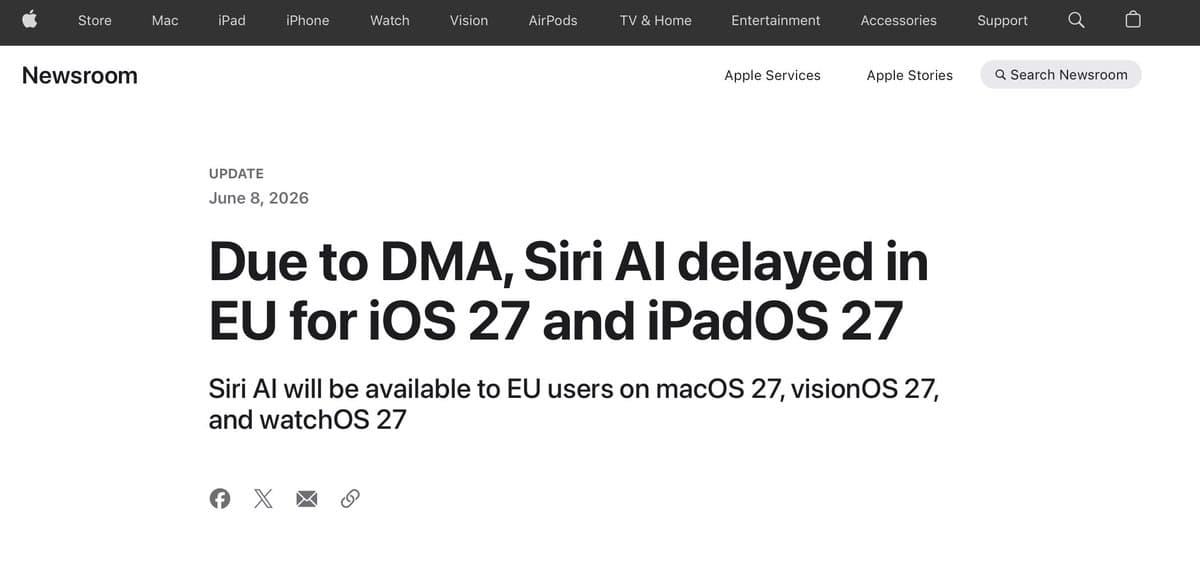
Apple says Siri AI won't launch on iPhone and iPad in the EU because the DMA requires giving rival AI assistants broad access to private user data. Craig Federighi called the move a 'deep disappointment' with no timeline for resolution.
Key facts
- Siri AI won't launch on iPhone and iPad in the EU.
- Apple proposed a 'Trusted System Agent' safeguard.
- European Commission rejected Apple's 18-month rollout plan.
- Apple Intelligence launched in US in October 2024.
- No timeline for EU Siri AI availability.
Apple is publicly blaming the European Union's Digital Markets Act (DMA) for blocking the launch of Siri AI on iPhone and iPad in Europe. According to @kimmonismus, the company argues that regulators interpret the DMA as requiring Apple to grant rival AI assistants broad access to private user data and control over apps — a condition Apple says would create major privacy and security risks.
Apple submitted proposed safeguards to the European Commission, including a "Trusted System Agent" and an 18-month rollout plan, but says those were rejected. As a result, there is currently no timeline for Siri AI on iOS and iPadOS in the EU. "We're deeply disappointed that our EU users won't have Siri AI on iPhone or iPad when we share our new software releases later this year," said Craig Federighi, Apple's senior vice president of software engineering.
The decision mirrors Apple's earlier choice to delay AI features like ChatGPT integration and image generation tools in the EU over DMA compliance concerns. Apple Intelligence, the broader suite of AI features, launched in the US in October 2024 but has been unavailable in Europe since. The standoff highlights a growing tension between EU tech regulation and the rapid deployment of AI features by US tech giants.
What Apple is really saying
Apple's framing is tactical: by pinning the blame on Brussels, it pressures the European Commission to offer concessions or face a PR narrative that EU regulation is harming consumers. The DMA's interoperability requirements were designed to open up dominant platforms, but Apple argues they would force it to open the iPhone's most sensitive APIs — like microphone access and app control — to competitors like Google Assistant or Microsoft Copilot. The Commission has not publicly responded to Apple's specific claims, but the DMA includes provisions for security exemptions.
The underlying conflict is structural: the DMA assumes platform openness is always beneficial, while Apple's AI strategy depends on tight hardware-software integration and on-device processing. There is no precedent for a DMA security exemption at this scale, and Apple's proposed "Trusted System Agent" has not been detailed publicly.
What to watch
Watch for the European Commission's formal response to Apple's claims, expected within weeks. If the Commission signals willingness to grant a security exemption for AI assistants, it could reset the timeline. If not, expect Apple to use Siri AI's absence as leverage in ongoing DMA appeals, with potential impact on the EU's broader AI Act enforcement.
Key Takeaways
- Apple blames EU DMA for blocking Siri AI on iPhone and iPad in Europe, citing privacy risks from required rival AI assistant access.
- No timeline for launch.