
AWS launched Lambda MicroVMs, a new serverless compute primitive for running untrusted code in isolated, stateful environments. Powered by Firecracker, the service targets AI coding assistants and multi-tenant apps needing VM-level isolation without infrastructure management.
Key facts
- Lambda MicroVMs launched June 2026 by AWS.
- Powered by Firecracker, used in 15 trillion monthly Lambda invocations.
- State preserved up to 8 hours per session.
- Targets AI coding assistants and multi-tenant apps.
- VM-level isolation with no shared kernel between sessions.
AWS today announced Lambda MicroVMs, a serverless compute primitive within AWS Lambda that provides isolated, stateful sandboxes for running user- or AI-generated code According to the AWS News Blog. Each MicroVM offers virtual machine-level isolation with no shared kernel or resources between sessions, near-instant launch and resume, and direct lifecycle control. The service preserves state up to 8 hours and pauses to a low idle cost when the user steps away.
Key Takeaways
- AWS launched Lambda MicroVMs for isolated, stateful sandboxes.
- Powered by Firecracker, it targets AI coding assistants with 8-hour state retention.
The Gap Lambda MicroVMs Fills
Developers building multi-tenant applications—such as AI coding assistants, interactive code environments, data analytics platforms, vulnerability scanners, and game servers—have faced a tradeoff. Virtual machines deliver strong isolation but take minutes to start. Containers launch in seconds but require significant hardening to safely contain untrusted code. Functions as a service are optimized for event-driven, request-response workloads, not long-running interactive sessions that retain state. Lambda MicroVMs is purpose-built for this gap, the company says.
Powered by Firecracker
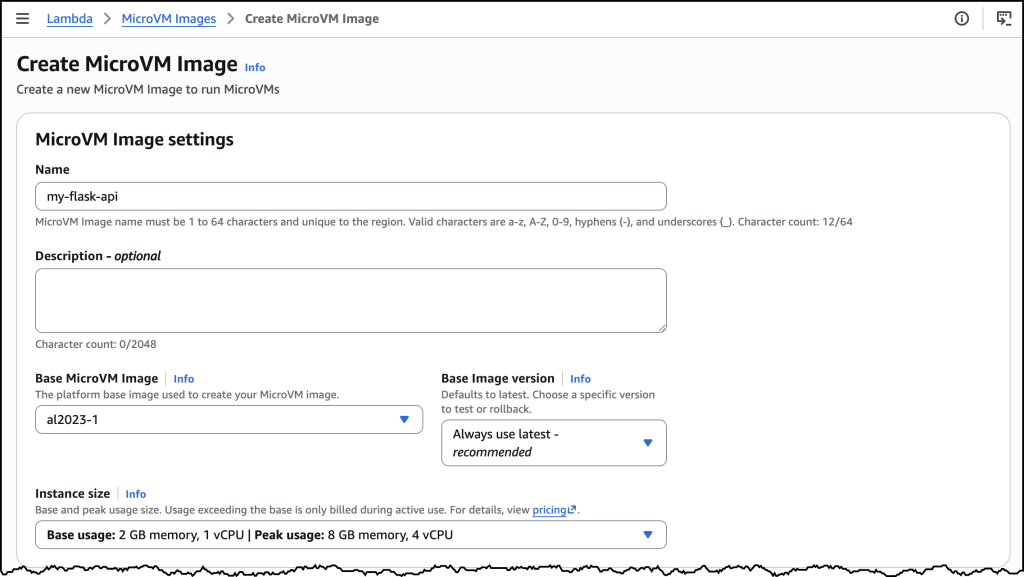
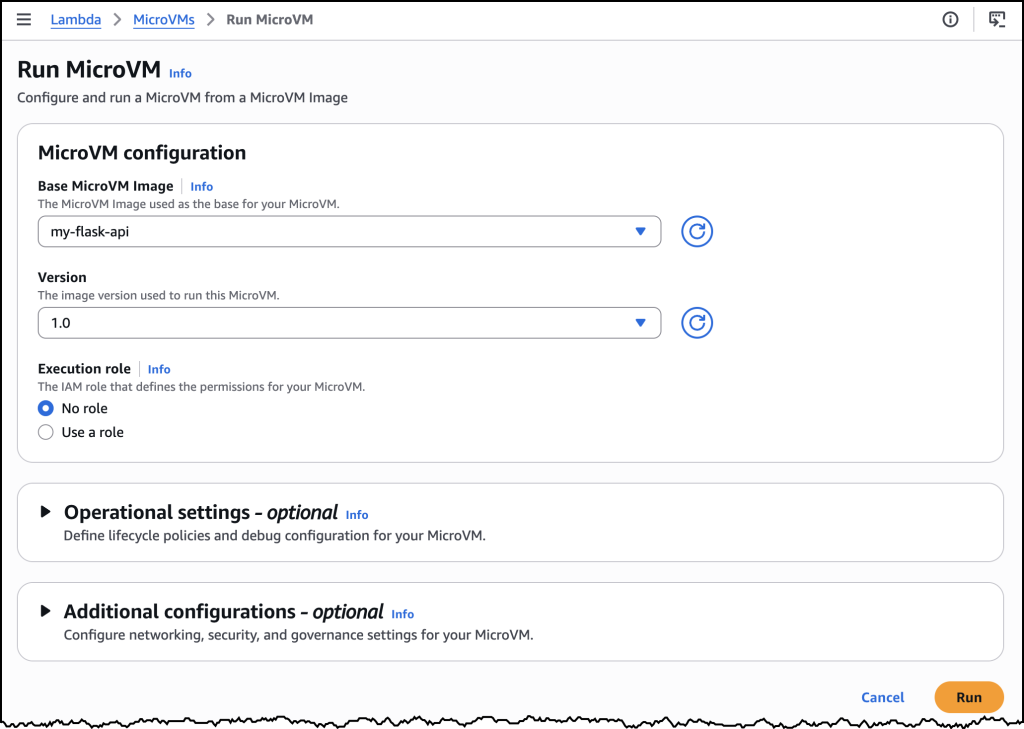
Lambda MicroVMs are powered by Firecracker, the same lightweight virtualization technology that has powered over 15 trillion monthly Lambda function invocations. Because Firecracker already underpins AWS Lambda Functions, the new service inherits the operational maturity of a stack running at massive scale. Users create a MicroVM Image by packaging an application—such as a Flask web app—into a zip file, uploading it to Amazon S3, and configuring it via the AWS Lambda console.
Community Response
Initial Hacker News discussion is minimal, with two posts totaling 16 points and zero comments as of publication. This may reflect the early stage of the announcement or that the service targets a specific developer persona rather than a broad audience.
What This Means for the AI Sandbox Market
The launch directly addresses a growing need among AI coding assistants and code-generation tools that must execute user-supplied scripts safely. Competitors like GitHub Codespaces and Replit offer container-based sandboxes, but Lambda MicroVMs' VM-level isolation and Firecracker's proven scale could shift preferences. The 8-hour state retention window is notably longer than typical serverless session limits, enabling interactive workflows where users step away and resume.
What to watch
Watch for adoption metrics in Q3 2026, particularly whether AI coding assistant startups like Replit or Cursor adopt Lambda MicroVMs over container-based sandboxes. Also monitor any pricing announcements for idle-state costs, which will determine viability for long-running interactive sessions.
Source: aws.amazon.com