Key Takeaways
- AWS released Strands and AgentCore, a production blueprint for evaluating AI agents.
- It generates realistic scenarios and tracks metrics like completion rate and cost, addressing the gap between lab benchmarks and real-world performance—critical for retail AI deployments.
What Happened
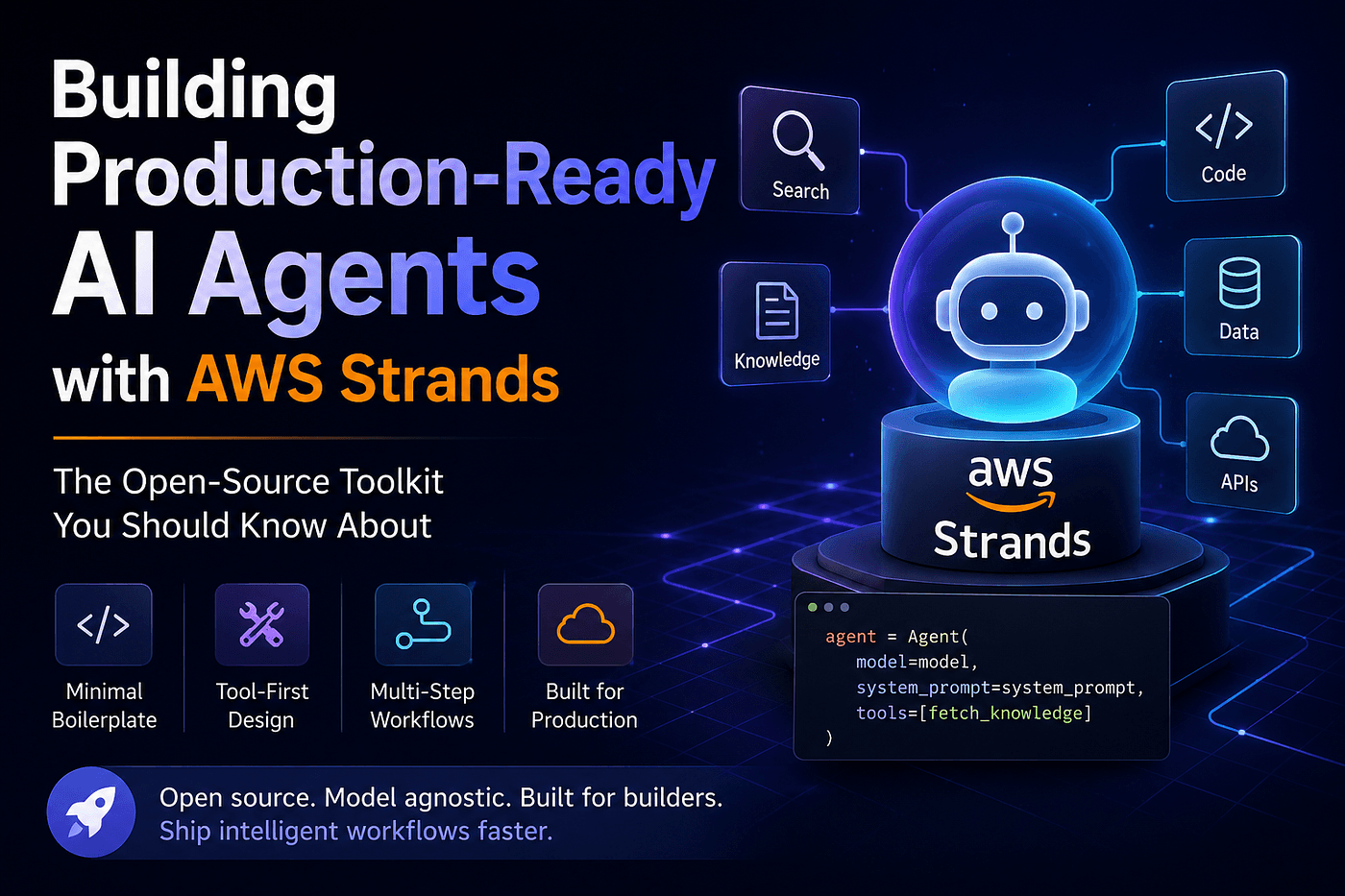
Amazon Web Services (AWS) published a production blueprint for evaluating AI agents, introducing two new components: Strands and AgentCore. The framework is designed to address a persistent problem in the agent ecosystem: the gap between how agents perform in controlled benchmarks (like GAIA or SWE-bench) and how they behave in real-world production environments.
Strands is a scenario generation engine that creates realistic, multi-step user journeys. Instead of testing an agent on isolated queries (e.g., "find the price of product X"), Strands generates sequences of interdependent actions that mimic actual user behavior—such as browsing a catalog, comparing items, checking inventory, and completing a purchase. Each "strand" includes branching logic, error conditions, and edge cases.
AgentCore is the measurement and observability layer. It tracks over 12 metrics per agent interaction, including:
- Task completion rate (did the agent achieve the user's goal?)
- Step efficiency (number of actions taken vs. optimal path)
- Latency (time to complete each step and total session)
- Cost per task (token usage, API calls, compute)
- Error recovery (how the agent handles failures or unexpected inputs)
The blueprint includes a reference architecture for deploying the evaluation pipeline alongside production agents, enabling continuous monitoring rather than periodic offline testing.
Technical Details
AWS's approach is notable for its emphasis on production-grade evaluation rather than static benchmarks. The framework is model-agnostic—it works with any LLM-based agent (Claude, Gemini, GPT, open-source models) and integrates with AWS services like Bedrock, Lambda, and CloudWatch.
Key technical components:
- Strands templates: Parametric scenarios defined in YAML or JSON, with configurable difficulty levels and domain-specific contexts (e.g., retail, finance, customer support).
- AgentCore SDK: A lightweight Python library that wraps agent calls, injecting observability hooks without modifying the agent code.
- Evaluation dashboard: Real-time visualization of metrics, with alerting on regressions (e.g., completion rate drops below 90%).
- Synthetic data generation: Strands can produce synthetic user profiles and histories to test personalization and memory.
The framework supports both offline (batch) and online (live) evaluation modes. In online mode, a percentage of production traffic is routed through the evaluation pipeline, with human reviewers sampling flagged interactions.
Retail & Luxury Implications
For retailers and luxury brands deploying AI agents—whether for customer service, personal shopping, or supply chain management—this blueprint addresses a critical pain point: trusting that agents will perform reliably in production.
Consider a luxury brand's personal shopping assistant: it must understand nuanced preferences ("a navy blue suit with a subtle herringbone pattern, under €3,000, available for in-store pickup in Milan"), handle multiple turns, and recover gracefully when a product is out of stock. Strands can generate thousands of such scenarios, covering edge cases that rarely appear in standard benchmarks.
AgentCore's cost-per-task metric is particularly relevant for luxury e-commerce, where a single agent interaction might involve multiple model calls (product search, image recognition, inventory check, recommendation generation). AWS's framework allows teams to optimize for both accuracy and cost—critical when margins are thin.
The continuous evaluation approach also enables A/B testing of different agent architectures (e.g., single-model vs. multi-agent systems) in production, with real-time feedback on which configuration drives better customer outcomes.
Business Impact
While AWS has not published specific performance numbers from early adopters, the framework's design targets several quantifiable improvements:
- Reduction in failed agent interactions: By catching regressions early, teams can maintain >95% task completion rates.
- Lower operational costs: AgentCore's cost tracking helps identify expensive sub-optimal paths, potentially reducing per-task costs by 20-40%.
- Faster iteration cycles: Continuous evaluation replaces manual QA, cutting release cycles from weeks to days.
For luxury brands, the ability to evaluate agents on brand-specific scenarios (e.g., handling VIP customer requests, multi-lingual support, compliance with data privacy regulations) is a direct competitive advantage.
Implementation Approach
Deploying Strands and AgentCore requires:
- Define scenarios: Work with domain experts to create strands templates covering key customer journeys.
- Integrate AgentCore: Wrap existing agent code with the AgentCore SDK (estimated 1-2 days for a typical agent).
- Set up evaluation pipeline: Deploy the reference architecture on AWS (Bedrock, Lambda, CloudWatch) or adapt to other clouds.
- Establish baselines: Run offline evaluation on historical data to set performance thresholds.
- Enable continuous monitoring: Route a percentage of production traffic through the evaluation pipeline.
AWS provides starter templates for common domains, including retail (product search, checkout, returns) and customer service (ticket resolution, escalation).
Governance & Risk Assessment
The evaluation framework itself is low-risk—it's a monitoring tool, not a decision-making system. However, the data collected (user interactions, agent decisions) must be handled with care, especially for luxury brands subject to GDPR and other privacy regulations.
AWS recommends:
- Anonymizing user data before logging to AgentCore.
- Setting retention limits on evaluation data.
- Using the framework to detect bias (e.g., agents consistently recommending lower-priced items to certain demographics).
The maturity level is early production—AWS has validated the framework internally and with select partners, but widespread adoption is pending.
Source: news.google.com