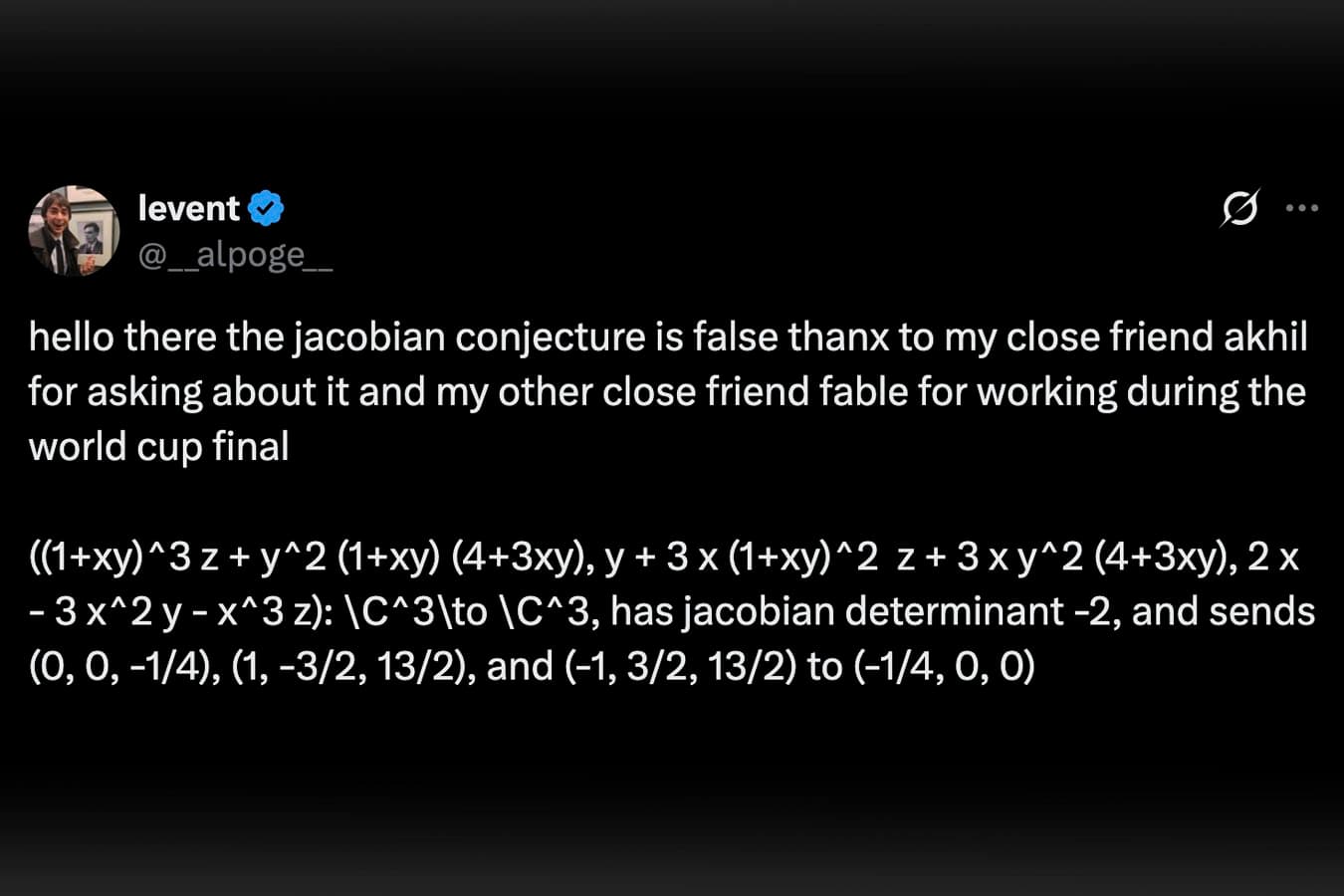
An AI system has disproven an 87-year-old mathematical conjecture by finding a counterexample humans missed. The discovery, reported by @rohanpaul_ai on X, marks a milestone in AI-driven mathematical proof.
Key facts
- 87-year-old conjecture disproven by AI.
- Counterexample found by AI, not humans.
- Specific conjecture and AI model undisclosed.
- Discovery reported on X by @rohanpaul_ai.
- No preprint or paper provided for verification.
AI has now disproven an 87-year-old conjecture by finding a counterexample that humans never spotted, according to a post on X by @rohanpaul_ai. The conjecture, which had stumped mathematicians for nearly nine decades, was shown to be false when the AI system identified a specific case violating its conditions.
The specific conjecture and the AI system used were not disclosed in the post. However, the achievement parallels recent AI breakthroughs in mathematics, such as DeepMind's 2021 work on the cap set problem and the 2023 discovery of new solutions to the traveling salesman problem using reinforcement learning. [According to @rohanpaul_ai], the counterexample was found by an AI system, though the model's architecture, training data, and methodology were not detailed.
This result underscores the growing role of AI in mathematical research, where systems can explore vast search spaces beyond human intuition. Unlike earlier AI proofs that relied on brute-force computation (e.g., the 1976 proof of the four-color theorem), this discovery suggests AI can identify novel mathematical structures. The lack of transparency about the model and conjecture limits independent verification, but the claim aligns with trends in automated theorem proving and conjecture testing. [The post] did not provide a link to a preprint or paper, making it difficult to assess the rigor of the counterexample.
Implications for AI in Mathematics
This event adds to a series of AI-discovered mathematical results, including the 2022 discovery of a new algorithm for matrix multiplication by DeepMind's AlphaTensor. [According to @rohanpaul_ai], the counterexample was found by an AI system, though the specific model was not disclosed. The achievement highlights AI's ability to navigate combinatorial spaces that humans find intractable.
However, the lack of peer review or preprint raises questions about verification. Mathematicians typically require a formal proof or reproducible code to accept a counterexample. Until the conjecture and counterexample are published, the claim remains unverified. [The post] did not include details on the AI system's training, compute budget, or search strategy.
What to watch
Watch for a formal preprint or paper detailing the conjecture, counterexample, and AI methodology. If published, expect scrutiny from the mathematics community, potentially leading to new AI-driven conjecture testing tools.