Beijing approved its first Space Computing Industry Innovation Center on June 1, 2026 — one week before SpaceX unveiled the AI1 orbital data-center satellite on June 8 — in a sequence that underscores how rapidly the US-China rivalry over AI infrastructure is escaping Earth's atmosphere.
The two efforts are not the same initiative, a distinction the initial reporting blurred. Understanding both matters for anyone tracking the orbital compute race.
Two Centers, Not One
Center 1 — Haidian District, BUPT-led. The Beijing Space Computing Industry Innovation Center, officially approved on June 1 in the Haidian technology corridor, is jointly led by Beijing University of Posts and Telecommunications (BUPT). Its six priority workstreams include radiation-hardened AI chips, orbital large language model inference, integrated space-ground networking, and inter-satellite laser communications. The formal inauguration is scheduled for the Beijing Space Computing Conference on June 29–30, 2026, when an Expert Committee and Industry Alliance will also be established.
Center 2 — E-Town, Ministry-backed. A separate Beijing Space Intelligent Computing Research Institute was established in late May in the Beijing Economic-Technological Development Area (E-Town). Its backers include the National Information Technology Application Innovation Park — a joint Ministry of Industry and Beijing municipal initiative — and private launch company LandSpace. GalaxySpace, capable of producing 150 mid-sized satellites per year, is a key manufacturing partner. The institute's roadmap calls for multiple networked experimental satellites and a trial integrated space-ground computing network, with an initial experimental satellite targeted for launch by 2028.
Key Facts
- BUPT Innovation Center: approved June 1, Haidian; inauguration June 29–30
- E-Town Research Institute: established late May; LandSpace and GalaxySpace among backers; first satellite 2028
- SpaceX AI1 satellite: unveiled June 8 by Elon Musk; 120 kW average compute, 70-meter wingspan; two prototype launches targeted for early 2027, scaling to ~1 GW of orbital capacity by late 2027
- SpaceX IPO: June 13, Nasdaq ticker SPCX, priced at $135/share, raised ~$75 billion — the largest IPO in Wall Street history; closed first day at $160.95, valuing SpaceX above $2.1 trillion
- China's CASC has reportedly invested over $10 billion in space-AI R&D per state media
- Alibaba's Qwen3 ran end-to-end local inference on an operational Chinese satellite in November 2025, marking the first general-purpose LLM executed in orbit
The Structural Asymmetry
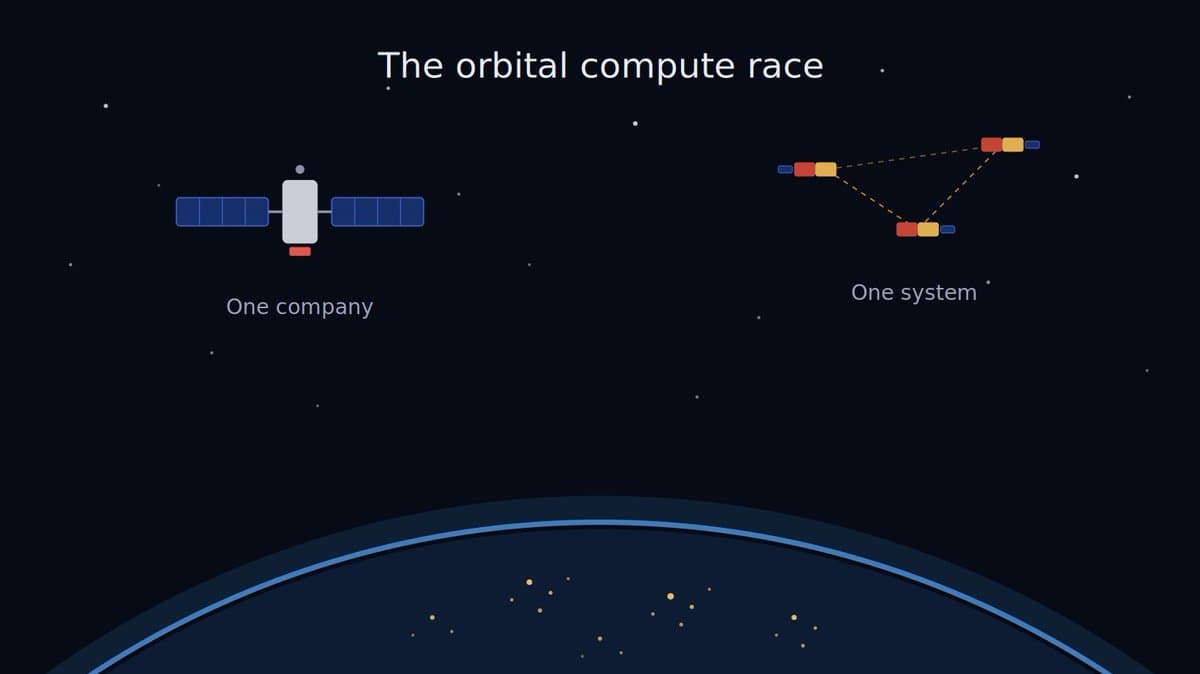
Wang Shangguang, BUPT's computer science dean, identified China's core problem plainly: SpaceX integrates chips, rockets, satellites, payloads, and applications into a single supply chain and sells the resulting compute through that same network. China's ecosystem, by contrast, suffers from what he described as "fragmented networks, isolated satellites, and broken compute" — each actor optimizing independently.
The two new institutes represent Beijing's institutional answer to that fragmentation: convening satellite integrators, chip designers, materials suppliers, and application developers under government-chartered umbrellas. The playbook mirrors what Beijing used to accelerate terrestrial semiconductor self-sufficiency after the 2022 US export-control regime — though AI silicon for orbit presents different engineering failure modes than structural manufacturing.
What SpaceX Is Actually Building
The AI1 satellite, revealed by Musk in a June 8 video, is a 70-meter-wide platform (wider than a Boeing 747) running 120 kW average / 150 kW peak compute with an interchangeable chip-payload design. SpaceX's roadmap targets two prototypes in early 2027, scaling to roughly 1 GW of annual orbital capacity by late 2027 — backed by a Terafab chip-fabrication joint venture with Tesla in rural Texas, projected at $55 billion in investment. SpaceX has already signed compute deals with Anthropic and Google. The company framed space compute as a Kardashev-scale energy arbitrage: solar power in orbit is constant, and heat dissipates passively into vacuum, eliminating the cooling and grid costs that now dominate terrestrial data-center economics.
Verified vs. Unverified
The "tokenized orbital compute" framing — compute cycles as tradeable orbital assets — originated in SemiAnalysis commentary and is not confirmed in official Chinese government or institute filings. Budget figures for either Chinese institute remain unpublished. No radiation-hardened AI accelerator, Chinese or American, has been publicly demonstrated at scale; both sides remain in early R&D.
What to Watch
The Beijing Space Computing Conference (June 29–30) will be the first public forum where Chinese industry players detail technical roadmaps. Watch for BUPT preprints on radiation-tolerant accelerator architectures — the earliest signal of actual silicon progress — and for E-Town institute funding disclosures in State Council filings. On the US side, SpaceX's AI1 prototype launch date ("early 2027") will be the first hard checkpoint for Musk's orbital compute roadmap.
Source: original