What Happened
A detailed technical guide, published on Towards AI, provides a comprehensive walkthrough for building AI agents from the ground up using the ReAct (Reasoning + Acting) paradigm. The article is not a news announcement but an educational deep dive aimed at practitioners. It focuses on the core components of agentic systems: the architectural blueprint that enables autonomous planning and execution, mechanisms for short-term and long-term memory, and the critical implementation of guardrails to ensure safe and controlled operation.
The guide positions itself as a resource for moving from simple automation scripts to sophisticated "autonomous reasoning systems." It implies a maturation of the underlying technology, suggesting that building reliable agents is now a tractable engineering challenge rather than purely a research problem. This aligns with the broader context from our knowledge graph, which notes that AI agents have recently crossed a critical reliability threshold, transforming them from reactive assistants into proactive, autonomous systems.
Technical Details
The core of the guide is the ReAct framework, which synergizes chain-of-thought reasoning with the ability to take actions (like calling an API, querying a database, or using a tool). An agent built on this pattern operates in a loop:
- Reason: Analyze its goal, its current state (from memory), and available tools to formulate a plan.
- Act: Execute a specific step from the plan, such as retrieving information or performing a calculation.
- Observe: Evaluate the result of the action.
- Repeat: Continue the cycle until the task is complete or a termination condition is met.
Key architectural components dissected include:
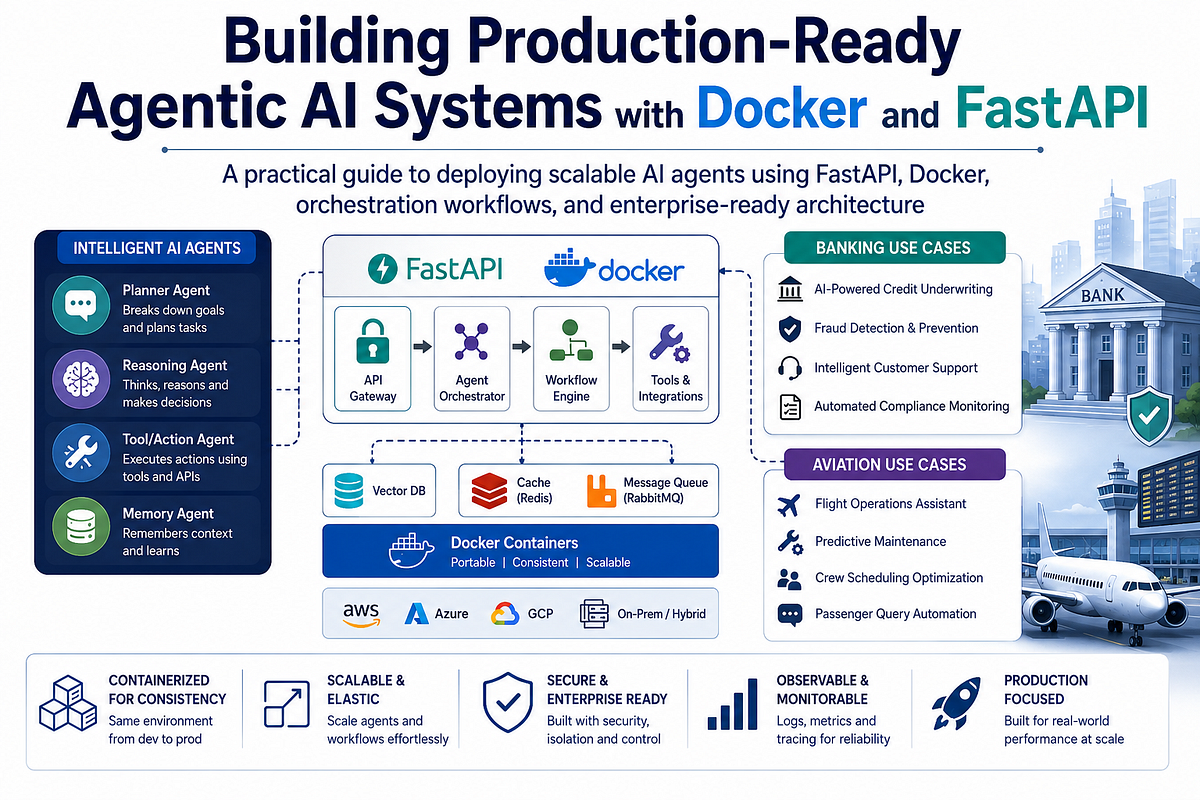
- Orchestrator/Planner: Typically a large language model (LLM) that directs the agent's workflow.
- Tools & Actions: The set of capabilities the agent can use to interact with the world (e.g., search, code execution, API calls).
- Memory Systems:
- Short-term/Working Memory: The context of the current task and recent steps.
- Long-term Memory: A vector database or similar store that allows the agent to learn from and recall past interactions, enabling personalization and continuity.
- Guardrails & Safety: This is emphasized as a non-negotiable layer. It includes validation checks on the agent's plans and outputs, budget controls (to prevent runaway API costs), and content filters to ensure brand-safe and compliant operations.
The article serves as a practical manual, likely covering implementation details using frameworks like LangChain or LlamaIndex, and discussing the trade-offs in designing such systems for reliability and scalability.
Retail & Luxury Implications
The potential applications of robust, well-architected AI agents in retail and luxury are profound, but they exist in the gap between a working prototype and a polished, customer-facing system. The guide provides the technical foundation to bridge that gap.
Potential High-Value Use Cases:
- Hyper-Personalized Digital Concierge: An agent with long-term memory could conduct a sustained, multi-session style advisory relationship. It would remember a client's past purchases, expressed preferences ("loved the texture of that Loro Piana coat"), and even rejected items to curate increasingly precise recommendations. It could autonomously coordinate across tools: checking inventory APIs, parsing new collection PDFs, and drafting personalized outreach emails.
- Autonomous Supply Chain & Operations Analyst: A ReAct agent could be tasked with continuous monitoring. It could reason through disparate data sources—weather APIs, shipping port status feeds, social sentiment analysis—to predict potential disruptions to raw material delivery (e.g., silk, leather) and proactively generate reports or even draft mitigation plans for planners.
- Intelligent Customer Service Resolution: Moving beyond scripted chatbots, an agent could handle complex, multi-issue tickets. For example, for a complaint about a delayed order and a damaged product, the agent could reason to: 1) Query the order management system, 2) Initiate a replacement via the warehouse API, 3) Calculate and issue a partial refund, and 4) Draft a coherent apology email—all in a single autonomous workflow.
- Creative Campaign Co-Pilot: Marketing teams could use an agent as a force multiplier. Given a brief like "concept a campaign for the new sustainable line targeting Gen Z," the agent could autonomously: perform competitive social media analysis, generate mood board images, draft copy variants, and even suggest a phased posting schedule, allowing humans to focus on high-level creative direction and approval.
The critical insight for luxury executives is that the value shifts from single-task automation to multi-step, goal-oriented problem-solving. The agent's ability to reason before acting is what unlocks these complex workflows. However, the guardrails section of the guide is arguably the most relevant for a brand-sensitive industry. Deploying autonomous systems requires failsafes for tone, brand voice, data privacy, and financial controls to avoid costly or reputation-damaging errors.