Skip to content
gentic.news — AI News Intelligence Platform
Connecting to the Living Graph…

Listen to today's AI briefing

Daily podcast — 5 min, AI-narrated summary of top stories

Developer at dual monitors coding a multi-stage AI workflow in Microsoft Agent Framework with Azure AI Foundry…
Open SourceBreakthroughScore: 94

Building Sequential AI Workflows with Microsoft Agent Framework and Azure AI Foundry

A technical walkthrough of implementing a sequential agent workflow for security incident triage using Microsoft's Agent Framework and Azure AI Foundry. Demonstrates how to structure multi-stage AI processes where each agent builds on previous outputs with full conversation history.

·Mar 25, 2026·4 min read··180 views·AI-Generated·Report error
Share:
Source: pub.towardsai.netvia towards_aiCorroborated

What Happened

A developer has published a detailed technical implementation guide for building sequential AI workflows using Microsoft's emerging Agent Framework within Azure AI Foundry. The article demonstrates a real-world security incident triage workflow where multiple specialized agents process information in stages, with each subsequent agent receiving the full conversation history from previous steps.

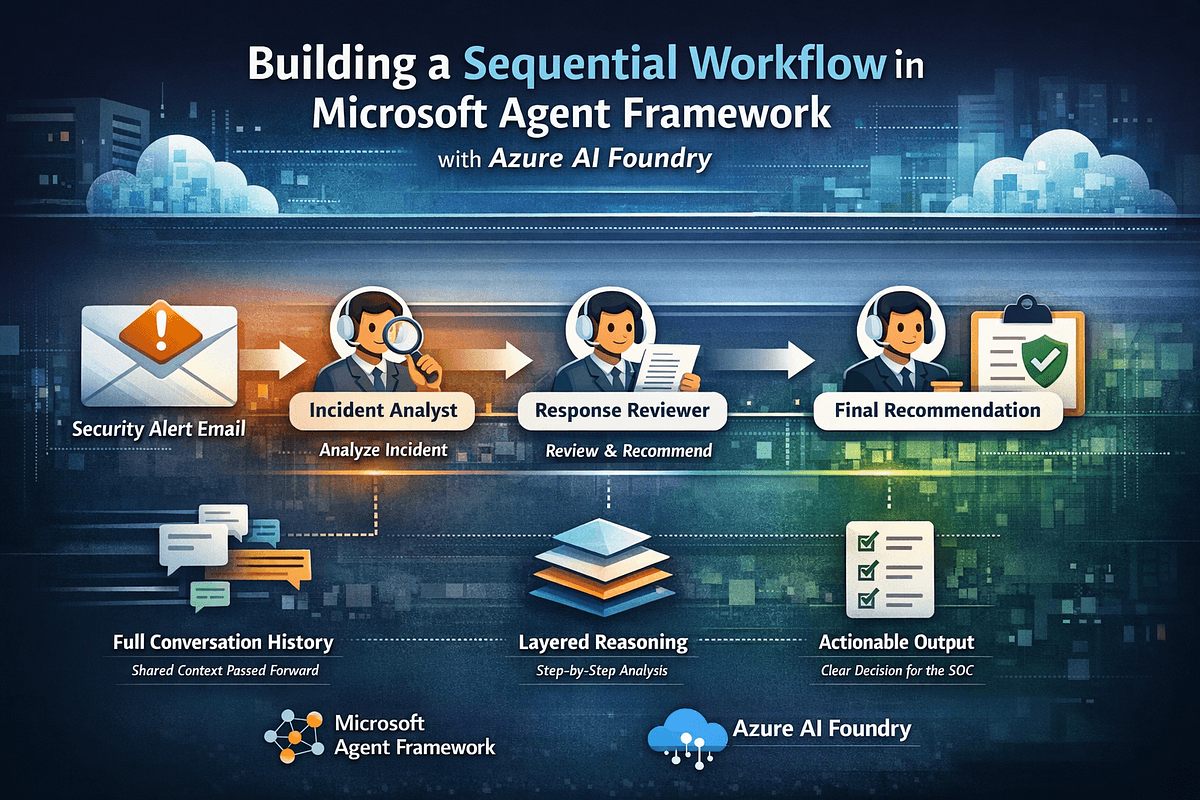
The author chose a security operations use case specifically to move beyond "toy examples" and demonstrate enterprise-relevant orchestration. The workflow follows a natural linear progression: Security Alert Email → Incident Analyst → Response Reviewer → Final Recommendation. This pattern mirrors how actual enterprise teams operate, where different specialists handle different stages of a process.

Technical Details

The implementation uses several key Microsoft technologies:

Azure AI Foundry serves as the foundational platform, providing model deployment and project management capabilities. The author connects to deployed models via the AzureOpenAIResponsesClient, which authenticates using Azure CLI credentials.

Microsoft Agent Framework provides the orchestration layer. The framework allows developers to define agents with specific roles and instructions, then chain them together in various patterns. In this case, the author uses the SequentialBuilder class to create a linear workflow.

Agent Design Pattern: The author creates two specialized agents:

  1. Incident Analyst: Analyzes incoming security reports and produces structured assessments with six specific sections (Incident Summary, Affected User/Asset, Suspected Threat Type, Severity, Missing Information, Recommended Immediate Containment Steps)
  2. Response Reviewer: Validates the analyst's findings, determines escalation urgency, and recommends next actions (Monitor, Investigate, Contain, or Escalate)

The key technical insight is that each downstream agent sees the full conversation history, not just the immediate previous output. This enables "layered reasoning" where agents build upon each other's work rather than starting from scratch.

Code Implementation: The workflow definition is surprisingly concise:

from agent_framework.orchestrations import SequentialBuilder
workflow = SequentialBuilder(
    participants=[incident_analyst, response_reviewer]
).build()

The execution uses asynchronous streaming to process the workflow, with the final output containing the complete conversation chain from initial user input through both agent responses.

Retail & Luxury Implications

While the source article focuses on security operations, the sequential orchestration pattern has clear applications in retail and luxury contexts. The fundamental concept—breaking complex workflows into specialized stages with handoffs—maps directly to several high-value retail processes.

Customer Service Escalation: Luxury brands could implement tiered support workflows where:

  • Agent 1: Initial triage agent categorizes the inquiry (product question, complaint, customization request)
  • Agent 2: Specialist agent provides detailed product information or technical specifications
  • Agent 3: Escalation agent handles complex complaints or VIP customer requests

Each agent would see the full history, ensuring continuity and preventing customers from repeating information.

Personal Styling Workflows: Sequential agents could handle different aspects of personal shopping:

  • Style Analyzer: Reviews customer preferences, purchase history, and style profile
  • Inventory Matcher: Identifies available items matching the style analysis
  • Availability Coordinator: Checks real-time stock across channels and locations
  • Personal Shopper: Crafts the final recommendation with personalized messaging

Quality Control and Authentication: For luxury goods, multi-stage verification workflows could include:

  • Document Reviewer: Analyzes certificates, receipts, and provenance documents
  • Visual Authenticator: Examines product images for authenticity markers
  • Risk Assessor: Evaluates transaction risk based on both previous analyses

Supply Chain Exception Handling: When disruptions occur, sequential agents could:

  • Impact Assessor: Determines which products and regions are affected
  • Alternative Sourcer: Identifies backup suppliers or inventory
  • Communication Planner: Drafts notifications for affected customers or stores

The Microsoft technology stack mentioned is particularly relevant given Microsoft's enterprise footprint. Many luxury retailers already use Azure services, making Azure AI Foundry a natural extension of existing infrastructure investments.

Implementation Considerations: Retail teams should note that while the pattern is powerful, it requires clear role definitions for each agent and careful prompt engineering to ensure agents don't contradict each other. The "full conversation history" feature is both a strength and a potential source of confusion if agents aren't properly instructed on how to interpret previous outputs.
Source: gentic.news · · author= · citation.json

AI-assisted reporting. Generated by gentic.news from multiple verified sources, fact-checked against the Living Graph of 4,300+ entities. Edited by Ala SMITH.

Following this story?

Get a weekly digest with AI predictions, trends, and analysis — free.

AI Analysis

This technical implementation showcases Microsoft's continued push into enterprise AI orchestration, following their recent pattern of releasing specialized tools for multi-agent workflows. Just last week, Microsoft launched Conductor CLI for building multi-agent Claude workflows with YAML, indicating a broader strategy around workflow orchestration across different AI models. The Microsoft Agent Framework represents Microsoft's answer to the growing demand for structured AI workflows in enterprise settings. Given Microsoft's partnerships with OpenAI (the developer of ChatGPT) and their competitive positioning against Amazon and Anthropic, this framework likely represents a strategic move to capture enterprise workflow orchestration before competitors establish dominance. The fact that this is built on Azure AI Foundry suggests Microsoft is leveraging its cloud infrastructure advantage to create integrated AI development platforms. For retail and luxury AI practitioners, this development is particularly relevant because it comes from Microsoft—a vendor already deeply embedded in most enterprise IT stacks. Unlike experimental frameworks from startups, Microsoft's offerings typically come with enterprise-grade security, compliance, and integration capabilities. The sequential workflow pattern demonstrated here aligns well with retail processes that naturally involve handoffs between departments or systems. However, teams should monitor how this framework matures, especially given recent reports of Microsoft leadership expressing dissatisfaction with their AI division's pace and output. This approach complements other retail AI developments we've covered, such as OpenAI's focus on shopping discovery and Shopify's catalog integration capabilities. Where those focus on consumer-facing applications, Microsoft's framework addresses the backend operational workflows that power those experiences.
Compare side-by-side
Microsoft Agent Framework vs Azure AI Foundry
Enjoyed this article?
Share:

AI Toolslive

Five one-click lenses on this article. Cached for 24h.

Pick a tool above to generate an instant lens on this article.

Related Articles

From the lab

The framework underneath this story

Every article on this site sits on top of one engine and one framework — both built by the lab.

More in Open Source

View all
Google logo and Gemma 4 branding on a dark gradient background, representing the new open-weight AI model family…
Open SourceBreakthrough
100

Google Releases Gemma 4 Family Under Apache 2.0, Featuring 2B to 31B Models with MoE and Multimodal Capabilities

Google has released the Gemma 4 family of open-weight models, derived from Gemini 3 technology. The four models, ranging from 2B to 31B parameters and including a Mixture-of-Experts variant, are available under a permissive Apache 2.0 license and feature multimodal processing.

engadget.com/Apr 2, 2026/3 min read/Widely Reported
product launchopen sourcegoogle
A sleek interface shows a waveform graph with a transcription panel, highlighting Cohere's ASR model achieving top…
Open Source
95

Cohere Transcribe: 2B-Parameter Open-Source ASR Model Achieves 5.42% WER, Topping Hugging Face Leaderboard

Cohere released Transcribe, a 2B-parameter open-source speech recognition model. It claims a 5.42% average word error rate, beating OpenAI Whisper v3 and topping the Hugging Face Open ASR Leaderboard.

the-decoder.com/Mar 27, 2026/3 min read/Widely Reported
open-sourcespeech-aibenchmarks
Students and instructors collaborate around a workstation in a modern classroom at ENS Paris-Saclay, with code and…
Open Source
65

ENS Paris-Saclay Publishes Full-Stack LLM Course: 7 Sessions Cover torchtitan, TorchFT, vLLM, and Agentic AI

Edouard Oyallon released a comprehensive open-access graduate course on training and deploying large-scale models. It bridges theory and production engineering using Meta's torchtitan and torchft, GitHub-hosted labs, and covers the full stack from distributed training to agentic AI.

admin/Mar 27, 2026/3 min read
open sourcellmsai engineering