What Happened
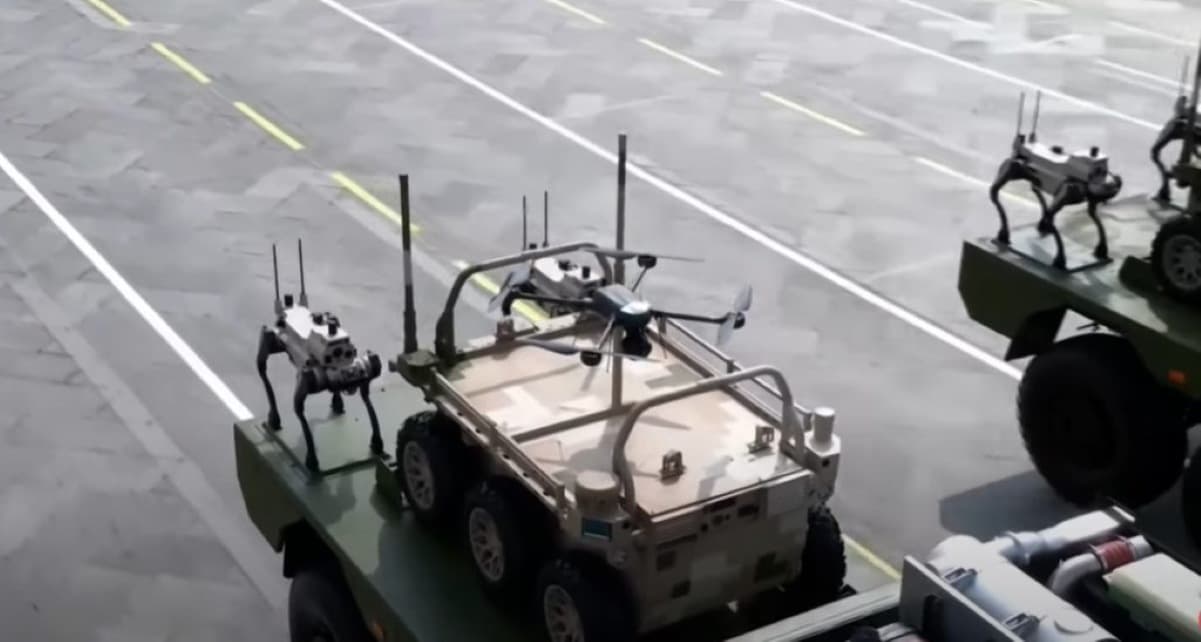
A brief social media post from AI researcher Rohan Paul has surfaced, revealing a new Chinese robotic combat system referred to as a "Robot Wolf Pack." The post, which appears to share information from another source, provides a short list of technical specifications. The system is described as being designed for battlefield use.
Technical Specifications (As Reported)
The post lists the following claimed capabilities:
- Speed: 15 kilometers per hour.
- Degrees of Freedom (DOF): 12. This suggests a highly articulated robotic platform capable of complex movements.
- Payload Capacity: 25 kilograms. This weight allowance is intended for modular weapon systems and other mission-specific equipment.
- Key Features: Obstacle clearing capability and a modular weapons architecture.
The term "Wolf Pack" implies a doctrine of operation involving multiple coordinated units, suggesting the system is designed for swarm or pack tactics rather than as a single platform.
Context & Immediate Implications
The revelation, while lacking official documentation or detailed imagery, points directly to ongoing, rapid development in military robotics within China. The specifications align with global trends toward lighter, more agile, and networked unmanned ground vehicles (UGVs) intended for infantry support and reconnaissance-by-force missions.
A 25 kg payload is significant; it is sufficient for light machine guns, anti-material rifles, grenade launchers, or sophisticated surveillance packages. The 15 km/h speed indicates a focus on keeping pace with dismounted infantry over rough terrain rather than high-speed dash. The emphasis on obstacle clearing and modularity highlights a design philosophy centered on tactical adaptability in complex environments.
The Challenge of Verification
This report originates from a social media post, not an official press release, whitepaper, or demonstration. As such, the claims are unverified. The development stage (prototype, in testing, or deployed) is unknown. The specific developer—whether a state-owned defense giant like Norinco, a private robotics firm, or a university research lab—is also not identified in the source material.
This pattern of initial information emerging via informal channels is not uncommon in the defense technology sector, often serving as a strategic leak or a test of public and analyst reaction.
gentic.news Analysis
This snippet of information on the "Robot Wolf Pack" fits into a clear and accelerating pattern of Chinese investment and demonstration in military robotics. It follows a series of documented developments, including the presentation of armed UGVs at defense expos and the operational use of smaller drones in simulated combat exercises. The "pack" terminology is particularly telling, as it directly engages with the most critical doctrinal shift in modern warfare: the move from single, expensive platforms to distributed, autonomous, and collaborative swarms.
This development does not occur in a vacuum. It is a direct parallel to programs in the United States, like the Army's Small Multipurpose Equipment Transport (S-MET) and various robotic combat vehicle (RCV) initiatives, and in Russia, with its Marker and Uran-9 platforms. The reported specs place this Chinese system squarely in competition with these Western and Russian programs, aiming for similar capabilities in infantry support and area denial. The modular weapons claim is a key feature also emphasized by American and European manufacturers, suggesting convergence on what the market (in this case, militaries) demand.
For practitioners and analysts, the core takeaway is not the specific numbers—which remain unverified—but the continued confirmation of the strategic direction. China is publicly signaling its commitment to automating the battlefield. The focus on a "pack" doctrine suggests research is advancing beyond single-robot control into the more complex realms of multi-agent coordination and autonomy, which has profound implications for future combat density and complexity.
Frequently Asked Questions
What is a "Robot Wolf Pack"?
A "Robot Wolf Pack" is an unofficial term, based on the social media post, for a new Chinese unmanned ground vehicle (UGV) system. The name implies it is designed for coordinated, multi-unit operations—similar to a pack of wolves—rather than as a standalone robot. This suggests a focus on swarm or collaborative battlefield tactics.
Who is building the Robot Wolf Pack?
The source material does not identify the manufacturer or developer. Given the military application, likely candidates include major Chinese state-owned defense contractors like Norinco or AVIC, advanced robotics research institutes, or private technology companies working on defense contracts. Official attribution is required for a definitive answer.
How does the Robot Wolf Pack compare to US military robots?
Based on the claimed specifications, it appears comparable to several US programs in development. The 25 kg payload and infantry-support role are similar to the vision for the US Army's Robotic Combat Vehicle-Light (RCV-L) and earlier programs like the Modular Advanced Armed Robotic System (MAARS). The 15 km/h speed is in the same operational range. The key differentiator, as suggested by the "pack" name, may be in the software and doctrine for controlling multiple units simultaneously.
Is the Robot Wolf Pack autonomous?
The source post does not specify the level of autonomy. It mentions obstacle clearing, which typically requires some degree of autonomous navigation. However, terms like "wolf pack" and "battlefield" do not automatically mean fully autonomous offensive operations. The system likely operates with varying levels of human supervision, from teleoperation to waypoint navigation with obstacle avoidance, which is the current state of the art for most military UGVs.