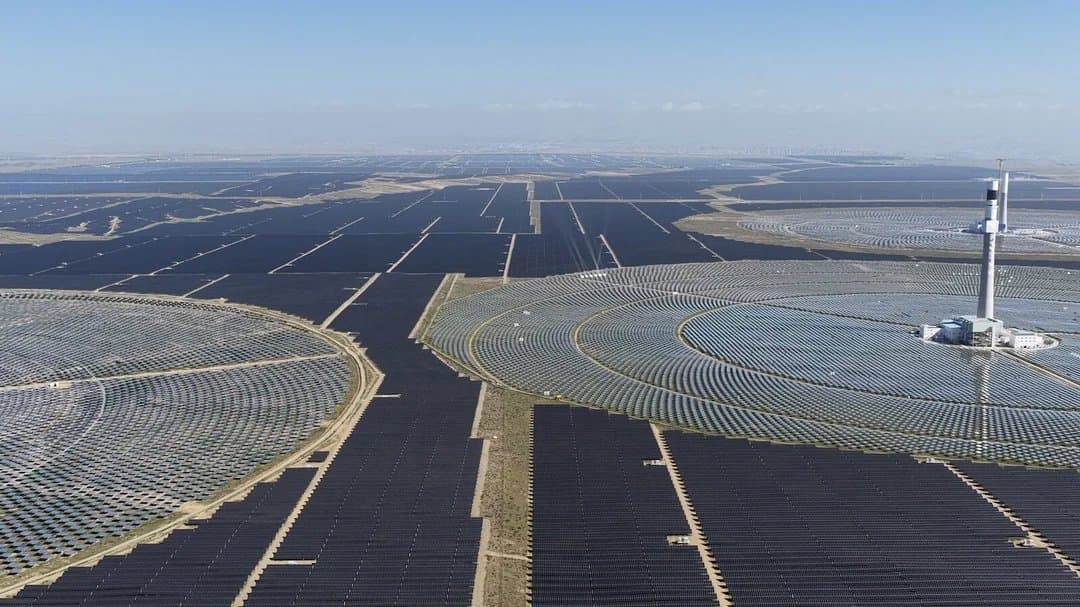
While much of the world focuses on AI algorithms and chip manufacturing, a more fundamental competition is unfolding thousands of feet above sea level. China is deploying a massive solar energy installation covering 162 square miles on the Tibetan Plateau—the world's highest and largest plateau—as part of a strategic push to dominate not just renewable energy production, but potentially the future of artificial intelligence itself.
The Scale of China's Solar Ambitions
China's solar expansion represents a dual dominance: the country is already the world's largest producer of solar panels, and through massive scale and technological innovation, has driven down production costs dramatically. This economic advantage allows for unprecedented deployment of renewable infrastructure. The Tibetan Plateau installation, with its high altitude and intense sunlight, represents an ideal location for maximizing solar efficiency, though it presents significant engineering and logistical challenges.
What makes this development particularly noteworthy isn't just the renewable energy aspect, but the strategic context in which it's occurring. As noted in the source material, "The biggest bottleneck will be energy. Whoever wants to win the race for AGI must also be the largest energy producer."
The Energy-AGI Nexus
This statement reveals a crucial insight about the future of artificial intelligence. While much public discussion focuses on algorithms, data, and computing hardware, the most fundamental constraint on advanced AI development may ultimately be energy availability. Training increasingly sophisticated AI models, particularly those approaching Artificial General Intelligence (AGI), requires staggering amounts of computational power—and thus electricity.
Current large language models already consume energy equivalent to hundreds of homes annually during training. Future AGI systems would likely require orders of magnitude more power. The nation that can provide abundant, affordable, and sustainable energy will have a decisive advantage in the AGI race.
China's Strategic Positioning
China's approach appears to be comprehensive:
- Manufacturing Dominance: Controlling the global solar panel supply chain
- Infrastructure Scale: Deploying massive renewable installations in optimal locations
- Cost Leadership: Driving down prices through scale and innovation
- Geographic Advantage: Utilizing high-altitude regions with superior solar conditions
This multi-pronged strategy positions China to potentially become the world's lowest-cost producer of clean energy at scale—exactly the kind of advantage needed to power energy-intensive AGI research and development.
Implications for Global AI Competition
The energy dimension of AI competition has been relatively underappreciated in public discourse. Most attention has focused on:
- Semiconductor manufacturing and export controls
- AI research talent and brain drain
- Data access and privacy regulations
- Algorithmic advancements and model architectures
However, energy infrastructure may prove to be the most binding constraint. Nations without abundant, affordable energy may find themselves unable to compete in the later stages of AGI development, regardless of their algorithmic innovations or chip designs.
Environmental and Geopolitical Considerations
China's solar expansion on the Tibetan Plateau also raises important questions about environmental impact in fragile ecosystems and the geopolitical implications of energy dominance. The ability to produce massive amounts of clean energy could reshape global power dynamics beyond just AI competition, affecting everything from manufacturing to climate negotiations.
The Future Energy-AI Landscape
Looking forward, we may see several developments:
- Increased investment in fusion research as a potential AGI power source
- More nations recognizing energy infrastructure as national security priorities for AI
- New forms of international competition and cooperation around energy access
- Potential energy export controls similar to current chip export restrictions
The race to AGI is increasingly looking like a race for energy supremacy. China's massive solar deployment represents one approach to solving this fundamental constraint, but other nations and companies are exploring alternatives including next-generation nuclear, geothermal, and other renewable sources.
Source: Analysis based on reporting from @kimmonismus/X regarding China's solar expansion and its implications for AGI development.
Conclusion
The 162 square miles of solar panels on the Tibetan Plateau represents more than just renewable energy progress—it's a strategic move in the deeper competition for artificial general intelligence. As AI systems grow more sophisticated and energy-intensive, the basic physics of computation means that energy availability may become the ultimate limiting factor. China's dual dominance in solar manufacturing and deployment positions the country uniquely in this emerging dimension of the AGI race, reminding us that the future of artificial intelligence may be determined as much by power plants as by research papers.