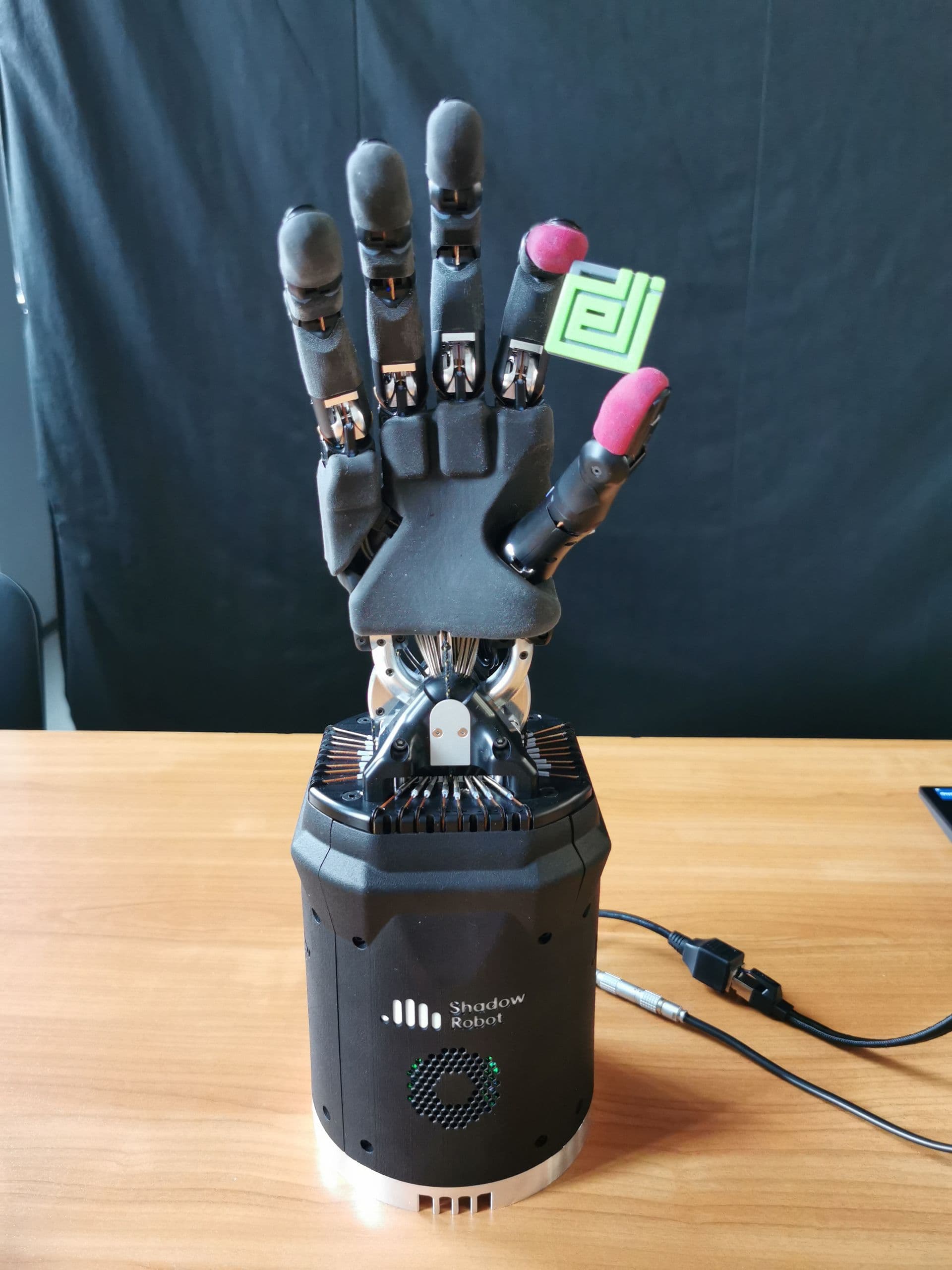
A Chinese technology company has publicly demonstrated a new, highly dexterous robotic hand. The system is reportedly capable of performing complex fine-motor tasks that require significant manipulation skill, such as playing finger games, solving a Rubik's cube, and handling small objects.
The announcement was made via a social media post that included a video link showcasing the hand's capabilities. The demonstration highlights a focus on advanced manipulation, moving beyond the simple pick-and-place or gripping functions common in many industrial robots.
Key Takeaways
- A Chinese tech company has unveiled a robotic hand designed for complex fine-motor tasks, including playing finger games and solving Rubik's cubes.
- This represents a step forward in robotic manipulation, a key challenge for real-world AI integration.
What Happened
The core of the announcement is a video demonstration of a robotic hand performing delicate tasks. The showcased abilities—specifically manipulating a Rubik's cube and engaging in coordinated finger movements—suggest a focus on high-degree-of-freedom control and sophisticated tactile feedback. This is a significant challenge in robotics, often requiring advanced computer vision, reinforcement learning, and precise actuator control.
Context
Developing robotic hands with human-like dexterity has been a long-standing "grand challenge" in robotics and AI. While companies like Boston Dynamics have excelled at dynamic locomotion, fine manipulation in unstructured environments remains difficult. Research institutions like OpenAI (with its Dactyl system) and Google's DeepMind have explored using AI to train robotic hands in simulation, but transferring that skill to the physical world is non-trivial.
This development from an unnamed Chinese firm indicates continued, competitive progress in the hardware and software integration needed for dexterous manipulation. Such technology is critical for expanding robotics from controlled factory floors into more complex service, logistics, and domestic applications.
gentic.news Analysis
This demonstration fits into a clear and accelerating trend we've been tracking: the shift from robotic mobility to robotic manipulation. For years, the public spectacle of robotics was dominated by walking and running machines. Now, the industry's focus is deepening on the end effector—the hand—which is arguably more complex and vital for useful work. As we covered in our analysis of Google's RT-2 model, the fusion of large vision-language models with robotic control is creating a new paradigm for instruction-following robots. A dexterous hand is the necessary physical counterpart to that AI "brain."
The lack of a named company in this initial teaser is notable. It could be a strategic reveal from a major player like Xiaomi (which has shown robotic labs and a humanoid prototype) or a specialized startup. Given the intense investment in automation and robotics within China's tech sector, and the government's stated goals in "AI + Robotics," this is likely a serious R&D effort rather than a one-off research project. It aligns with the broader, global race to build general-purpose robotic platforms, where dexterous manipulation is a key differentiator.
Frequently Asked Questions
Which Chinese company made this robotic hand?
The initial social media announcement did not name the specific company behind the development. The video is a teaser, and more details, including the firm's identity and technical specifications, are likely to follow in a formal product or research paper release.
What AI technology is used to control the hand?
The source material does not specify the control algorithms. However, achieving such dexterity typically involves a combination of technologies. These likely include computer vision for perceiving objects and hand position, reinforcement learning trained in simulation for planning finger movements, and potentially imitation learning from human demonstrations. Precise torque control in the actuators is also a critical hardware component.
How does this compare to other dexterous robotic hands?
Publicly known benchmarks include the Shadow Robot Company's Dexterous Hand, used in research, and OpenAI's former Dactyl project, which used a Shadow Hand to solve a Rubik's cube with AI. The new hand appears to be a similar form factor—a multi-fingered, anthropomorphic design. The key differentiators will be its cost, reliability, speed, and the specific AI software stack that controls it, none of which are detailed in this initial reveal.
What are the practical applications of this technology?
If the technology matures and can be produced reliably, applications are vast. They span complex assembly in electronics manufacturing, handling irregular items in warehouse logistics, performing delicate tasks in laboratory settings, and eventually assisting in domestic or healthcare environments where gentle, precise manipulation is required.