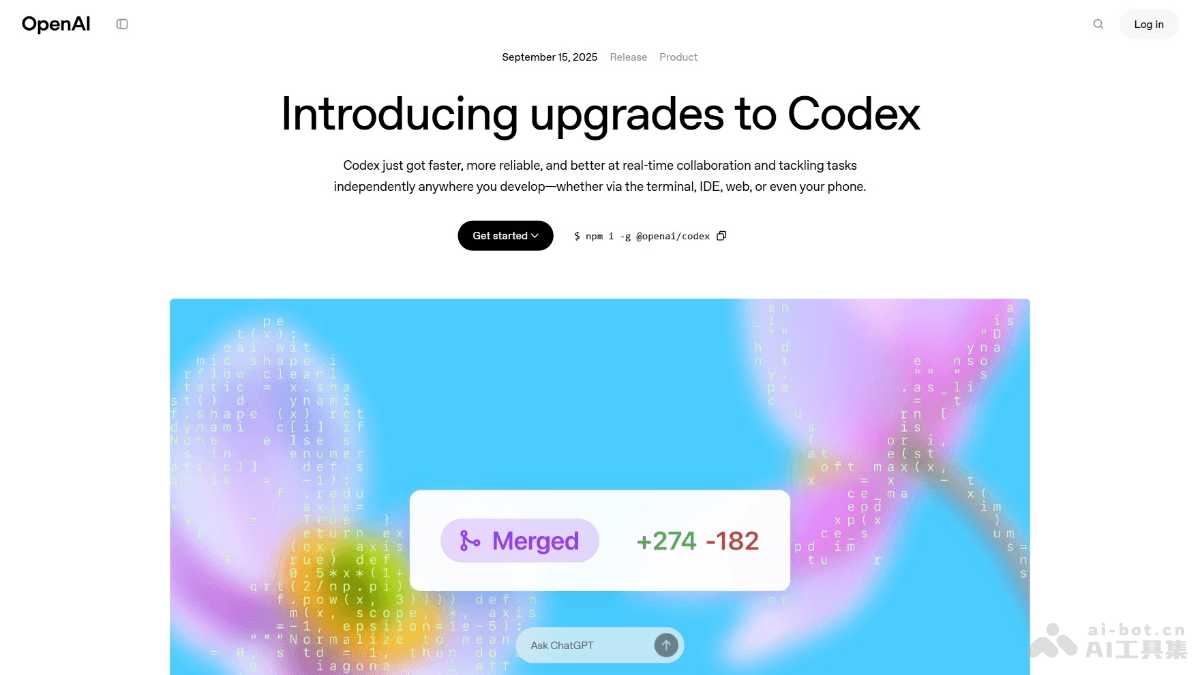
Cloudflare has announced the integration of OpenAI's latest models, GPT-5.4 and Codex, into its Agent Cloud platform. This move is designed to provide enterprises with a unified environment to build, deploy, and scale AI agents for real-world, production-grade tasks, emphasizing speed and security.
Key Takeaways
- Cloudflare has integrated OpenAI's GPT-5.4 and Codex models into its Agent Cloud platform.
- This allows enterprises to build, deploy, and scale AI agents for production workflows with built-in security and performance.
What's New: A Platform for Production AI Agents
Agent Cloud, launched earlier this year, is Cloudflare's serverless platform for running AI agents. The new integration brings OpenAI's most advanced models directly into this environment. Enterprises can now leverage GPT-5.4 for complex reasoning and Codex for code generation and understanding within their agentic workflows, all hosted and managed on Cloudflare's global network.
The core value proposition is operational simplicity: developers can build multi-step, autonomous AI agents that interact with APIs and data sources, and deploy them globally on Cloudflare's infrastructure without managing underlying servers or scaling concerns.
Technical Details: Built on Cloudflare's Stack
The integration is native. Developers using Agent Cloud can select OpenAI's models as the reasoning engine for their agents. Key technical features include:
- Model Access: Direct API access to GPT-5.4 and Codex within the Agent Cloud workflow builder.
- Global Deployment: Agents are deployed across Cloudflare's network of over 310 cities, aiming for low-latency execution worldwide.
- Security & Isolation: Workflows run in Cloudflare's secure, isolated runtime environments, with built-in DDoS protection and network security.
- Connectivity: Agents can be easily connected to other Cloudflare services (like R2 object storage, Workers, and the CDN) and external APIs.
The platform handles the orchestration, state management, and tool-calling required for sophisticated agentic loops, abstracting the complexity from the developer.
How It Compares: The Enterprise Agent Platform Race
This partnership places Cloudflare in direct competition with other cloud providers offering AI agent development environments.
Cloudflare Agent Cloud OpenAI (GPT-5.4, Codex) Global network performance, integrated security suite, serverless scaling. AWS Bedrock Agents Multiple (Anthropic, Meta, Cohere, etc.) Broad model choice, deep integration with AWS ecosystem. Microsoft Copilot Studio OpenAI (via Azure) Tight integration with Microsoft 365 and Power Platform. Google Vertex AI Agent Builder Gemini Native integration with Google Search and Workspace.Cloudflare's edge is its developer-friendly serverless architecture and its core competency in performance and security at the network edge. For enterprises already invested in Cloudflare's stack for security and delivery, this offers a natural path to deploying AI agents.
What to Watch: Performance and Ecosystem Lock-in
The success of this integration will hinge on two factors:
- Real-world Latency & Cost: While promising, the actual end-to-end latency and cost-per-workflow for complex agents using powerful models like GPT-5.4 need validation in production. Cloudflare's edge network must offset the potential overhead of model API calls.
- Vendor Strategy: This is a deep partnership with OpenAI. Enterprises gain a streamlined path but must consider a single model provider strategy. The lack of immediate multi-model support (like Bedrock offers) could be a limitation for some use cases.
gentic.news Analysis
This announcement is a strategic consolidation in the rapidly evolving AI agent infrastructure layer. It follows Cloudflare's broader push into AI inference, which began with the launch of Workers AI in late 2024, offering serverless runs of open-source models. The Agent Cloud platform, launched in Q1 2026, represented the logical next step: orchestrating those models into purposeful, multi-step agents.
The partnership with OpenAI is significant. It aligns with a trend we noted in our coverage of Microsoft's Ignite 2025, where deep model-provider partnerships (like Microsoft-OpenAI) are creating vertically integrated stacks. Cloudflare is executing a similar play but from the network edge outward, rather than the cloud core. This also creates an interesting competitive dynamic with Google Cloud's Vertex AI Agent Builder, which we analyzed last month for its deep Gemini and Search integration. Cloudflare is betting that its performance and security pedigree will trump the data ecosystem advantages of hyperscalers.
For technical leaders, the key question is whether agentic workflows become a primary application architecture. If they do, the battle shifts from mere model access to the quality of the orchestration, security, and runtime environment—areas where Cloudflare has historically competed well. This move pressures other CDN and edge providers (like Fastly) to articulate their own AI agent strategy.
Frequently Asked Questions
What is Cloudflare Agent Cloud?
Agent Cloud is a serverless platform from Cloudflare designed specifically for building, deploying, and running AI agents. It handles the infrastructure, state management, and scaling required for agents that perform multi-step tasks using tools and APIs.
What models are available in Agent Cloud with this integration?
With this announcement, developers can use OpenAI's GPT-5.4 (for advanced reasoning and planning) and Codex (for code-related tasks) as the core models powering their agents within the Agent Cloud platform.
How does this differ from using the OpenAI API directly?
While you could build an agent using the OpenAI API directly, Agent Cloud provides the full orchestration framework, a globally distributed runtime, built-in security, and easy connections to other services (databases, APIs, storage). It moves the challenge from building an agent framework to simply defining an agent's logic.
Is my data secure when using Agent Cloud with OpenAI?
According to the partnership details, the integration runs within Cloudflare's secure runtime. Cloudflare emphasizes its isolation and security protocols. However, as with any cloud service, enterprises should review the specific data processing agreements and understand where model inference calls are routed.