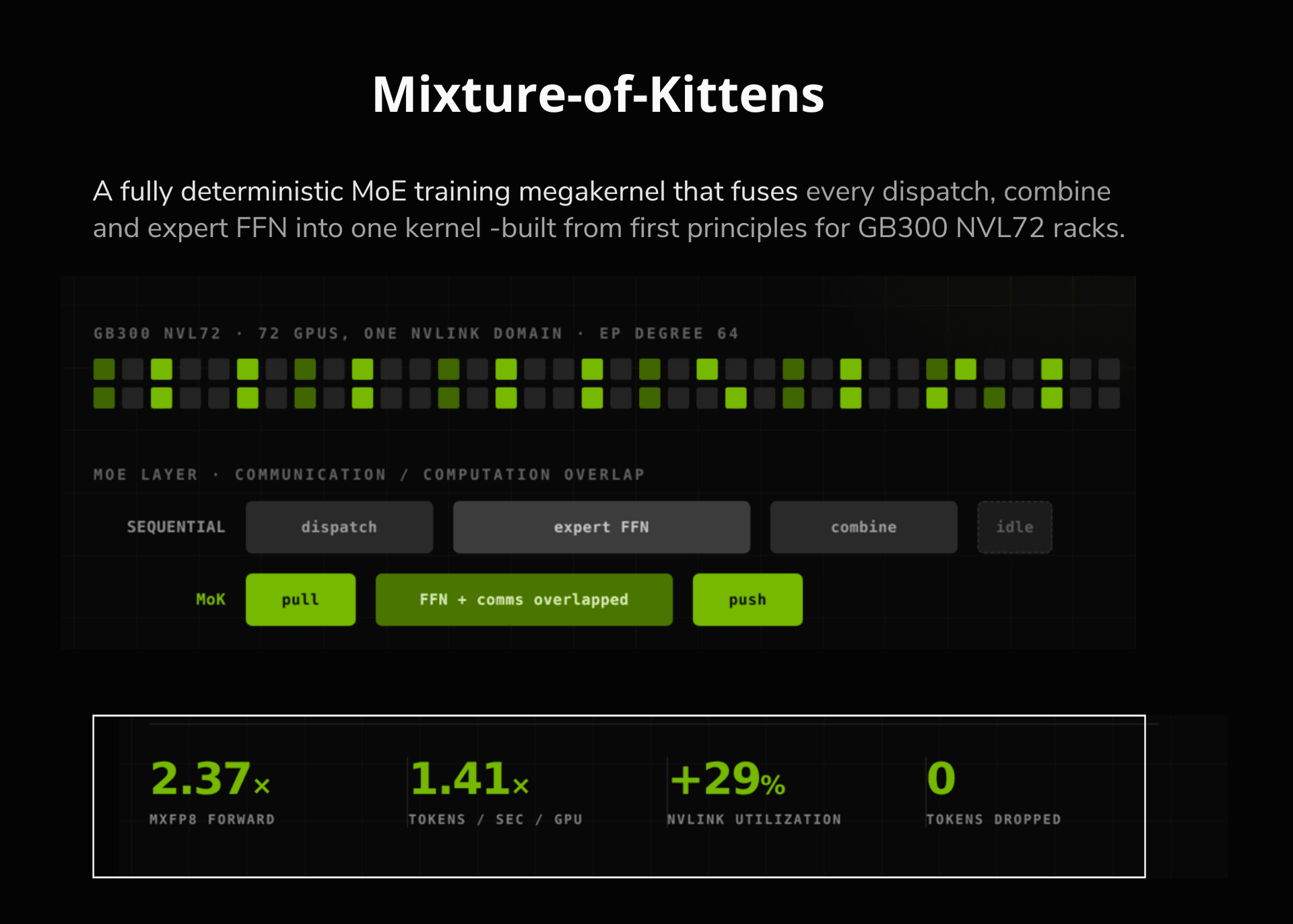
Cursor open-sourced Mixture-of-Kittens, an MoE megakernel for NVL72s, targeting inference efficiency. The kernel, released on GitHub, aims to cut memory overhead for sparse Mixture-of-Experts models.
Key facts
- Cursor released Mixture-of-Kittens, an MoE megakernel for NVL72s
- Kernel targets sparse MoE models for inference efficiency
- Cursor valued at $9B+, with $400M+ funding
- No benchmark numbers disclosed for the kernel
- Google reported negative free cash flow in Aug 2026 due to AI capex
Key Takeaways
- Cursor open-sourced Mixture-of-Kittens, an MoE megakernel for NVL72s, targeting inference efficiency.
- No benchmarks disclosed, but the move signals Cursor's infrastructure ambitions.
Cursor's Infrastructure Play
Cursor, the AI code editor by Anysphere, released Mixture-of-Kittens, an open-source MoE megakernel optimized for NVIDIA NVL72 racks According to Cursor. The kernel targets sparse Mixture-of-Experts (MoE) models, a technique where a router activates only a subset of expert sub-networks per token, scaling parameter count without proportional compute cost.
This is a notable move for a company primarily known for its code editor, valued at $9B+ with $400M+ in funding. By open-sourcing a kernel, Cursor is signaling a deeper investment in AI infrastructure, potentially to optimize inference for its own models or to influence the broader ecosystem.
The kernel's specific performance metrics are not disclosed. Cursor did not publish benchmark numbers comparing Mixture-of-Kittens against existing kernels like NVIDIA's TensorRT-LLM or vLLM. The lack of data makes it hard to assess the kernel's real-world impact, but the strategic intent is clear: Cursor is positioning itself as a player in AI infrastructure, not just an application layer.
Why This Matters
The timing is significant. Google, a major investor in Anthropic and a key player in AI infrastructure, reported its first negative free cash flow since 2004 due to AI capex in August 2026. Hyperscalers are spending heavily on specialized hardware, and efficient kernels are critical to maximizing ROI.
Mixture-of-Kittens could offer a more efficient alternative for running MoE models on NVL72s, which are high-density GPU racks designed for large-scale training and inference. If the kernel delivers on its promise, it could reduce the cost of serving MoE models, a major expense for AI companies.
However, without benchmarks, the kernel's effectiveness remains unproven. The community response on Hacker News has been muted, with 12 points and no comments, suggesting cautious interest rather than immediate adoption.
The Bigger Picture
Open-sourcing infrastructure is a common strategy for companies to build ecosystem goodwill and attract talent. By releasing Mixture-of-Kittens, Cursor may be courting developers who value transparency and control over their inference stack. It also positions Cursor as a thought leader in AI systems, potentially attracting enterprise customers who prioritize efficiency.
This move aligns with Cursor's broader strategy as an AI-native tool. The company has been expanding beyond code editing, and a kernel release could be a precursor to more infrastructure offerings. It remains to be seen if Cursor will follow up with more detailed technical documentation or benchmarks.
What to watch
Watch for Cursor to release benchmark numbers or a follow-up technical report on Mixture-of-Kittens. If the kernel shows significant speedups over vLLM or TensorRT-LLM, expect adoption in the MoE serving community. Also monitor Cursor's infrastructure investments, as this could signal a broader platform strategy.
Source: news.google.com