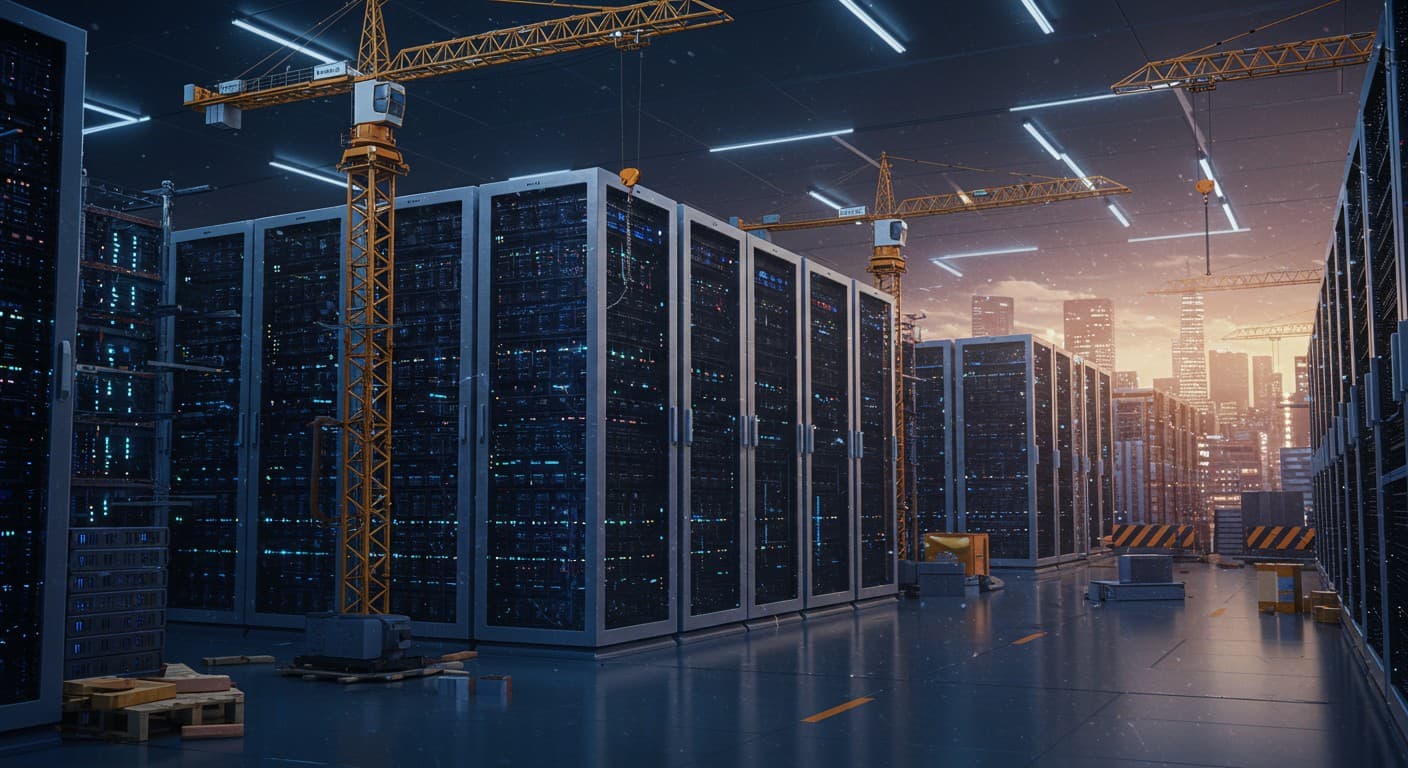
A tweet from AI commentator Rohan Paul highlights a striking labor market signal: skilled electricians working on data center construction are reportedly earning annual salaries of $260,000, a figure cited by Mike Rowe. This wage premium coincides with an unprecedented surge in data center construction, driven almost entirely by demand for artificial intelligence compute infrastructure.
The Construction Scale: 25.3 GW and 89% Pre-Committed
The core driver is scale. According to the linked report, as of February 2026, the Americas had 25.3 gigawatts (GW) of data center capacity under construction. To contextualize this number, a single, large hyperscale data center might consume 50-100 megawatts (MW). This pipeline represents the equivalent of 250 to 500 massive new facilities.
More critically, the report states that nearly 89% of this capacity was already pre-committed before delivery. This indicates that the construction is not speculative; it is being built against firm, contracted demand from cloud providers (like Amazon Web Services, Microsoft Azure, Google Cloud) and large AI companies (like OpenAI, Anthropic, xAI) scrambling to secure power and space for their GPU clusters.
The Skilled Labor Bottleneck
The reported $260,000 salary for electricians is a direct function of supply and demand for a critical, time-sensitive skill. Building a data center is not simply constructing a warehouse. It requires:
- High-Voltage Electrical Work: Connecting to substations and managing power distribution at a massive scale.
- Critical Power Systems: Installing redundant, uninterruptible power supplies (UPS) and backup generators—the lifeline for always-on AI inferencing.
- Precision Cooling Infrastructure: Deploying complex chilled water and direct-to-chip cooling systems necessary to manage the immense heat output of dense GPU racks.
This work requires licensed electricians with specific experience, creating a severe bottleneck. The construction timeline for these multi-billion-dollar projects is compressed, and delays are extraordinarily costly for clients who have pre-committed. Consequently, contractors are bidding up wages to attract and retain the necessary talent, leading to the six-figure salaries for tradespeople without traditional four-year degrees.
The AI Infrastructure Gold Rush
This labor market phenomenon is a downstream effect of the AI hardware arms race. Training frontier AI models like GPT-5, Claude 4, or Gemini 2.0 requires tens of thousands of NVIDIA H100, B100, or equivalent GPUs. Running inference for millions of users of ChatGPT, Copilot, or other AI services requires even more distributed, low-latency capacity.
Every major tech company's strategy now includes securing "AI-ready" data center capacity—sites with sufficient power, cooling, and connectivity. This has triggered a global scramble for suitable locations, often near major power sources like hydroelectric dams or nuclear plants, and has made skilled construction labor a key constraint.
gentic.news Analysis
This report on electrician wages is a tangible, on-the-ground indicator of the AI infrastructure boom's secondary economic effects, which we have been tracking in our coverage of the semiconductor and energy sectors. It directly connects to our previous reporting on NVIDIA's data center revenue surpassing $40 billion per quarter and the company's guidance that "demand for Blackwell GPUs will exceed supply well into 2026." That GPU demand translates directly into demand for the facilities that house them.
The 25.3 GW pipeline figure is staggering. For comparison, a large nuclear power plant unit generates about 1 GW. The industry is attempting to build the equivalent of over 25 new nuclear plants' worth of dedicated computing infrastructure in the Americas alone. The 89% pre-commitment rate underscores that this is not a bubble; it is a fundamental re-architecting of global digital infrastructure with AI as the primary workload. This aligns with Microsoft's and Google's massive, multi-year capital expenditure announcements, which have consistently exceeded Wall Street forecasts.
Furthermore, this creates a fascinating tension in the labor market and education policy. While the narrative around AI often focuses on potential job displacement in white-collar sectors, here we see it creating ultra-high-wage opportunities in blue-collar, skilled trades that cannot be automated or offshored. The physical buildout of AI's foundation is proving to be a significant countervailing force in the employment landscape, potentially reshaping discussions about vocational training versus traditional college degrees.
Frequently Asked Questions
How can an electrician make $260,000 a year?
This salary is for highly skilled, licensed electricians working on major data center construction projects, likely involving significant overtime, hazard pay, and travel premiums. The wage is driven by an extreme shortage of qualified tradespeople who can perform the complex, high-stakes electrical work required to bring multi-billion-dollar AI data centers online on an aggressive schedule. Contractors pay a premium to avoid costly delays.
What does 25.3 GW of data center capacity mean?
A gigawatt (GW) is one billion watts. 25.3 GW represents the total maximum power draw of all data centers currently under construction in the Americas. Since AI data centers, especially those housing dense GPU clusters, run at very high utilization, this figure closely correlates with total compute capacity. It signifies a massive expansion of physical infrastructure, requiring equivalent new power generation and transmission to support it.
Why is 89% of data center capacity pre-committed?
Cloud providers (AWS, Azure, Google Cloud) and large AI labs are engaged in a fierce competition to secure guaranteed compute capacity for training and running their models. Given long lead times for construction and persistent shortages of critical components like GPUs and power transformers, companies are signing long-term leases and power purchase agreements for capacity years in advance to ensure they have the infrastructure needed to compete. This pre-commitment de-risks the construction for developers.
Is this trend sustainable?
The sustainability of both the construction pace and the wage premium depends on continued explosive growth in demand for AI compute. If AI adoption and model complexity continue their current trajectory, demand for capacity will remain strong. However, bottlenecks in the electrical grid, semiconductor supply, and skilled labor could eventually slow the pace. The wage premium for electricians may moderate if training pipelines successfully produce more qualified workers, but the underlying demand for data center space is likely structural, not cyclical.