What the Researchers Built
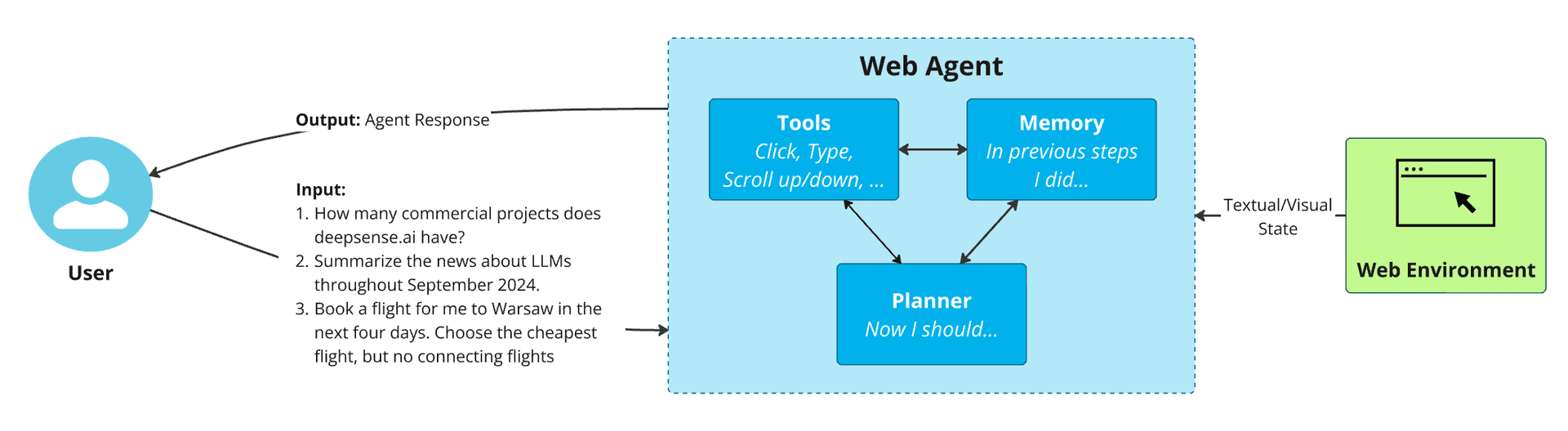
Current benchmarks for web-based AI agents, like WebArena or Mind2Web, operate in a purely digital sandbox. They test an agent's ability to navigate a website, fill forms, or retrieve information, but they lack any connection to the physical world. The Ego2Web benchmark, introduced in a new arXiv paper, aims to close this gap by grounding web agent tasks in real-world, egocentric video perception.
The core innovation is the benchmark's structure: each task consists of a real-world, first-person video recording paired with a web-based task that requires understanding the video's content. For example, a video might show a user looking at a specific book on their shelf. The agent must recognize the book from the video, then execute a web task such as "find the lowest price for this book on Amazon and add it to the cart." This simulates a realistic workflow for future AI assistants, particularly those operating through augmented reality (AR) glasses, where visual perception of the environment directly triggers digital actions.
Key Results
The paper reports two primary sets of results: the performance of their novel automatic evaluation method, and the performance of current AI agents on the benchmark itself.
Evaluation Method Performance: The team developed Ego2WebJudge, an LLM-as-a-Judge automatic evaluation system. It achieves approximately 84% agreement with human judgment on task success evaluation. This is presented as a substantial improvement over existing automatic evaluation methods for web agents, which often struggle with nuanced task completion assessment.
Agent Performance: The researchers tested "diverse State-of-the-Art (SoTA) agents" on Ego2Web. The results are stark: agent performance is described as "weak, with substantial headroom across all task categories." While the paper does not publish specific numeric scores for individual agents (e.g., GPT-4V, Gemini, Claude), it states that no agent performed well, highlighting the benchmark's difficulty and the immaturity of agents capable of this cross-domain reasoning. An ablation study confirmed that accurate video understanding is critical for success, and that current agents are significantly limited in this integrated capability.
How It Works
The Ego2Web benchmark was constructed using a semi-automated pipeline to ensure scale and quality:
- Data Generation: An automatic pipeline proposes potential video-task pairs. The videos are real-world, first-person recordings.
- Human Verification & Refinement: Human annotators verify, refine, and ensure the quality and logical connection of each proposed pair. This creates a curated dataset of "well-constructed, high-quality video-task pairs."
- Task Diversity: The benchmark covers multiple categories, including e-commerce (find/buy a seen product), media retrieval (find a song or video based on a heard clip or seen poster), and knowledge lookup (search for information about a recognized object or landmark).
For evaluation, the Ego2WebJudge method uses a large language model to assess an agent's execution trace against the ground-truth task. The LLM is prompted to judge whether the agent's actions successfully completed the user's intent as derived from the video, achieving the reported 84% human alignment.
Why It Matters
Ego2Web addresses a critical missing piece in agent evaluation. As noted in our Knowledge Graph, industry leaders have predicted 2026 as a breakthrough year for AI agents, and agents have recently crossed a "critical reliability threshold" for programming. However, most of this progress is confined to digital domains. Ego2Web explicitly tests the next frontier: an agent's ability to serve as a bridge between physical perception and digital action.
The poor performance of current SoTA agents is a significant finding. It indicates that while agents excel at browsing predefined websites or writing code, their ability to integrate noisy, real-world visual understanding with precise web-based planning and tool use is still nascent. This benchmark provides a concrete, measurable way for the research community to track progress toward the vision of seamless physical-digital AI assistants.
gentic.news Analysis
This paper arrives amid a surge in agent-related research and commercial activity, as reflected in our Knowledge Graph showing AI Agents appearing in 25 articles this week alone. Ego2Web directly confronts a limitation hinted at in other recent coverage. For instance, our article on AI agents working in persistent 3D office simulators explores digital embodiment, while Ego2Web demands embodiment in the physical world. Similarly, the governance frameworks discussed in our coverage of the Harvard Business Review's AI Agent guidelines will become exponentially more complex when agents can perceive and act upon the real world through video feeds.
The benchmark's timing is crucial. Following warnings about agents blindly following dangerous instructions (March 20, 2026, per KG history), Ego2Web introduces a testbed where faulty visual understanding could lead to incorrect—and potentially costly—real-world actions, like purchasing the wrong item. It moves the evaluation needle from "can the agent execute a click sequence?" to "can the agent correctly interpret the user's physical context and intent?"
Furthermore, the development of Ego2WebJudge as a reliable automatic evaluator (84% human agreement) is a secondary but important contribution. Scalable evaluation has been a bottleneck for complex agent benchmarks. This method could influence evaluation design beyond this specific benchmark, aiding the rapid iteration needed in a field trending as heavily as autonomous AI agents.
Frequently Asked Questions
What is the Ego2Web benchmark?
Ego2Web is a new benchmark for evaluating multimodal AI agents. It pairs short, real-world first-person videos with related web tasks. To succeed, an agent must first understand the content and intent from the video (e.g., identify a product on a shelf) and then successfully execute a corresponding task on the web (e.g., find and purchase that product online). It is the first benchmark to bridge egocentric visual perception with web agent execution.
How well do current AI models like GPT-4V perform on Ego2Web?
According to the research paper, current state-of-the-art AI agents perform "weakly" on the Ego2Web benchmark, with "substantial headroom for improvement across all task categories." The paper tested diverse leading agents and found that none handled the integrated challenge of accurate video understanding and precise web task planning effectively. Specific scores for models like GPT-4V or Claude were not published, but the overall results indicate this is a significantly harder challenge than existing web-only benchmarks.
What is Ego2WebJudge?
Ego2WebJudge is an automatic evaluation method developed alongside the benchmark. It uses a large language model (LLM) as a judge to assess whether an agent's web interaction trace successfully completed the task implied by the egocentric video. The researchers report that this method achieves approximately 84% agreement with human evaluators, which is substantially higher than previous automatic evaluation methods for web agents, enabling more scalable and consistent benchmarking.
Why is a benchmark like Ego2Web important for AI development?
Ego2Web is important because it tests a critical capability for future AI assistants: seamlessly connecting the physical and digital worlds. Most current AI agents operate purely in digital spaces. For assistants powered by augmented reality (AR) or robotics to be useful, they must understand the user's real-world context and take appropriate digital actions. Ego2Web provides a standardized, measurable way for researchers to train and evaluate models on this core, integrated skill, guiding progress toward truly useful embodied AI.