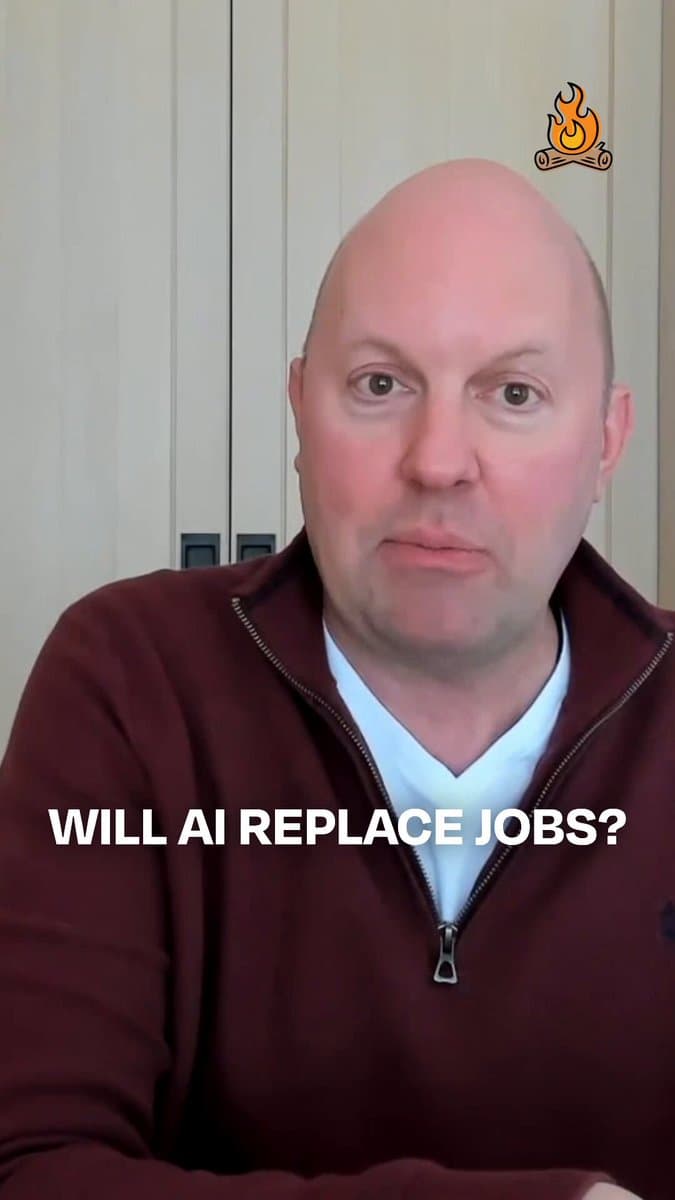
Venture capitalist and technology pioneer Marc Andreessen has shifted the conversation about artificial intelligence's impact on employment with a crucial distinction: we should be focusing on "task loss" rather than "job loss." In a recent statement that has sparked significant discussion in tech and business circles, Andreessen suggests that within a decade, the most valuable professional skill will be instructing AI systems to build products, rather than humans building them directly.
Redefining the Automation Conversation
Andreessen's perspective represents a fundamental reframing of how we discuss technological displacement. For years, public discourse has centered on which jobs will disappear as AI systems become more capable. The venture capitalist argues this focus is misplaced, suggesting instead that we examine which specific tasks within jobs will be automated, and how this will transform rather than eliminate roles.
"Everybody wants to talk about job loss, but really what you want to look at is task loss," Andreessen stated, according to a tweet from AI commentator Rohan Paul. This distinction matters because while entire jobs may evolve dramatically, the human role within those jobs may shift toward higher-level functions rather than disappearing entirely.
The Rise of the AI Instructor
Andreessen's most provocative prediction concerns the nature of valuable work in the coming decade: "In 10 years, the key job will be instructing AI how to build products, not humans building them directly."
This vision suggests a future where professionals across industries—from software development to manufacturing, from architecture to scientific research—will spend less time executing tasks and more time designing systems, providing strategic direction, and training AI assistants to handle implementation details.
This transition mirrors historical shifts in other industries. Consider how architects moved from hand-drawing blueprints to using CAD software, or how financial analysts transitioned from manual calculations to spreadsheet modeling. In each case, the professional's role evolved toward higher-level conceptual work while technology handled more routine execution.
Implications for Education and Skills Development
If Andreessen's prediction proves accurate, it has profound implications for how we prepare future generations for the workforce. Traditional education that emphasizes specific technical skills may become less valuable than education that develops:
- Systems thinking - Understanding how components interact within complex systems
- Communication skills - Precisely articulating goals, constraints, and requirements to AI systems
- Creative problem-framing - Defining problems in ways that AI can effectively address
- Ethical judgment - Making decisions about what should be built and why
- Iterative refinement - Testing AI outputs and providing corrective feedback
This suggests a potential renaissance for liberal arts education, which traditionally emphasizes critical thinking, communication, and ethical reasoning—precisely the skills that might become most valuable in an AI-instructing economy.
The Economic Transformation Ahead
Andreessen's vision implies a significant restructuring of economic value creation. If instructing AI becomes the primary value-adding human activity, we might see:
- Increased productivity - Individuals able to accomplish what previously required teams
- Lower barriers to creation - More people able to bring ideas to reality without specialized technical skills
- New forms of specialization - Experts in specific domains of AI instruction emerging
- Changed corporate structures - Flatter organizations with fewer middle managers and more AI-managed workflows
This transformation could potentially address current economic challenges around productivity growth while creating new forms of inequality based on who can most effectively work with AI systems.
Historical Context and Technological Transitions
Andreessen's perspective aligns with historical patterns of technological disruption. The Industrial Revolution didn't eliminate human labor but transformed it from agricultural to manufacturing work. The computer revolution didn't eliminate office jobs but transformed them from paper-based to digital workflows.
What makes the current moment distinctive is the breadth of tasks potentially affected. Previous technological revolutions primarily automated physical or routine cognitive labor. Current AI developments suggest the potential to automate increasingly complex cognitive tasks, from writing and design to analysis and decision support.
Challenges and Considerations
While Andreessen's vision offers an optimistic perspective on human-AI collaboration, several challenges merit consideration:
- Transition period disruption - The shift from task execution to AI instruction won't happen smoothly for all workers
- Psychological adjustment - Many people derive satisfaction from hands-on creation and may struggle with more abstract instructional roles
- Economic distribution - How will value be distributed between those who instruct AI and those who own the AI systems?
- Quality control - Ensuring AI-built products meet safety, ethical, and quality standards
These challenges suggest that the transition Andreessen describes will require thoughtful policy, corporate responsibility, and social adaptation, not just technological advancement.
Looking Forward
Marc Andreessen's distinction between job loss and task loss provides a valuable framework for navigating the coming decade of AI advancement. By focusing on how human roles will evolve rather than simply which jobs might disappear, we can better prepare individuals, organizations, and societies for the changes ahead.
The venture capitalist's prediction that instructing AI will become the "key job" suggests a future where human creativity, judgment, and strategic thinking become more valuable than ever—not despite AI, but precisely because of it. As with previous technological revolutions, the most successful individuals and societies will likely be those who adapt most effectively to new ways of creating value.
Source: Statement by Marc Andreessen as shared by Rohan Paul on X (formerly Twitter)