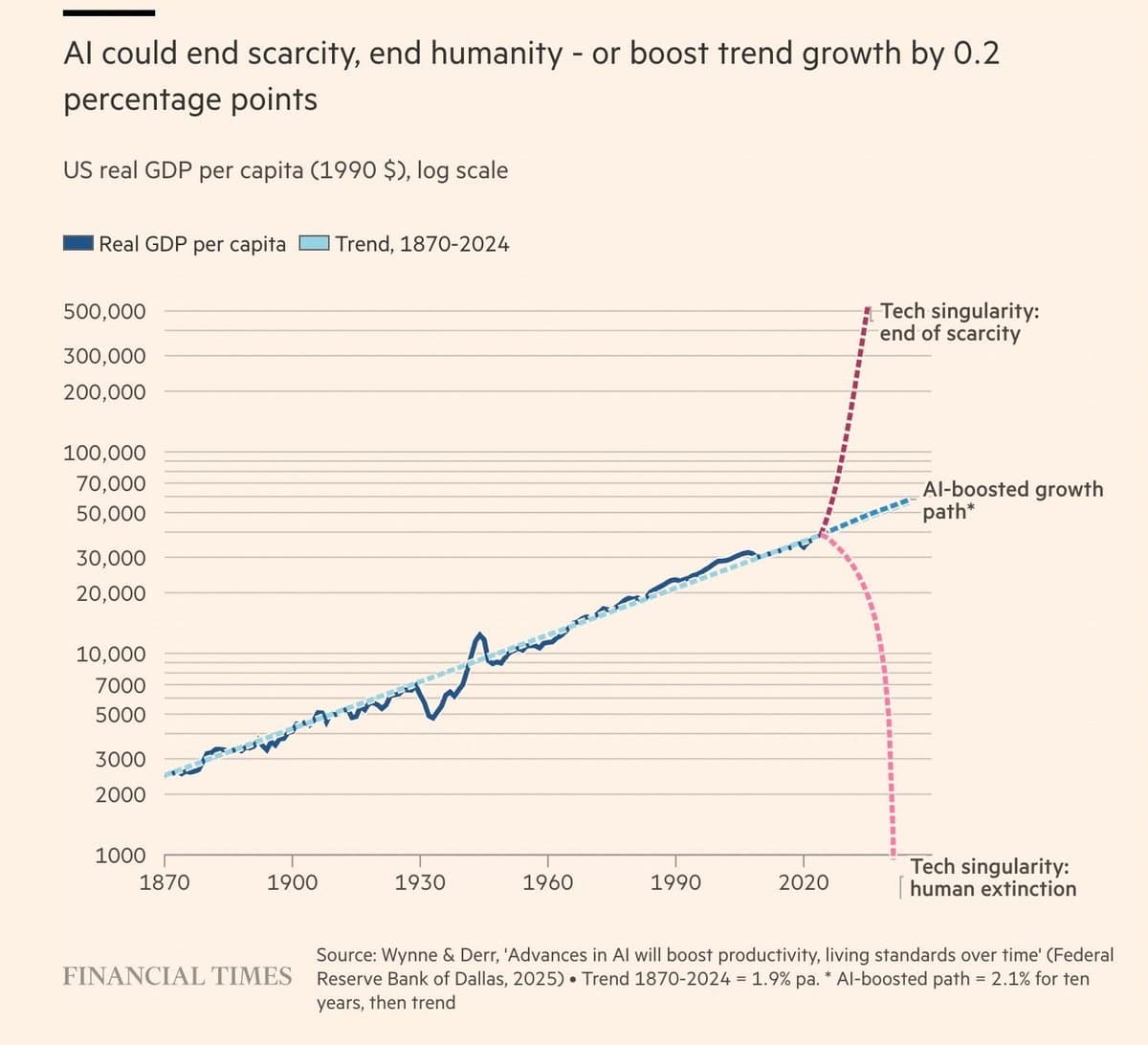
A striking visualization published by the Financial Times has ignited fresh debate about artificial intelligence's potential trajectories, presenting what appears to be equal probability between humanity's extinction and unprecedented abundance. The chart, highlighted by social media commentators including @kimmonismus, represents a significant moment in mainstream financial journalism's engagement with AI's most extreme possibilities.
The Chart That Started the Conversation
The visualization in question appears in FT's coverage of AI development timelines and risk assessment. What makes this particular graphic noteworthy isn't just its content—which presents a binary outcome distribution—but its source. As @kimmonismus noted: "What I find much more interesting is that this graph (50% chance that humanity will be wiped out, 50% that we will live in abundance) does not come from a slop blog but from the Financial Times."
This distinction matters because the FT represents establishment financial journalism, not speculative tech commentary or academic papers. When a publication with the FT's credibility and audience presents such stark probabilities, it signals a shift in how seriously extreme AI outcomes are being considered within mainstream economic and policy circles.
Context: From Niche Concern to Mainstream Discussion
For years, discussions about AI existential risk were largely confined to specialized conferences, academic papers, and certain tech industry circles. Organizations like the Machine Intelligence Research Institute and researchers like Nick Bostrom have long warned about potential catastrophic outcomes from advanced AI systems. However, these concerns were often dismissed as alarmist or speculative by mainstream commentators.
Recent developments have changed this landscape dramatically:
- The rise of transformative AI: Systems like GPT-4, Claude 3, and other large language models have demonstrated capabilities that surprised even many experts
- Industry leader warnings: Figures like Geoffrey Hinton, Yoshua Bengio, and Demis Hassabis have publicly expressed concerns about AI safety
- Policy attention: Governments worldwide are developing AI regulations, with existential risk considerations increasingly entering official discussions
- Investment patterns: Venture capital flowing into AI safety and alignment research has grown substantially
The FT chart represents a crystallization of these trends into a format accessible to financial professionals, policymakers, and educated general readers.
What the 50/50 Split Actually Means
It's crucial to understand what this probability distribution represents. The 50% chance of human extinction versus 50% chance of abundance isn't a precise scientific calculation but rather a visualization of expert uncertainty. Several interpretations are possible:
- Metaphorical representation: The equal split may symbolize the profound uncertainty about AI's ultimate impact rather than literal probabilities
- Aggregated expert opinion: The chart might reflect survey data from AI researchers about possible outcomes
- Scenario planning tool: Financial institutions often use such visualizations to prepare for radically different futures
What's significant is that a respected financial publication considers both extremes plausible enough to present them as equally weighted possibilities to its audience.
Implications for Different Sectors
Financial Markets and Investment
The FT's presentation has immediate implications for how investors approach AI companies and technologies. If there's genuine 50% probability of catastrophic outcomes, traditional risk assessment models need adjustment. We might see:
- Increased due diligence on AI safety practices
- Growth in "alignment investing" focused on beneficial AI development
- New insurance products for AI-related risks
- Pressure on companies to demonstrate safety alongside capability
Policy and Regulation
For policymakers, the chart reinforces the urgency of developing robust AI governance frameworks. The binary outcome suggests that incremental regulation might be insufficient—either we develop systems that prevent catastrophic outcomes, or we risk triggering them.
Corporate Strategy
Technology companies developing advanced AI now face increased scrutiny about their risk management practices. The FT's framing could accelerate existing trends toward:
- More transparent safety research
- External auditing of AI systems
- International cooperation on safety standards
- Slower deployment of potentially risky capabilities
Criticisms and Counterarguments
Not everyone agrees with the FT's presentation. Critics might argue:
- Probability misrepresentation: Assigning 50% to extinction risk may be mathematically unjustified and alarmist
- False dichotomy: The future likely involves multiple outcomes between extinction and abundance
- Source credibility: Even establishment publications can sensationalize complex topics
- Self-fulfilling prophecy: Presenting extinction as equally likely could influence development toward that outcome through changed incentives
However, the very fact that these criticisms are being leveled against a mainstream financial publication's AI coverage represents progress in the debate's sophistication.
Historical Parallels and Precedents
This moment resembles other technological inflection points where mainstream recognition of extreme risks emerged:
- Nuclear technology: Initially celebrated for energy potential, then recognized for existential risk
- Biotechnology: Early excitement tempered by dual-use concern and safety debates
- Climate change: From scientific curiosity to recognized planetary emergency
In each case, mainstream recognition preceded significant policy action and changed development trajectories. The FT chart may represent a similar turning point for AI.
The Path Forward: From Recognition to Action
Recognizing extreme AI risks is only the first step. The crucial question becomes: What actions follow from this recognition?
Potential next steps include:
- Improved risk assessment: Developing more nuanced models than simple 50/50 splits
- International coordination: Creating frameworks for AI development that prioritize safety
- Technical research: Accelerating work on AI alignment, robustness, and controllability
- Public engagement: Educating broader society about AI's potential and perils
- Corporate responsibility: Encouraging technology companies to adopt safety-first development practices
The FT chart's greatest value may be in forcing these conversations into mainstream financial and policy circles where resource allocation decisions are made.
Conclusion: A Watershed Moment in AI Discourse
The Financial Times' decision to visualize AI's potential outcomes as equally balanced between extinction and abundance represents more than just another data visualization. It signals that concerns once considered fringe have entered establishment discourse with serious implications for investment, policy, and technological development.
As @kimmonismus observed, the source matters. When speculative blogs discuss existential risk, it's easily dismissed. When the Financial Times presents similar concerns to its global audience of decision-makers, the conversation changes fundamentally.
The coming years will determine whether this moment leads to substantive action or remains merely an interesting data point in AI's development history. What's clear is that the stakes—as visualized in that simple chart—could not be higher.
Source: Financial Times visualization highlighted by @kimmonismus on Twitter/X